Caste Census Open Ended Enumeration Challenges
Source:Indian Express ↗
Why It Matters
Understanding the mechanics, administrative bottlenecks, and classification challenges of a caste census is crucial for evaluating welfare targeting, social equity policies, and data governance in India.
Summary
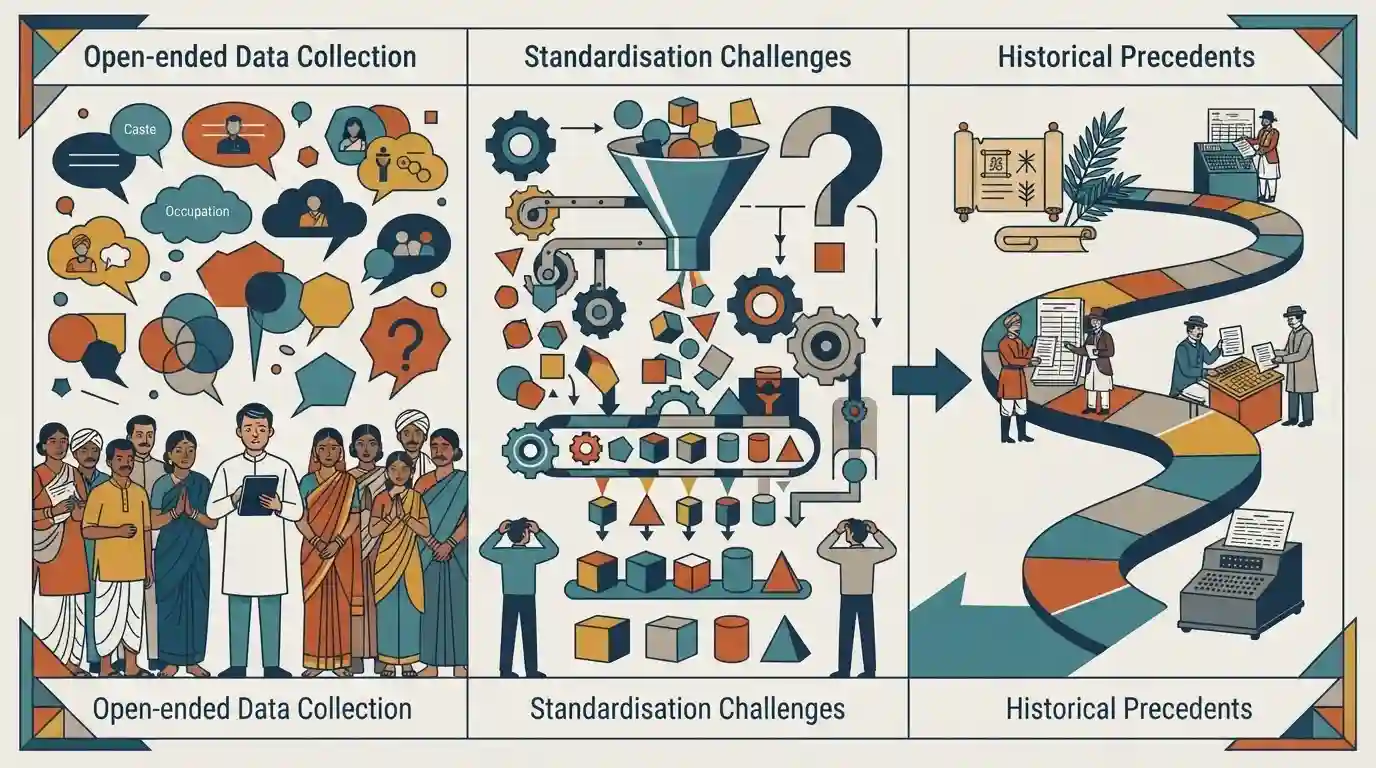
An analysis of the proposed caste census enumeration methodology, focusing on open-ended data collection, standardisation challenges, and historical precedents in India's demographic tracking.
Key Points
- The upcoming caste census involving open-ended enumeration presents unique data challenges, classification hurdles, and historical complexities.
- Open-ended enumeration allows respondents to report any caste or sub-caste name, leading to millions of granular variations that complicate data processing, standardisation, and policy formulation.
- Historical caste enumerations in India have faced similar methodological challenges regarding the fluidity of caste identities, overlapping nomenclature, and political implications of data categorisation.
- Accurate socio-economic profiling requires robust data standardisation frameworks to handle sub-caste proliferation without diluting the objective of targeted welfare delivery.
Important Terms
Census of India

A decennial statutory administrative exercise conducted under the Census Act 1948 by the Registrar General and Census Commissioner to collect comprehensive demographic and socio-economic data across India.
UPSC context
GS Paper I & II (Indian Society, Governance, Demography). Tests understanding of official data systems, population trends, and socio-economic planning.
Prelims Trap
The 2011 Socio-Economic and Caste Census (SECC) was conducted as an integral part of the decennial Census of India under the Census Act of 1948.
The 2011 SECC was not a part of the statutory decennial Census of India under the Census Act 1948; it was conducted separately under the administrative framework of the Ministry of Rural Development.
Static Concepts Connected
What is the legal framework and administrative machinery governing the Census of India?
- Statutory Basis: Conducted under the Census Act of 1948 as a statutory central government responsibility under Union List Entry 69.
- Administrative Authority: The Registrar General and Census Commissioner of India manages demographic data collection across states and UTs.
- Data Privacy: Individual-level raw census data is protected under strict confidentiality provisions and cannot be accessed for legal or tax purposes.
Cross-Topic Patterns
Caste Census + e-Shram Informal Sector Data
The methodological hurdles of classifying millions of self-reported sub-castes closely mirror the fiscal and administrative bottlenecks seen in standardising informal sector data on e-Shram.
Executive Domain + Judicial Review in Affirmative Action
Judicial oversight on executive policy-making in caste enumeration connects administrative federalism with judicial review of welfare distribution frameworks.

Caste census methodology + SECC 2011 open-ended data proliferation vs pre-coded categorisation likely to feature in Prelims.
Linked PYQs · 1
Linked PYQs · 1
- 2026PrelimsGS1
Consider the following statements about the provisions pertaining to the Scheduled Castes and the Scheduled Tribes in India : 1. Provisions regarding the administration of the Tribal Areas in the States of Assam, Meghalaya, Tripura and Mizoram are given in the Fifth Schedule of the Constitution of India. 2. Some tribes of India are entitled to exemption from paying Income Tax on certain incomes. 3. The Constitution of India provides for reservation of seats in Panchayats for women belonging to the Scheduled Castes and the Scheduled Tribes. Which one of the following conclusions based on the above statements is correct ?
