Examining data challenges in open ended caste census
Source:Indian Express ↗
ఇది ఎందుకు ముఖ్యం
Understanding the administrative, methodological, and historical challenges of caste enumeration is crucial for policy formulation, social justice, and governance debates in India.
సారాంశం
An analytical look into the complexities, history, and data-related challenges of conducting a caste census with open-ended enumeration in India.
ముఖ్య అంశాలు
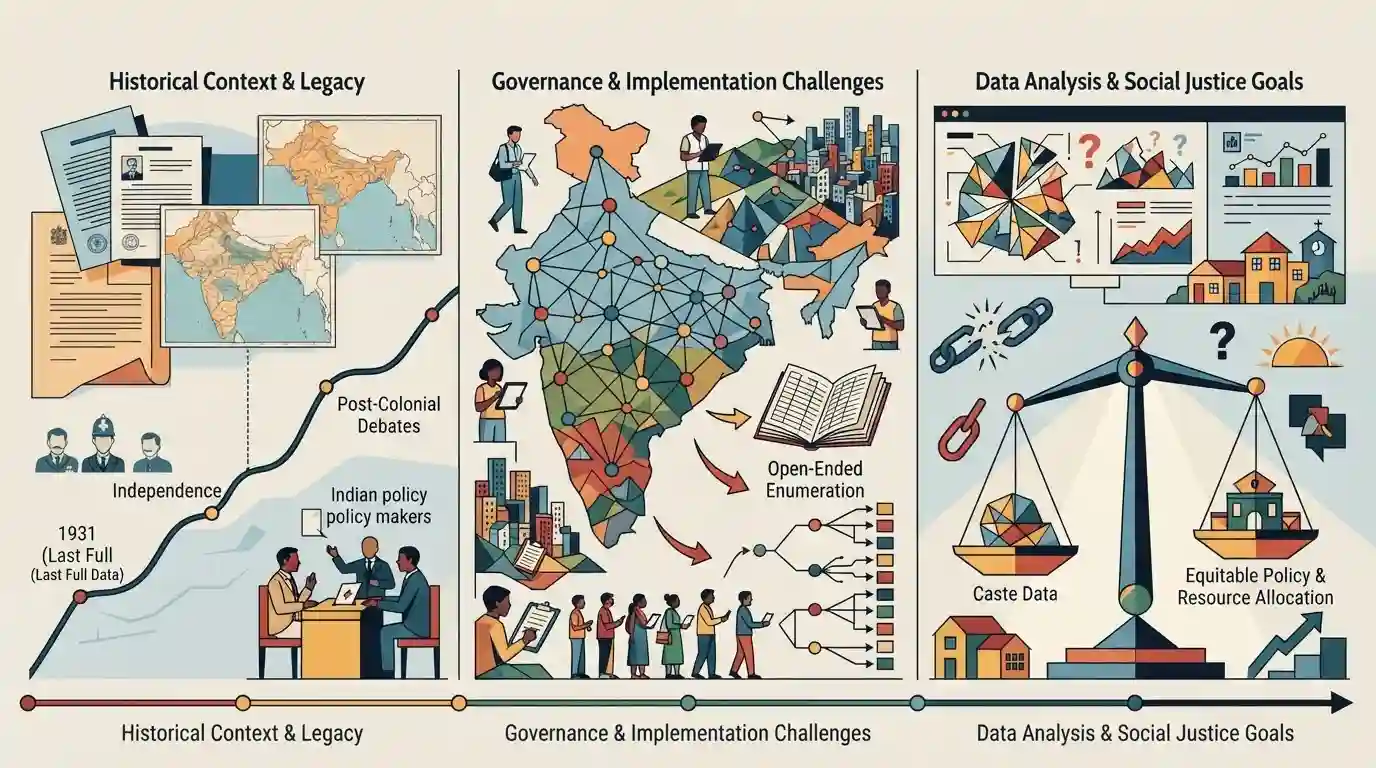
- The discussion around conducting a caste census in India involves examining open-ended enumeration, data collection challenges, and historical precedents from colonial and post-independence censuses.
- Open-ended enumeration allows respondents to state any caste name, sub-caste, or synonym, leading to massive data classification and standardisation challenges.
- Historical experiences, such as the 1931 Census and the Socio-Economic and Caste Census (SECC) 2011, highlight the complexities and data errors involved in processing caste-based metrics.
- A robust methodology and clear administrative framework are essential to prevent policy distortions and social friction.
ముఖ్యమైన పదాలు
Census Act 1948

The primary central legislation enacted in 1948 that provides the legal framework, administrative machinery, and mandatory protocols for conducting population censuses and ensuring data confidentiality in India.
UPSC context
UPSC Prelims/Mains (Polity & Governance): Tests knowledge of statutory frameworks governing administrative data collection, census operations, and legal confidentiality mandates.
Office of the Registrar General and Census Commissioner of India
The statutory authority operating under the Ministry of Home Affairs, responsible for planning, organizing, and executing the decennial population census and civil registration systems in India.
UPSC context
UPSC Prelims/Mains (Governance): Tests institutional mechanisms, administrative bodies, and statutory roles involved in demographic data management and national planning.
అనుసంధానమైన స్థిర భావనలు
What is the constitutional and statutory framework governing the Census of India?
- Constitutional Basis: Union List Entry 69 of the Seventh Schedule empowers the Parliament to legislate on census.
- Statutory Act: The Census Act of 1948 provides the legal framework for conducting decennial censuses and maintaining confidentiality of data.
- Nodal Agency: Conducted by the Office of the Registrar General and Census Commissioner under the Ministry of Home Affairs.
What were the key findings and limitations of the Socio-Economic and Caste Census (SECC) 2011?
- Technological Shift: First paperless census conducted across rural and urban India using handheld electronic devices.
- Data Complexity: Generated over 46.7 lakh distinct caste and sub-caste names due to open-ended enumeration without pre-coded lists.
- Withheld Data: Raw caste data was never officially published due to massive classification, spelling, and standardisation errors.
అంతర-అంశ నమూనాలు
Caste Census + Digital Governance and Data Architecture
Unstandardized open-ended caste data generates massive administrative noise, complicating targeted welfare delivery and exacerbating data governance hurdles under the Digital India framework.
Social Stratification + Post-Independence Constitutional Framework
The historical shift from the 1931 colonial census to post-independence constitutional reliance solely on SC/ST reflects evolving state approaches to social stratification.

Caste census methodology, SECC 2011 errors, and open-ended enumeration challenges will feature in a multi-statement governance/society MCQs.
అనుసంధాన PYQలు · 1
అనుసంధాన PYQలు · 1
- 2026PrelimsGS1
Consider the following statements about the provisions pertaining to the Scheduled Castes and the Scheduled Tribes in India : 1. Provisions regarding the administration of the Tribal Areas in the States of Assam, Meghalaya, Tripura and Mizoram are given in the Fifth Schedule of the Constitution of India. 2. Some tribes of India are entitled to exemption from paying Income Tax on certain incomes. 3. The Constitution of India provides for reservation of seats in Panchayats for women belonging to the Scheduled Castes and the Scheduled Tribes. Which one of the following conclusions based on the above statements is correct ?
