Balancing Caste and Class Dynamics in OBC Reservations
Source:The Hindu ↗
Why It Matters
Crucial for understanding the evolving jurisprudence and policy debates surrounding affirmative action, creamy layer exclusions, and social justice in India.
Summary
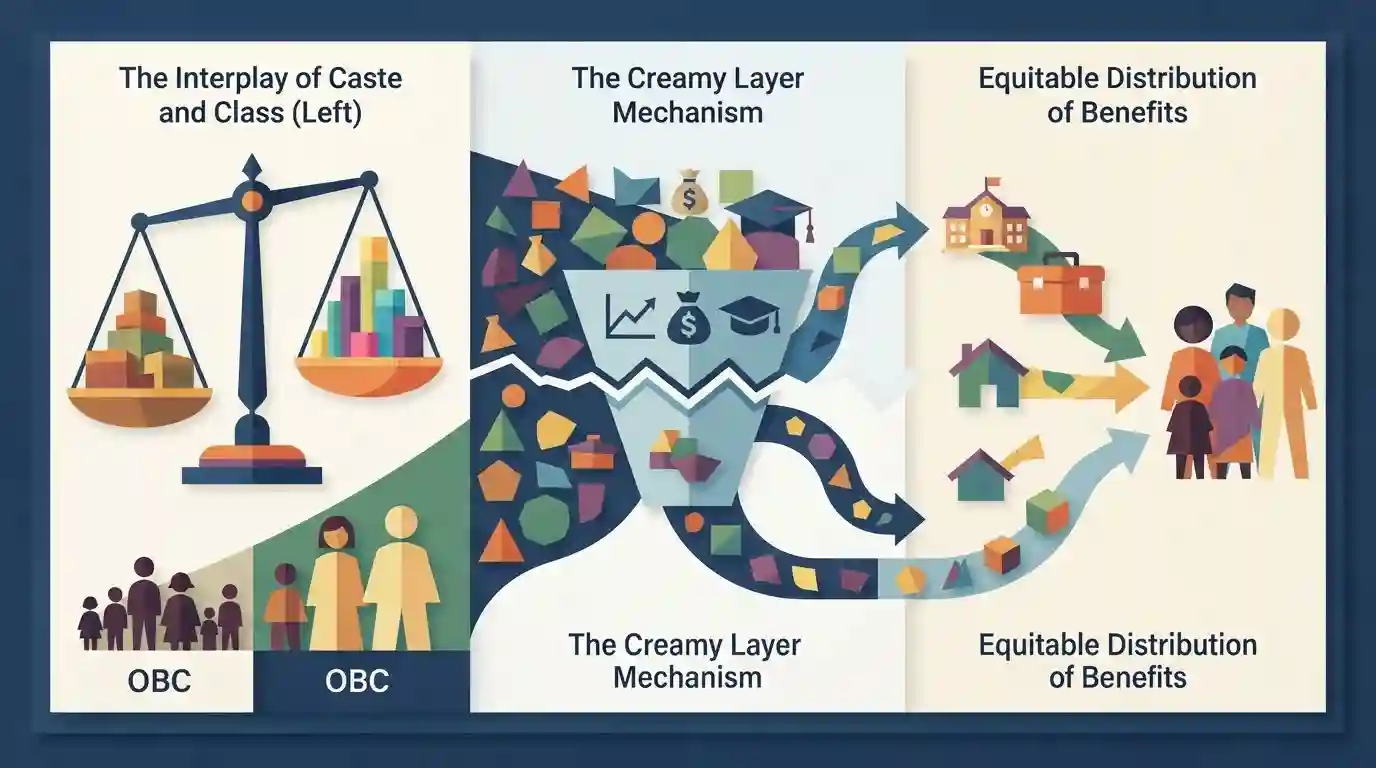
The editorial examines the intricate relationship between caste and class in the context of Other Backward Classes (OBC) reservations, emphasizing the significance of the creamy layer principle in ensuring genuine social justice and equitable distribution of affirmative action benefits.
Key Points
- The debate over OBC reservation highlights the tension between caste-based identification and class-based economic criteria (creamy layer).
- Exclusion of the creamy layer ensures that the benefits of affirmative action trickle down to the most disadvantaged within backward classes rather than concentrating among the affluent elite.
- Judicial precedents emphasize balancing substantive equality with structural criteria to prevent the entrenchment of privilege within reserved categories.
- Reforming affirmative action requires dynamic assessments of economic mobility alongside social backwardness.
Important Terms
Indra Sawhney judgment

A landmark 1992 nine-judge Supreme Court ruling that upheld 27% OBC reservations, capped total reservations at 50%, and introduced the creamy layer principle to exclude advanced individuals from backward classes.
UPSC context
UPSC GS Paper II (Polity & Constitution): Tests judicial review, fundamental rights, and the legal framework governing affirmative action and reservations.
National Commission for Backward Classes
A constitutional body established under Article 338B (via the 102nd Amendment Act) to investigate, monitor, and protect the rights and welfare of socially and educationally backward classes.
UPSC context
UPSC GS Paper II (Polity & Governance): Tests statutory and constitutional bodies, governance structures, and mechanisms for protecting vulnerable sections.
Supreme Court of India
The apex judicial institution of India that interprets the Constitution and adjudicates disputes regarding fundamental rights, affirmative action policies, and reservation limits.
UPSC context
UPSC GS Paper II (Polity & Constitution): Tests the role of the judiciary in constitutional interpretation, judicial review, and balancing social justice with equality.
Prelims Trap
The 102nd Constitutional Amendment permanently stripped state legislatures of any power to identify or notify socially and educationally backward classes.
Aspirants often assume the 102nd Amendment stripped states of power entirely, whereas subsequent legislative amendments restored states' authority to maintain their own SEBC lists.
Static Concepts Connected
What are the key constitutional provisions and judicial milestones governing OBC reservations in India?
- Enabling Articles: Article 15(4) & 16(4) empower the State to make special provisions for the advancement of any socially and educationally backward classes of citizens.
- Indra Sawhney Case: Indra Sawhney (1992) capped reservations at 50% (barring extraordinary circumstances) and mandated the exclusion of the 'creamy layer'.
- Constitutional Status: 102nd Amendment Act (2018) gave constitutional status to the NCBC under Article 338B and inserted Article 342A.
Cross-Topic Patterns
Affirmative action criteria and federal welfare governance
The creamy layer debate in OBC quotas runs parallel to debates on economic sub-classification within Scheduled Castes, linking social justice jurisprudence with federal welfare governance.

Indra Sawhney principles, creamy layer thresholds, and Article 338B/342A constitutional mechanisms are perennial UPSC prelims favorites.
Linked PYQs · 2
Linked PYQs · 2
- 2022MainsGS2
Discuss the role of the National Commission for Backward Classes in the wake of its transformation from a statutory body to a constitutional body.
- 2023PrelimsGS1
Consider the following statements: Statement-I: The Supreme Court of India has held in some judgements that the reservation policies made under Article 16(4) of the Constitution of India would be limited by Article 335 for maintenance of efficiency of administration. Statement-II: Article 335 of the Constitution of India defines the term 'efficiency of administration'. Which one of the following is correct in respect of the above statements?
