Caste Census and Sub-Categorisation in Affirmative Action
Source:The Hindu ↗
Why It Matters
The shift towards conducting a national caste census is pivotal for re-evaluating India's reservation policies and affirmative action. Understanding the arguments for sub-categorisation and the logistical challenges of caste enumeration is crucial for GS-1 (Society) and GS-2 (Social Justice and Governance).
Summary
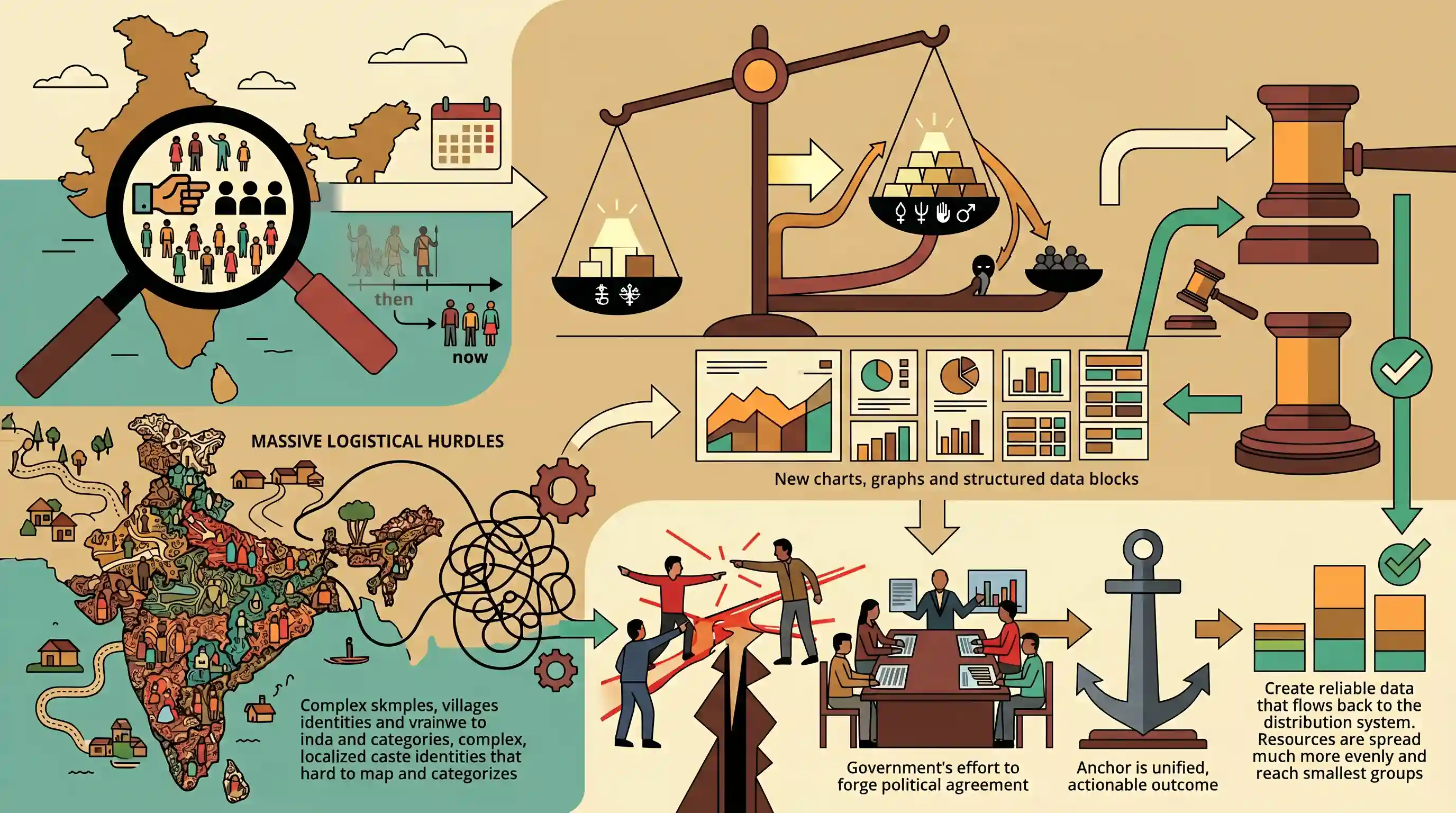
The anticipated inclusion of caste data in the upcoming Census, the first such exercise since 1931, represents a major shift in India's affirmative action landscape. This move seeks to provide empirical backing for the sub-categorisation of Scheduled Castes, Scheduled Tribes, and Other Backward Classes, ensuring that reservation benefits reach the most marginalized segments rather than being cornered by dominant sub-groups. While bodies like the Supreme Court and the Justice G. Rohini Commission have supported such rationalization, the enumeration process faces massive logistical hurdles due to the vast, complex, and localized nature of caste identities in India. The Central government must forge political consensus to navigate the likely political polarization and ensure the exercise yields reliable, actionable data.
Key Points
- The upcoming Census is expected to collect caste data for the first time since 1931, departing from the previous practice of only categorizing SCs, STs, and religious affiliations.
- The data aims to address debates around the sub-categorisation of SCs, STs, and OBCs to ensure affirmative action benefits reach the most marginalized communities.
- Recent developments like the Supreme Court's clearance for sub-categorisation within SCs and STs, and the Justice G. Rohini Commission's report on OBCs, highlight the push towards rationalizing reservations and addressing the 'creamy layer'.
- Significant logistical and enumeration challenges exist, such as distinguishing between castes and sub-castes, dealing with linguistic variations, and handling self-identified community claims, as evidenced by the SECC 2011 which yielded over 46 lakh 'castes'.
- To avoid political polarization seen during state-level caste enumerations, the Centre needs to build consensus on the census's specifics and methodology.
Important Terms
Caste Census

A decadal enumeration of India's population that includes data on specific caste identities. While regular for SCs/STs, a full caste census hasn't been conducted since 1931; it aims to provide data for targeted social justice.
UPSC context
GS Paper II (Social Justice/Governance). Tests understanding of demographic data's role in policy formulation and constitutional mandates for backward classes.
Socio Economic and Caste Census (SECC) 2011
A 2011 survey by the Ministries of Rural Development and Housing to map household deprivation. While its socio-economic data informed welfare schemes, its caste-based findings remain unreleased due to methodological errors and political sensitivity.
UPSC context
GS Paper II/III. Relevant for discussions on welfare targeting, data-driven governance, and the challenges of enumerating complex social identities.
Justice G. Rohini Commission
A commission formed in 2017 under Article 340 to examine the sub-categorisation of Other Backward Classes (OBCs). It seeks to address the 'inequitable distribution' of reservation benefits currently dominated by a few influential sub-groups.
UPSC context
GS Paper II (Polity/Social Justice). Tests knowledge of constitutional commissions and the legal evolution of OBC reservations.
Sub-categorisation
The division of broad reservation categories (SC, ST, or OBC) into smaller groups based on varying degrees of backwardness. It ensures that 'more backward' communities receive a guaranteed share of reservation benefits.
UPSC context
GS Paper II. Focuses on the principle of 'substantive equality' and the administrative rationalization of affirmative action policies.
State of Punjab v. Davinder Singh (2024)
A landmark 2024 Supreme Court ruling that upheld the power of states to sub-classify Scheduled Castes and Scheduled Tribes for reservations, overturning the 2004 E.V. Chinnaiah judgment.
UPSC context
GS Paper II (Judiciary/Polity). Crucial for understanding the evolving judicial interpretation of Articles 14, 341, and 342.
Article 340
A constitutional provision empowering the President to appoint a commission to investigate the conditions of socially and educationally backward classes and recommend measures for their advancement and welfare.
UPSC context
GS Paper II (Constitution). Fundamental for questions regarding the identification of 'Backward Classes' and the role of the President/Commissions.
Affirmative Action
Policies, such as reservations in education and employment, designed to uplift historically marginalized groups (SCs, STs, and OBCs) to achieve social equity and correct historical injustices.
UPSC context
GS Paper II. The foundational concept for all reservation-related debates, testing the candidate's grasp of social justice and inclusive growth.
Prelims Trap
"The Census of India has not collected any caste-related demographic data since the 1931 census."
False. Post-independence censuses stopped enumerating all castes (like OBCs), but they have consistently collected and published demographic data for Scheduled Castes (SCs) and Scheduled Tribes (STs).
Static Concepts Connected
How are SCs/STs legally notified and who holds the power to sub-classify them?
- Presidential Notification: Under Articles 341 and 342, the President notifies the initial list of SCs and STs for a specific State or Union Territory.
- Parliamentary Amendment: Once notified, only Parliament can enact a law to include or exclude specific communities from the Presidential list of SCs/STs.
- State Sub-classification: The Supreme Court (2024) ruled that State governments possess constitutional authority to sub-classify communities already within the SC/ST list to ensure benefits reach the most backward.
How does the Socio-Economic Caste Census (SECC) differ from the regular decennial Census?
- Statutory Backing: The regular Census is conducted under the Census Act, 1948, whereas the SECC 2011 was conducted through an executive order without this specific statutory backing.
- Data Confidentiality: The Census Act mandates strict confidentiality of individual data. Conversely, SECC data is specifically meant to be shared with government departments to identify welfare beneficiaries.
Cross-Topic Patterns
Creamy Layer and SC/ST Sub-classification
The push for a comprehensive caste census provides empirical backing for extending the 'creamy layer' concept and sub-categorisation (via the Davinder Singh judgment) to SCs and STs, not just OBCs.
SECC vs. Decennial Census methodologies
SECC's failure to standardise caste names (yielding 46 lakh entries) highlights governance challenges in data standardisation, echoing issues faced in mapping internal migration and informal sector workers.

Expect a 2026 Prelims question mixing the history of the 1931 Census, SECC 2011 methodology, and State powers to sub-classify SCs/STs.
Linked PYQs · 2
Linked PYQs · 2
- 2018MainsGS1
Caste system is assuming new identities and associational forms. Hence, caste system cannot be eradicated in India." Comment.
- 2022MainsGS1
Analyse the salience of 'sect' in Indian society vis-a-vis caste, region and religion.
