Supreme Court Dismisses Plea Against In-House Inquiry Report
Source:The Hindu ↗
Why It Matters
It clarifies the constitutional validity of the judiciary's in-house inquiry mechanism vis-a-vis Parliament's exclusive power to impeach judges, making it highly relevant for GS-2 Polity questions on judicial accountability and separation of powers.
Summary
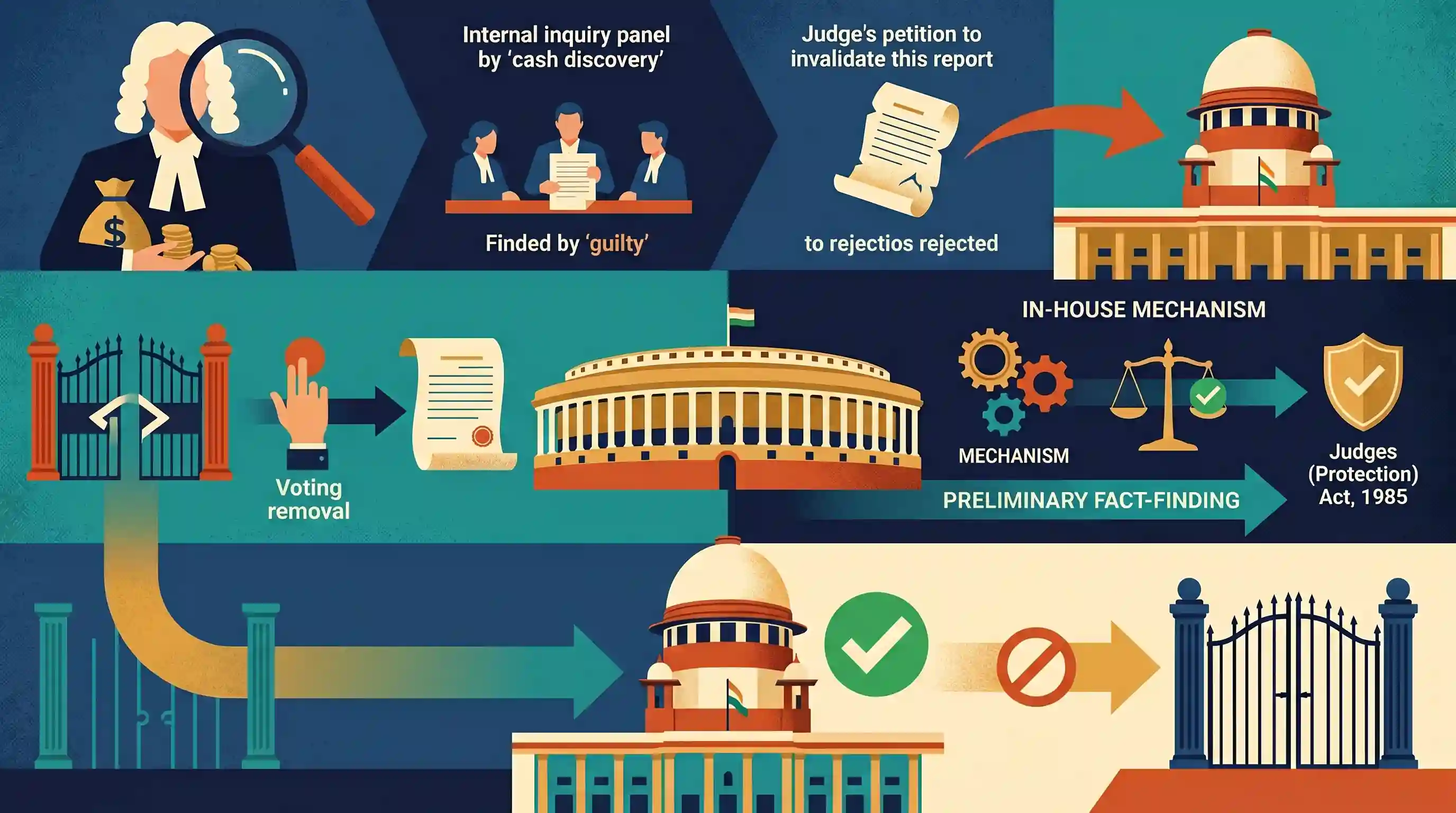
The Supreme Court of India dismissed a petition by Allahabad High Court Judge Yashwant Varma, who sought to invalidate an in-house panel report finding him guilty of misconduct in a 'cash discovery' case. The core constitutional debate focused on whether the judiciary's internal inquiry procedure violates Parliament's exclusive authority to remove judges under Articles 124(5) and 218. The Court upheld the legality of the in-house mechanism, characterizing it as a preliminary fact-finding process supported by the Judges (Protection) Act, 1985. This ruling reinforces internal judicial accountability mechanisms while clarifying that they do not encroach upon the legislative branch's formal impeachment powers.
Key Points
- The Supreme Court dismissed a plea by Allahabad HC Judge Yashwant Varma challenging an in-house inquiry report that found him guilty of misconduct.
- Justice Varma argued that the in-house procedure is extra-constitutional and bypasses Parliament's exclusive authority to remove judges under Articles 124(5) and 218 of the Constitution.
- The Court held that the in-house inquiry is a legal, preliminary fact-finding process backed by the Judges (Protection) Act, 1985.
- The ruling clarifies that internal judicial accountability mechanisms do not fetter or usurp Parliament's exclusive impeachment powers.
Important Terms
In-house Procedure (Judiciary)

An internal mechanism adopted by the Supreme Court in 1999 to investigate allegations of misconduct against higher judiciary judges through peer-led inquiry committees before any formal impeachment.
UPSC context
GS II/Judiciary. Tests knowledge of non-statutory accountability mechanisms and the balance between judicial independence and internal discipline.
Judges (Inquiry) Act, 1968
Statutory framework enacted in 1968 to regulate the investigation and proof of "misbehaviour or incapacity" of Supreme Court and High Court judges during the removal process.
UPSC context
GS II/Judiciary. Essential for understanding the "Removal of Judges" procedure and the statutory operationalization of Article 124(5).
Judges (Protection) Act, 1985
A 1985 Act providing immunity to judges from civil or criminal proceedings for official acts, while supporting the legality of specific inquiry processes into judicial conduct.
UPSC context
GS II/Judiciary. Tests awareness of the legal safeguards for judicial independence and the limits of judicial immunity.
Article 124(5)
Constitutional provision empowering Parliament to regulate the procedure for the investigation and proof of a judge's misbehaviour or incapacity before their removal.
UPSC context
GS II/Indian Constitution. Key to understanding the separation of powers and the legislature's oversight role in judicial accountability.
Article 218
Constitutional provision that extends the procedure for the removal of Supreme Court judges (under Article 124) to the judges of High Courts.
UPSC context
GS II/Judiciary. Tests the constitutional link between the Supreme Court and High Courts regarding tenure and removal.
Proved Misbehaviour
One of the two specific constitutional grounds for a judge's removal, requiring formal investigation and proof of serious ethical or professional lapses.
UPSC context
GS II/Judiciary. A critical term for the removal process, emphasizing that allegations must be formally substantiated.
Prelims Trap
"The In-House Procedure for judges is mandated by the Judges (Inquiry) Act, 1968."
The In-House Procedure is a self-regulatory peer-review mechanism adopted by the SC in 1999. The 1968 Act governs only formal parliamentary impeachment, not internal inquiries.
Static Concepts Connected
What is the formal procedure for the removal of Supreme Court and High Court judges?
- Constitutional grounds: Judges can be removed solely on the grounds of "proved misbehaviour" or "incapacity" under Articles 124(4) and 218.
- Motion initiation: Requires the signatures of 100 Lok Sabha or 50 Rajya Sabha MPs; admission is at the Speaker/Chairman's discretion.
- Statutory inquiry: If admitted, a 3-member committee investigates the charges under the Judges (Inquiry) Act, 1968.
- Final passage: Requires a special majority in both Houses of Parliament, followed by a formal Presidential order.
What are the consequences of a guilty finding under the judicial In-House Procedure?
- Resignation advice: The Chief Justice formally advises the errant judge to resign or opt for voluntary retirement.
- Work withdrawal: If the judge refuses to step down, the Chief Justice withdraws all judicial and administrative work.
- Executive notification: The CJI informs the President and Prime Minister, setting the stage for Parliament to initiate formal impeachment.
Cross-Topic Patterns
NJAC vs. Judicial Self-Regulation
The judiciary's reliance on the In-House Procedure reflects its historical resistance to external oversight, echoing the core arguments used to strike down the National Judicial Appointments Commission (NJAC) in 2015.
Impeachment motions and Speaker's discretion
The intersection of judicial accountability and parliamentary privilege is heavily tested, particularly regarding the Speaker/Chairman's absolute discretion to reject a formal judge removal motion at the very threshold.

Expect a Prelims question differentiating the statutory Judges (Inquiry) Act 1968 from the Supreme Court's 1999 In-House Procedure.
Linked PYQs · 1
Linked PYQs · 1
- 2019PrelimsGS1
Consider the following statements: 1. The motion to impeach a Judge of the Supreme Court of India cannot be rejected by the Speaker of the Lok Sabha as per the Judges (Inquiry) Act, 1968. 2. The Constitution of India defines and gives details of what constitutes 'incapacity and proved misbehaviour' of the Judges of the Supreme Court of India. 3. The details of the process of impeachment of the Judges of the Supreme Court of India are given in the Judges (Inquiry) Act, 1968. 4. If the motion for the impeachment of a Judge is taken up for voting, the law requires the motion to be backed by each House of the Parliament and supported by a majority of total membership of that House and by not less than two-thirds of total members of that House present and voting. Which of the statements given above is/are correct?
