Judicial Accountability and In-House Inquiry Procedures in India
Source:The Hindu ↗
Why It Matters
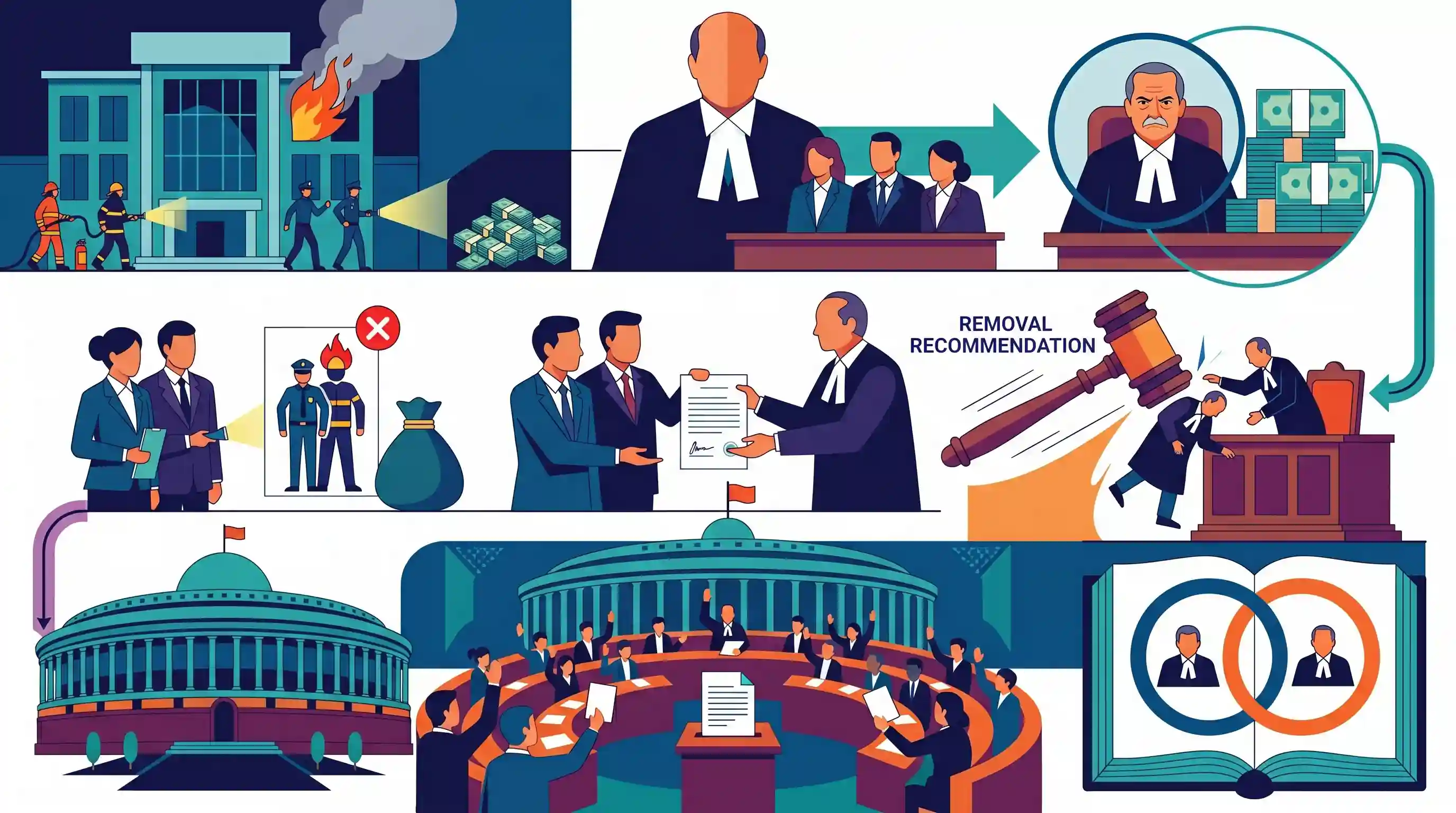
Judicial independence must be balanced by accountability. The 'in-house procedure' is a vital mechanism to investigate allegations against higher judiciary judges before formal constitutional processes—like impeachment under Article 124(4)/217(1) and the Judges (Inquiry) Act, 1968—are initiated. This incident presents a high-profile, real-world example of these constitutional and institutional safeguards in action.
Summary
An in-house inquiry committee appointed by the Chief Justice of India has concluded that large amounts of cash were discovered at the official residence of High Court Judge Yashwant Varma following a fire incident. The committee criticized the police and fire authorities for failing to lodge an FIR or officially seize the cash, and recommended his removal from office. Consequently, a motion for his impeachment is expected to be introduced in Parliament. The case underscores the functioning of internal judicial accountability mechanisms and the procedural rigors of removing a constitutional court judge.
Key Points
- Following a fire at the official residence of High Court Judge Yashwant Varma, large sums of cash were discovered in a trunk in a gutted storeroom.
- Delhi Police and Fire authorities failed to file an FIR or prepare a seizure memo, instead handing the cash back to the judge's staff, prompting allegations of a cover-up.
- CJI D.Y. Chandrachud constituted a three-member in-house inquiry committee comprising High Court Justices Sheel Nagu, G.S. Sandhawalia, and Anu Sivaraman to investigate the incident.
- The committee confirmed the discovery of the cash, criticized the authorities' "slipshod" approach, and recommended proceedings for the judge's removal.
- A formal motion for the impeachment of the judge is anticipated to be introduced in Parliament during the upcoming Monsoon Session.
Important Terms
Judges (Inquiry) Act, 1968

Statutory framework regulating the investigation and proof of misbehaviour or incapacity of Supreme Court and High Court judges. It operationalizes Article 124(5) to maintain judicial accountability.
UPSC context
GS Paper II (Judiciary/Governance). Tests knowledge of the legal mechanism for judicial removal and the balance between independence and accountability.
Inquiry Committee
A judicial body constituted under the 1968 Act (for impeachment) or the 1999 In-house Procedure to investigate allegations of misconduct against sitting judges.
UPSC context
GS Paper II (Judiciary). Tests understanding of procedural rigors and the quasi-judicial nature of fact-finding in judicial oversight cases.
Impeachment of Judges
The constitutional process (Art 124(4) & 218) to remove superior court judges for 'proved misbehaviour' or 'incapacity'. Requires a special majority in both Houses of Parliament.
UPSC context
GS Paper II (Polity). Core topic for 'Separation of Powers' and 'Checks and Balances' between the Legislature and Judiciary.
In-house Procedure
Internal judicial mechanism adopted in 1999 for handling complaints of misconduct. It allows the judiciary to self-regulate without legislative interference, potentially leading to resignation or impeachment recommendations.
UPSC context
GS Paper II (Judiciary). Tests familiarity with non-statutory accountability mechanisms and judicial independence vs. transparency.
Parliament of India
The final decision-making body for judicial removal. A motion must be passed by two-thirds of members present and voting, representing at least half the total membership.
UPSC context
GS Paper II (Legislature). Tests understanding of Parliament's role in constitutional checks and the removal of constitutional authorities.
Supreme Court of India
The highest constitutional court whose Chief Justice (CJI) initiates in-house inquiries and recommends removal proceedings to the President and Prime Minister.
UPSC context
GS Paper II (Judiciary). Tests knowledge of the administrative powers of the CJI and the apex court's oversight role.
Prelims Trap
The Constitution of India explicitly outlines the detailed procedure for the investigation and removal of a High Court judge.
Article 124(4) only prescribes the grounds (proved misbehaviour/incapacity) and voting majority. The actual investigation process is governed by a statute: the Judges (Inquiry) Act, 1968.
Static Concepts Connected
What is the statutory procedure for the impeachment of a judge?
- Initiation: A removal motion requires signatures of 100 Lok Sabha or 50 Rajya Sabha MPs. The Speaker/Chairman holds discretionary power to admit or reject it.
- Statutory Investigation: If admitted, a 3-member committee (Supreme Court Judge, High Court Chief Justice, distinguished jurist) investigates the charges under the Judges (Inquiry) Act, 1968.
- Special Majority: Removal requires a special majority in both Houses (majority of total membership and 2/3rd of members present and voting), followed by a Presidential order.
What is the "In-House Procedure" for judicial accountability?
- Origin: Adopted via a 1999 Supreme Court resolution, it acts as a peer-review mechanism to bridge the gap between minor misconduct and formal impeachable offenses.
- Mechanism: The CJI forms a committee of judges to investigate serious complaints. If 'proved misbehaviour' is found, the CJI advises the judge to resign or initiates steps for removal.
Cross-Topic Patterns
Veeraswami judgment & criminal prosecution
Police hesitation to file an FIR links back to the 1991 K. Veeraswami judgment, which explicitly mandates the CJI's prior sanction before registering a criminal case against a sitting High Court or Supreme Court judge.
Opacity of judicial accountability frameworks
The reliance on an internal committee connects to broader debates on judicial opacity, the striking down of the NJAC, and the tension between judicial independence and democratic accountability mechanisms.

Expect a Prelims question testing the differences between the 1999 In-House Procedure and the statutory Judges (Inquiry) Act, 1968.
Linked PYQs · 2
Linked PYQs · 2
- 2019PrelimsGS1
Consider the following statements: 1. The motion to impeach a Judge of the Supreme Court of India cannot be rejected by the Speaker of the Lok Sabha as per the Judges (Inquiry) Act, 1968. 2. The Constitution of India defines and gives details of what constitutes 'incapacity and proved misbehaviour' of the Judges of the Supreme Court of India. 3. The details of the process of impeachment of the Judges of the Supreme Court of India are given in the Judges (Inquiry) Act, 1968. 4. If the motion for the impeachment of a Judge is taken up for voting, the law requires the motion to be backed by each House of the Parliament and supported by a majority of total membership of that House and by not less than two-thirds of total members of that House present and voting. Which of the statements given above is/are correct?
- 2023MainsGS2
“Constitutionally guaranteed judicial independence is a prerequisite of democracy.” Comment.
