Judicial accountability and proposed impeachment process for judge
Source:Indian Express ↗
Why It Matters
The impeachment of a judge is a rare and significant constitutional event. It is directly relevant to UPSC GS2 (Structure, organization and functioning of the Judiciary) and tests candidates' knowledge of constitutional mechanisms (Article 124) and statutory procedures (Judges Inquiry Act, 1968) ensuring judicial accountability.
Summary
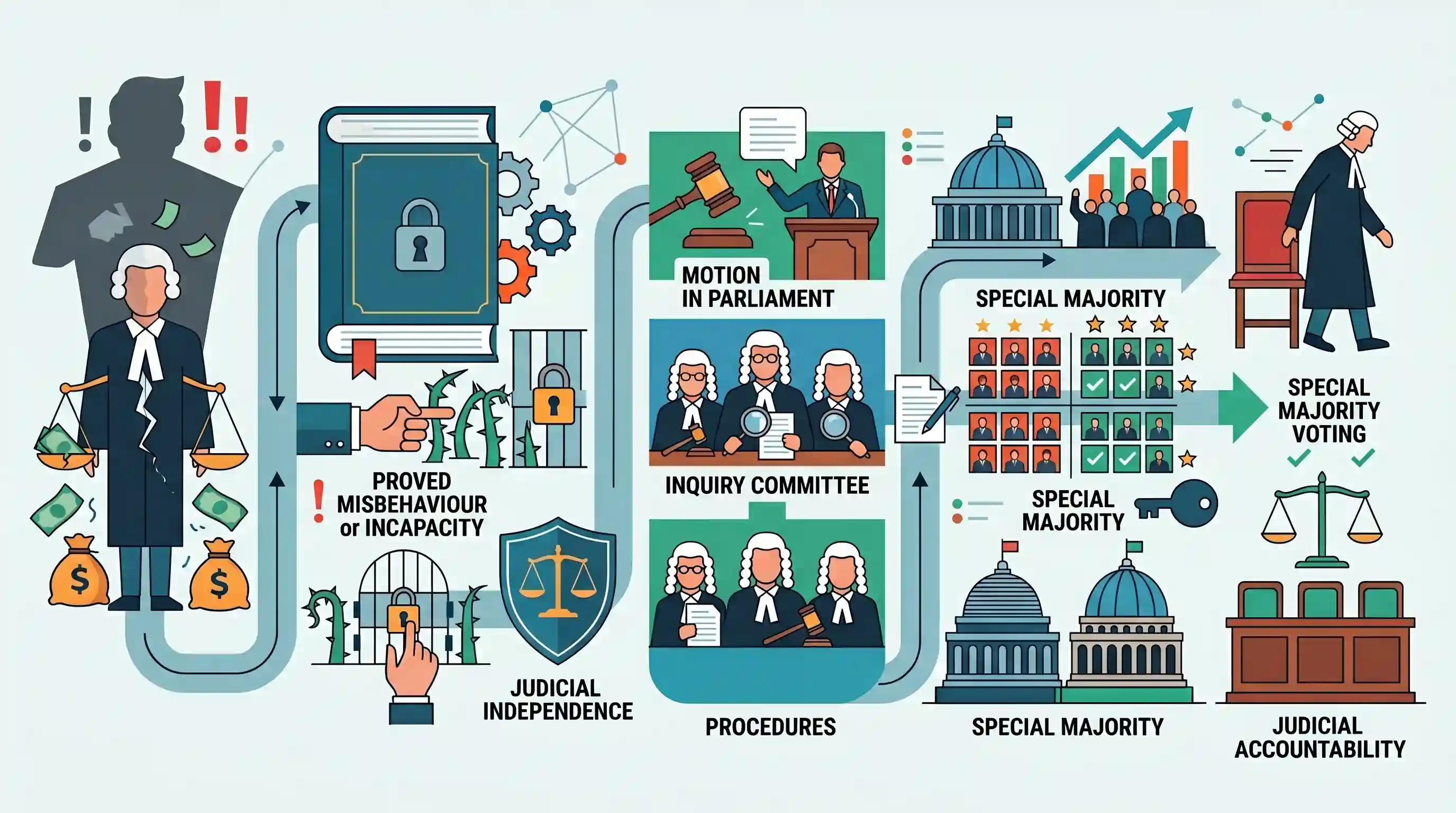
The government is likely to initiate an impeachment motion against Justice Varma following the recovery of cash at his residence, spotlighting the issue of corruption and accountability within the Indian judiciary. The process for removing a higher judiciary judge is intentionally stringent to protect judicial independence, requiring 'proved misbehaviour or incapacity' under Article 124(4) of the Constitution. The procedure, detailed in the Judges (Inquiry) Act, 1968, involves a formal inquiry committee and necessitates a special majority in both Houses of Parliament for passage. This incident emphasizes the ongoing challenge of ensuring judicial probity without compromising institutional autonomy.
Key Points
- The government is considering an impeachment motion against Justice Varma after the discovery of unaccounted cash at his residence, raising serious concerns regarding corruption in the higher judiciary.
- The removal of a Supreme Court or High Court judge in India is governed by Article 124(4) of the Constitution on the grounds of 'proved misbehaviour or incapacity'.
- The statutory procedure for investigation is outlined in the Judges (Inquiry) Act, 1968, which requires an inquiry by a three-member committee before the motion can be taken up for voting.
- Passing an impeachment motion requires a special majority in both Houses of Parliament—a majority of the total membership and two-thirds of the members present and voting.
- This development reignites debates around the effectiveness of existing mechanisms for judicial accountability and the delicate balance between accountability and judicial independence.
Important Terms
Judges (Inquiry) Act, 1968

Statutory framework enacted under Article 124(5) to regulate the investigation and proof of misbehaviour or incapacity of Supreme Court and High Court judges.
UPSC context
GS Paper II: Judiciary/Statutory Bodies. Crucial for understanding the procedural 'how' of judicial removal beyond constitutional text.
Article 124(4)
Constitutional provision detailing the removal of Supreme Court judges by the President after a parliamentary address supported by a special majority.
UPSC context
GS Paper II: Indian Constitution. Core article for judicial independence and the 'separation of powers' doctrine.
Article 217
Specifies that High Court judges are removed by the President via the same stringent procedure used for Supreme Court judges under Article 124(4).
UPSC context
GS Paper II: Structure and Organization of Judiciary. Tests knowledge of procedural parity between HC and SC judges.
Proved Misbehaviour or Incapacity
The only two grounds permitted by the Constitution for the removal of a judge, as established under Article 124(4).
UPSC context
GS Paper II: Judiciary. Key for defining the constitutional threshold required to initiate removal proceedings.
Special Majority
The voting threshold for judicial removal: majority of total House membership and two-thirds of members present and voting in both Houses.
UPSC context
GS Paper II: Parliament. Tests understanding of different majority types and their specific constitutional applications.
Judicial Accountability
The obligation of the judiciary to be answerable for conduct and decisions while maintaining independence from the executive and legislature.
UPSC context
GS Paper II/IV: Governance and Ethics. A major theme regarding judicial reforms and institutional integrity.
Prelims Trap
The Speaker/Chairman is bound to admit a judicial removal motion if it has the requisite 100/50 MP signatures.
The Presiding Officer enjoys absolute discretionary power to either admit or reject the removal motion upon receiving it, regardless of MP signatures.
Static Concepts Connected
What is the statutory process for removing a Supreme Court or High Court judge?
- Initiation: 100 Lok Sabha or 50 Rajya Sabha MPs submit a motion to the Presiding Officer, who possesses discretionary power to admit or reject it.
- Investigation: If admitted, the Judges (Inquiry) Act 1968 mandates a 3-member committee (SC Judge, HC Chief Justice, eminent jurist) to investigate the charges.
- Parliamentary Voting: If the committee finds guilt, both Houses must pass the motion by a special majority (majority of total membership + 2/3rds present and voting).
How does the Constitution address 'misbehaviour' of higher judiciary judges?
- Constitutional Grounds: Article 124(4) and Article 217 specify 'proved misbehaviour or incapacity' as the only grounds for removing an SC or HC judge.
- Undefined Terms: The Constitution deliberately does not define these terms, leaving the threshold of proof to statutory procedures and parliamentary inquiry mechanisms.
Cross-Topic Patterns
Special majorities in Parliament
UPSC frequently tests the nuances of 'special majorities'. Judge removal requires an Article 368-style majority, distinctly differing from the President's impeachment which requires 2/3rds of total membership.
NJAC & Accountability vs. Independence
This crisis revives the core debate behind the struck-down 99th Amendment (NJAC), pitting the need for executive-backed judicial accountability against the constitutional safeguard of judicial independence.

Expect a multi-statement Polity question in 2026 contrasting the removal process of the President (Art 61) with SC/HC Judges (Art 124).
Linked PYQs · 3
Linked PYQs · 3
- 2019PrelimsGS1
Consider the following statements: 1. The motion to impeach a Judge of the Supreme Court of India cannot be rejected by the Speaker of the Lok Sabha as per the Judges (Inquiry) Act, 1968. 2. The Constitution of India defines and gives details of what constitutes 'incapacity and proved misbehaviour' of the Judges of the Supreme Court of India. 3. The details of the process of impeachment of the Judges of the Supreme Court of India are given in the Judges (Inquiry) Act, 1968. 4. If the motion for the impeachment of a Judge is taken up for voting, the law requires the motion to be backed by each House of the Parliament and supported by a majority of total membership of that House and by not less than two-thirds of total members of that House present and voting. Which of the statements given above is/are correct?
- 2025MainsGS2
"Constitutional morality is the fulcrum which acts as an essential check upon the high functionaries and citizens alike...." In view of the above observation of the Supreme Court, explain the concept of constitutional morality and its application to ensure balance between judicial independence and judicial accountability in India.
- 2023MainsGS2
“Constitutionally guaranteed judicial independence is a prerequisite of democracy.” Comment.
