Vehicular Emissions and Urban Mobility Challenges in Delhi
Source:Indian Express ↗
Why It Matters
The article highlights the critical intersection of urban planning, environmental degradation, and governance. It provides a case study of how inadequate public transport infrastructure and poor policy enforcement exacerbate air pollution, relevant for GS3 (Environment and Infrastructure) and GS2 (Governance).
Summary
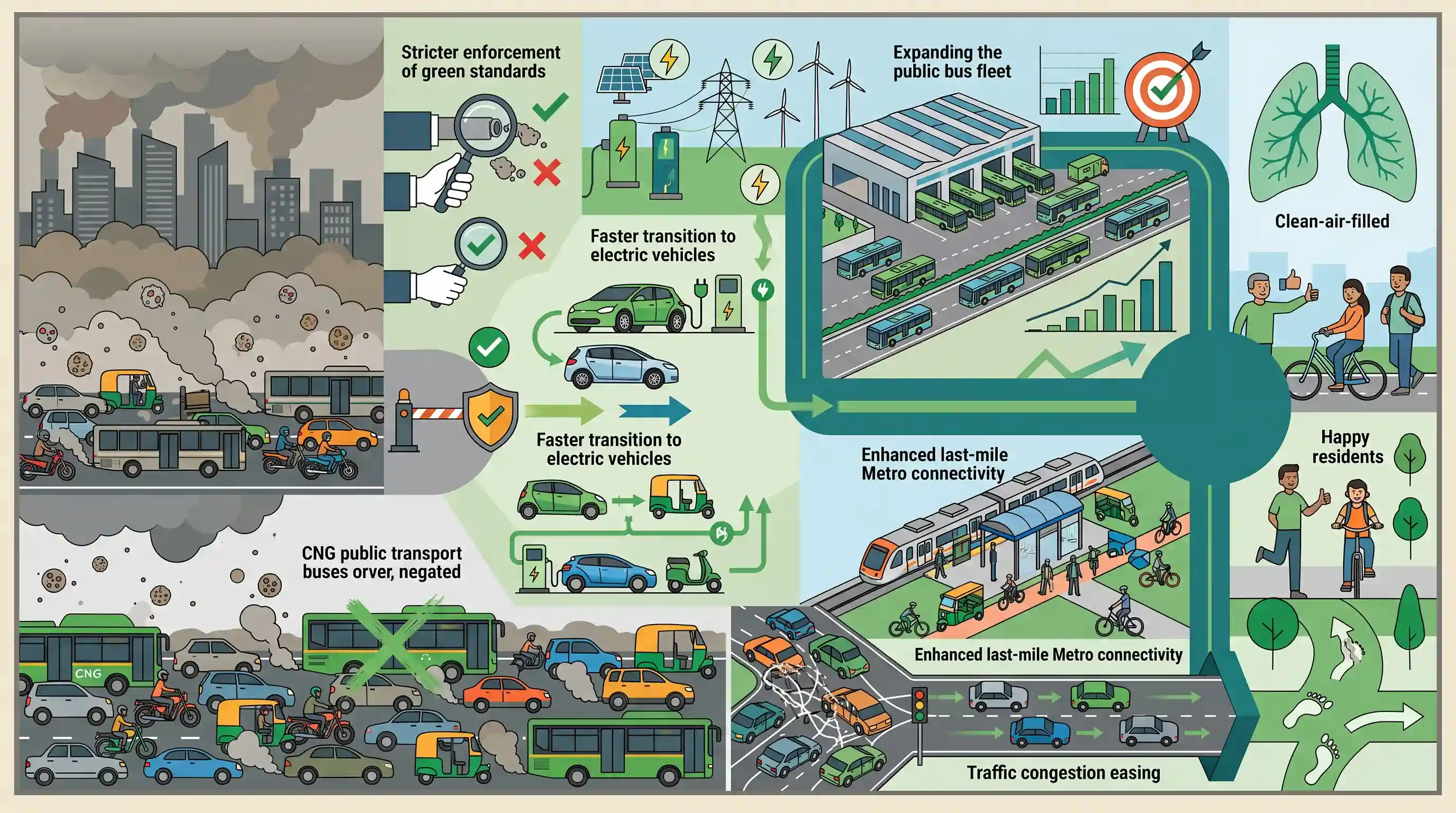
Vehicular emissions are a primary driver of Delhi's severe air pollution, negating earlier improvements achieved by transitioning public transport to CNG. To combat this, authorities are pushing for stricter enforcement of green standards and a faster transition to electric vehicles (EVs). However, technological shifts alone are insufficient. The crisis demands systemic improvements in urban mobility, including expanding the public bus fleet to meet decades-old Supreme Court targets, enhancing last-mile connectivity for the Metro, and easing traffic congestion. The Delhi government must take visible, comprehensive actions to build public trust and encourage behavioral changes among residents.
Key Points
- Vehicular emissions remain a major constituent of the National Capital Region's (NCR) toxic air, offsetting the environmental gains made after the Supreme Court shifted public transport to CNG in 2001.
- The PM's Principal Secretary has directed NCR states to penalise defaults on green standards and accelerate the transition to electric vehicles (EVs).
- Reliance on private vehicles has grown due to inadequate public transportation; Delhi's bus fleet still falls short of the 10,000 buses targeted by the Supreme Court in 1998.
- Despite the expansion of the Metro network and electric bus fleet, the lack of last-mile connectivity makes public transit less attractive to commuters.
- Traffic congestion significantly worsens the problem, increasing emissions by up to seven times, necessitating better urban mobility planning alongside behavioral changes like carpooling.
Important Terms
Vehicular Emissions

Gaseous and particulate discharge (like NOx and PM2.5) from motor vehicles. In Delhi, these are a primary contributor to severe air quality degradation.
UPSC context
GS3: Environmental Pollution; critical for understanding source-apportionment in urban air quality management.
Last-mile Connectivity
The final leg of a commute between a transit hub (Metro/Bus) and the destination. Gaps here discourage public transport and increase private car usage.
UPSC context
GS1: Urbanization; GS3: Infrastructure; essential for achieving multi-modal transport integration goals.
Urban Mobility
The movement of people within urban areas via various modes. Sustainable mobility prioritizes public transit, walking, and cycling over private motorized transport.
UPSC context
GS1: Urbanization; GS3: Infrastructure; highlights the shift from vehicle-centric to people-centric planning.
Supreme Court (Environmental Oversight)
Judicial intervention in environmental policy, exemplified by the 1998 landmark order mandating the conversion of Delhi’s entire bus fleet to cleaner fuel (CNG).
UPSC context
GS2: Judiciary; GS3: Environment; tests the role of Public Interest Litigation (PIL) in governance.
CNG (Compressed Natural Gas)
A methane-based fuel used as a cleaner alternative to diesel. It was mandated for Delhi's public transport in 1998 to combat toxic particulate emissions.
UPSC context
GS3: Environment & Energy; focuses on alternative fuels and the history of Delhi’s pollution control.
Electric Vehicles (EVs)
Vehicles powered by electricity with zero tailpipe emissions. They are the target of current government policies like FAME-II to decarbonize urban transport.
UPSC context
GS3: Infrastructure/Economy; vital for India's Net Zero targets and reducing urban fossil fuel reliance.
CAQM (Commission for Air Quality Management)
A statutory body established to coordinate and oversee air quality management in the National Capital Region and adjoining areas.
UPSC context
GS3: Statutory Bodies/Environment; tests administrative frameworks for regional environmental governance.
Prelims Trap
"Stubble burning is the primary year-round contributor to Delhi's PM2.5 pollution."
Stubble burning causes a severe seasonal spike (Oct-Nov), but vehicular emissions and road dust are the largest consistent, year-round contributors to Delhi's baseline PM2.5 pollution.
Static Concepts Connected
What is the legal basis for Supreme Court interventions in air pollution?
- Article 21: The SC expanded the Right to Life to include the Right to a Clean Environment, famously seen in the M.C. Mehta cases.
- Mandated CNG transition: Prompted by PILs, the SC in 1998 directed the phased conversion of Delhi's entire public transport and bus fleet to CNG by 2001.
- Continuing Mandamus: The Court uses this tool to keep cases open for monitoring implementation, leading to bodies like the erstwhile EPCA (now CAQM) to enforce norms.
How do BS-VI emission norms differ from earlier BS-IV standards?
- Sulfur content: BS-VI drastically reduces sulfur content in motor fuel to 10 ppm, down from 50 ppm in BS-IV, minimizing particulate matter output.
- Nitrogen Oxides (NOx): Mandates a significant reduction in Nitrogen Oxide (NOx) emissions, requiring advanced exhaust treatment for both diesel and petrol vehicles.
- OBD requirement: Mandates On-Board Diagnostics (OBD) to continuously monitor the vehicle's emission control system in real-time.
Cross-Topic Patterns
EVs vs Critical Mineral Security
Shifting from CNG/ICE vehicles to EVs reduces urban tailpipe emissions but introduces geopolitical vulnerabilities regarding lithium and rare earth supply chains, shifting dependency from oil to minerals.
Fragmented Urban Governance and Transit
The lack of last-mile connectivity highlights the failure of the 74th Amendment to empower unified Metropolitan Planning Committees (MPCs) and Unified Metropolitan Transport Authorities (UMTAs) for integrated planning.

Expect a 2026 Prelims question testing the year-round PM2.5 contributors in NCR alongside EV transition mechanisms like PM E-DRIVE.
Linked PYQs · 3
Linked PYQs · 3
- 2023MainsGS3
The adoption of electric vehicles is rapidly growing worldwide. How do electric vehicles contribute to reducing carbon emissions and what are the key benefits they offer compared to traditional combustion engine vehicles?
- 2022MainsGS2
“The most significant achievement of modern law in India is the constitutionalization of environmental problems by the Supreme Court.” Discuss this statement with the help of relevant case laws.
- 2021MainsGS3
Describe the key points of the revised Global Air Quality Guidelines (AQGs) recently released by the World Health Organisation (WHO). How are these different from its last update in 2005? What changes in India's National Clean Air Programme are required to achieve these revised standards?
