US And Iran Resume Indirect Nuclear Diplomacy Amid Regional Tension
Source:The Hindu ↗
Why It Matters
The geopolitical stability of West Asia is vital for India's energy security, diaspora welfare, and strategic investments like the Chabahar port. Fluctuations in U.S.-Iran relations dictate global oil prices and regional peace, which directly impact India's economic growth and foreign policy calculus.
Summary
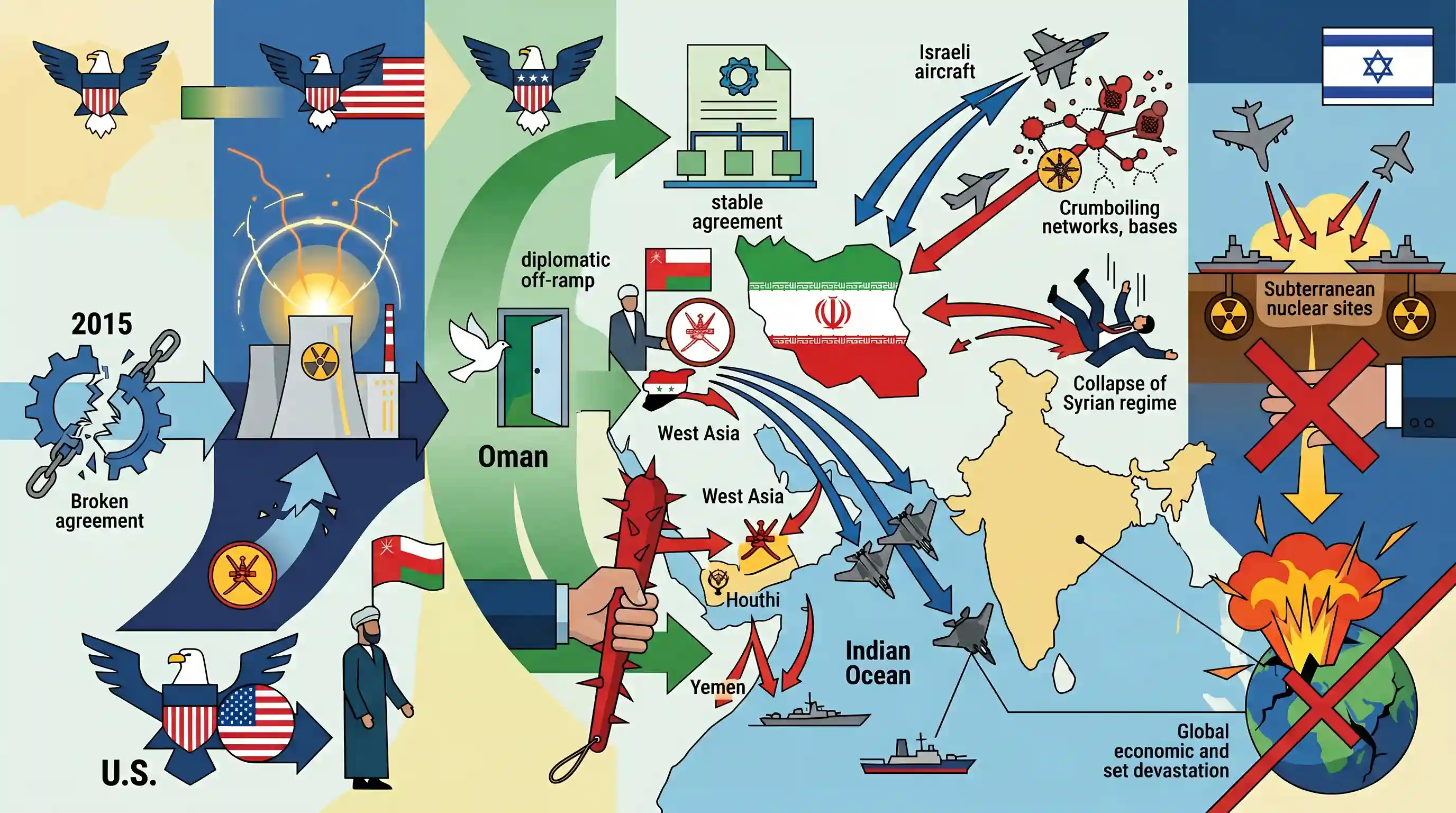
The editorial analyzes the renewed, indirect diplomatic talks between the U.S. and Iran, mediated by Oman, regarding Iran's nuclear program. Despite the previous Trump administration's withdrawal from the 2015 Joint Comprehensive Plan of Action (JCPOA), which led Iran to accelerate its nuclear capabilities, the U.S. is now offering a diplomatic off-ramp. However, this is accompanied by a heavy-handed "stick" approach: the U.S. has ramped up its military presence in West Asia, bombed Houthi forces in Yemen, and deployed B-2 bombers to the Indian Ocean. Concurrently, Iran's regional leverage has diminished following Israeli strikes on its proxies and the fall of the Assad regime in Syria. While Israel pushes for military strikes on Iran's subterranean nuclear facilities, Trump has temporarily vetoed this, recognizing that a military conflict would devastate regional security and the global economy. The article concludes that returning to a framework similar to the 2015 agreement remains the most rational solution for de-escalation.
Key Points
- The U.S. and Iran have resumed high-stakes indirect diplomatic talks, mediated by Oman, to address Tehran's rapidly advancing nuclear programme.
- Diplomatic negotiations are taking place against the backdrop of the first Trump administration's sabotage of the 2015 JCPOA, which initially triggered Iran's nuclear acceleration.
- Iran's regional influence has been significantly weakened by Israel's military offensives against its 'axis of resistance' and the recent collapse of the allied Assad regime in Syria.
- President Trump is deploying a "carrot and stick" approach, combining a willingness to negotiate with severe military posturing, including moving B-2 bombers to the Indian Ocean and striking Houthi targets in Yemen.
- Due to Iran's scattered and deeply buried nuclear facilities, a military attack would be catastrophic for regional security and the global economy, making a diplomatic solution the only viable path forward.
Important Terms
Joint Comprehensive Plan of Action (JCPOA)

A 2015 landmark agreement between Iran and the P5+1 (UNSC permanent members plus Germany) to limit Iran's nuclear enrichment in exchange for lifting economic sanctions.
UPSC context
GS Paper II: Important for International Relations, multilateral agreements, and India's energy security/connectivity via the Chabahar port.
Axis of Resistance
An informal, Iran-led military and political coalition including Hezbollah, Hamas, the Houthis, and various Iraqi militias, aimed at countering Western and Israeli influence in West Asia.
UPSC context
GS Paper II: Vital for understanding regional security, non-state actors, and Iran's strategic depth in West Asian geopolitics.
Houthis
A Yemen-based Zaidi Shia militant group, also known as Ansar Allah, which is backed by Iran and controls significant territory, including the capital Sanaa.
UPSC context
GS Paper II: Relevant for maritime security (Red Sea/Bab el-Mandeb), regional conflicts, and their impact on global trade routes.
Maximum Pressure Policy
A U.S. geopolitical strategy involving crippling economic sanctions and diplomatic isolation to force Iran to renegotiate its nuclear and missile programs.
UPSC context
GS Paper II: Tests knowledge of unilateral vs. multilateral diplomacy and the impact of developed-country policies on developing nations.
Omani Mediation
Often called the 'Switzerland of West Asia,' Oman maintains a neutral foreign policy that facilitates secret and indirect negotiations between adversaries like the U.S. and Iran.
UPSC context
GS Paper II: Illustrates middle-power diplomacy and the importance of neutral platforms in de-escalating regional tensions.
Prelims Trap
The JCPOA is a bilateral nuclear disarmament treaty signed exclusively between the United States and Iran.
The JCPOA was a multilateral framework involving the P5+1 and the EU. Aspirants mistakenly assume it is bilateral due to heavy media focus on US-Iran tensions.
Static Concepts Connected
What makes the Strait of Hormuz a geopolitical flashpoint?
- Location: Located between Iran and Oman, it links the Persian Gulf to the Gulf of Oman and the Arabian Sea.
- Trade Volume: It facilitates roughly 20% of global petroleum transit, making it an indispensable maritime energy chokepoint.
- Vulnerability: Iran frequently threatens to close it during escalations, which directly threatens India's energy security and inflation targets.
How is uranium enrichment categorized for nuclear applications?
- Isotopic Separation: Natural uranium mostly contains U-238. Enrichment processes use centrifuges to increase the concentration of the fissile U-235 isotope.
- Thresholds: Civilian nuclear power reactors typically require 3-5% enriched uranium, while weapons-grade material requires roughly 90% enrichment.
- Subterranean Sites: Iranian enrichment facilities like Fordow are buried deep underground into mountains to withstand bunker-buster conventional military strikes.
Cross-Topic Patterns
Middle-power mediation in West Asia
Oman’s "friend to all" mediation in US-Iran talks mirrors Qatar’s role in Gaza, illustrating the growing diplomatic agency of smaller Gulf states in global conflicts.
Chokepoints + Macroeconomic stability
Geopolitical shocks in the Persian Gulf threaten the Strait of Hormuz, directly impacting India's crude oil import bill, current account deficit, and imported inflation.

Map questions linking Iran's nuclear sites, Oman's borders, and chokepoints (Hormuz/Bab-el-Mandeb) are highly probable in Prelims 2026.
Linked PYQs · 4
Linked PYQs · 4
- 2018MainsGS2
In what ways would the ongoing US-Iran Nuclear Pact Controversy affect the national interest of India? How should India respond to this situation?
- 2025MainsGS2
"Energy security constitutes the dominant kingpin of India's foreign policy, and is linked with India's overarching influence in Middle Eastern countries.” How would you integrate energy security with India's foreign policy trajectories in the coming years?
- 2017MainsGS2
The question of India's Energy Security constitutes the most important part of India's economic progress. Analyze India's energy policy cooperation with West Asian countries.
- 2023PrelimsGS1
Consider the following statements: Statement-I: Israel has established diplomatic relations with some Arab States. Statement-II: The 'Arab Peace Initiative' mediated by Saudi Arabia was signed by Israel and Arab League. Which one of the following is correct in respect of the above statements?
