Red Sea Shipping Attacks Disrupt Global Maritime Supply Chains
Source:The Hindu ↗
Why It Matters
The Red Sea and Bab el-Mandeb strait are critical global chokepoints for international trade and energy shipments. Sustained instability in this region directly threatens global supply chains, inflates freight and energy costs, and necessitates a robust international maritime security response, profoundly impacting India's economic and strategic interests.
Summary
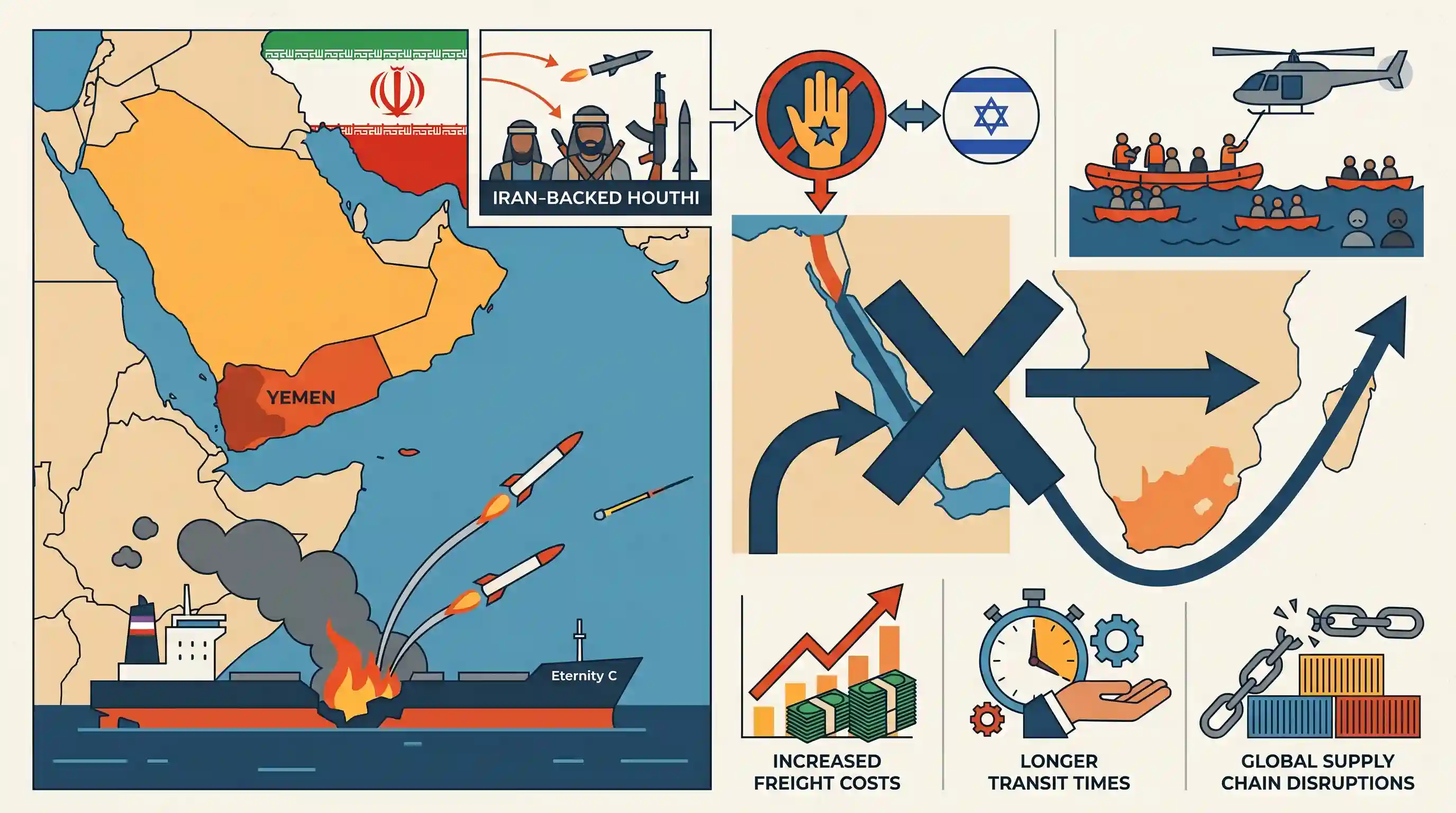
Five crew members from the Liberian-flagged bulk carrier Eternity C were rescued after the vessel was attacked and sunk in the Red Sea off rebel-held Yemen. The attack, alongside a similar assault on the ship Magic Seas, is part of a renewed wave of Iran-backed Houthi strikes following a recent Iran-Israel conflict. The EU naval force reported casualties, including three deaths among the crew. These ongoing attacks severely disrupt global maritime trade by forcing shipping companies to bypass the Red Sea—a critical chokepoint that handles about 12% of global trade—and detour around southern Africa, significantly increasing transit times and freight costs.
Key Points
- The Liberian-flagged bulk carrier Eternity C was attacked and sunk in the Red Sea off the coast of Yemen, resulting in casualties including three deaths among the predominantly Filipino crew.
- Five crew members were rescued by international forces, including the EU naval mission, while search operations continued for the missing sailors.
- The incident is part of a renewed wave of attacks by Iran-backed Houthi rebels on commercial vessels, escalating tensions following a recent conflict between Iran and Israel.
- Frequent maritime strikes have forced major freight companies to reroute ships around southern Africa, severely disrupting the Red Sea route which traditionally handles 12% of global trade.
Important Terms
Houthis (Ansar Allah)

An Iran-backed Zaydi Shia rebel group in Yemen that controls the capital, Sana’a, and targets international shipping in the Red Sea to protest Israel’s actions in Gaza.
UPSC context
GS Paper 2; tests knowledge of non-state actors and their impact on regional stability and India's maritime trade.
Bab el-Mandeb Strait
A strategic maritime chokepoint between Yemen and the Horn of Africa, connecting the Red Sea to the Gulf of Aden; it handles approximately 12% of global trade.
UPSC context
GS Paper 1 and 2; vital for mapping and analyzing global supply chain vulnerabilities.
United Kingdom Maritime Trade Operations (UKMTO)
A British Royal Navy-led information conduit that provides security alerts and serves as the primary point of contact for merchant vessels in the Indian Ocean and Red Sea.
UPSC context
GS Paper 3; examines international cooperation mechanisms used to protect global trade routes from non-state threats.
Operation Aspides
A defensive European Union naval mission launched in 2024 to protect commercial ships from Houthi attacks in the Red Sea and ensure freedom of navigation.
UPSC context
GS Paper 2; focuses on multilateral security groupings and the EU's role as a regional security provider.
Ambrey
A leading global private maritime security intelligence firm that provides real-time monitoring, risk assessments, and security services for commercial vessels in high-risk zones.
UPSC context
GS Paper 3; explores the role of private agencies in monitoring non-traditional threats to global commerce.
Cape of Good Hope
A major headland in South Africa used as an alternative trade route to bypass the Red Sea, significantly increasing transit times and freight costs.
UPSC context
GS Paper 1; relevant for world geography and understanding the economic geography of global trade routes.
Prelims Trap
"Operation Aspides is a United States-led military coalition aimed at securing commercial shipping in the Red Sea."
Operation Aspides is an EU-led defensive mission. The US-led mission is Operation Prosperity Guardian. UPSC frequently swaps lead organizations to create false statements.
Static Concepts Connected
What is the geographical alignment of the Bab el-Mandeb Strait?
- Bordering nations: It is bounded by Yemen on the Arabian Peninsula, and Djibouti and Eritrea on the Horn of Africa.
- Water bodies connected: It forms a vital strategic link connecting the Red Sea to the northwest with the Gulf of Aden and the Indian Ocean to the southeast.
How does bypassing the Red Sea economically impact global trade?
- Cape detour: Vessels must reroute via southern Africa, adding 3,000-6,000 nautical miles and 10-14 days to standard Europe-Asia transit times.
- Freight and inflation: Extended voyages dramatically increase fuel consumption, war-risk insurance premiums, and container freight rates, contributing heavily to global supply-chain inflation.
Cross-Topic Patterns
Red Sea crisis and imported inflation
Disrupted chokepoints spike global freight and insurance costs. For a net-importer like India, this directly translates into imported inflation and pressure on the Current Account Deficit (CAD).
Axis of Resistance mapping in Prelims
The Houthis act as the Yemeni arm of Iran's "Axis of Resistance." UPSC increasingly tests aspirants by asking them to match such non-state actors to their base countries and strategic objectives.

Expect a 2026 Prelims map question pairing West Asian straits (Bab el-Mandeb, Hormuz) with bordering nations and associated naval missions.
Linked PYQs · 3
Linked PYQs · 3
- 2024PrelimsGS1
Consider the following statements : Statement-I : Sumed pipeline is a strategic route for Persian Gulf oil and natural gas shipments to Europe. Statement-II : Sumed pipeline connects the Red Sea with the Mediterranean Sea. Which one of the following is correct in respect of the above statements?
- 2025MainsGS2
"Energy security constitutes the dominant kingpin of India's foreign policy, and is linked with India's overarching influence in Middle Eastern countries.” How would you integrate energy security with India's foreign policy trajectories in the coming years?
- 2023MainsGS2
‘Sea is an important Component of the Cosmos’ Discuss in the light of the above statement the role of the IMO (International Maritime Organisation) in protecting environment and enhancing maritime safety and security.
