Care Economy Formalization and Female Labor Force Participation
Source:The Hindu ↗
हे का महत्त्वाचे आहे
The care economy has emerged as a major focal point in UPSC (e.g., explicitly asked in GS3 2023). Understanding the link between unpaid care work, female labor force participation, and macroeconomic growth is crucial for answers in both GS1 (Society/Women) and GS3 (Economy/Inclusive Growth).
सारांश
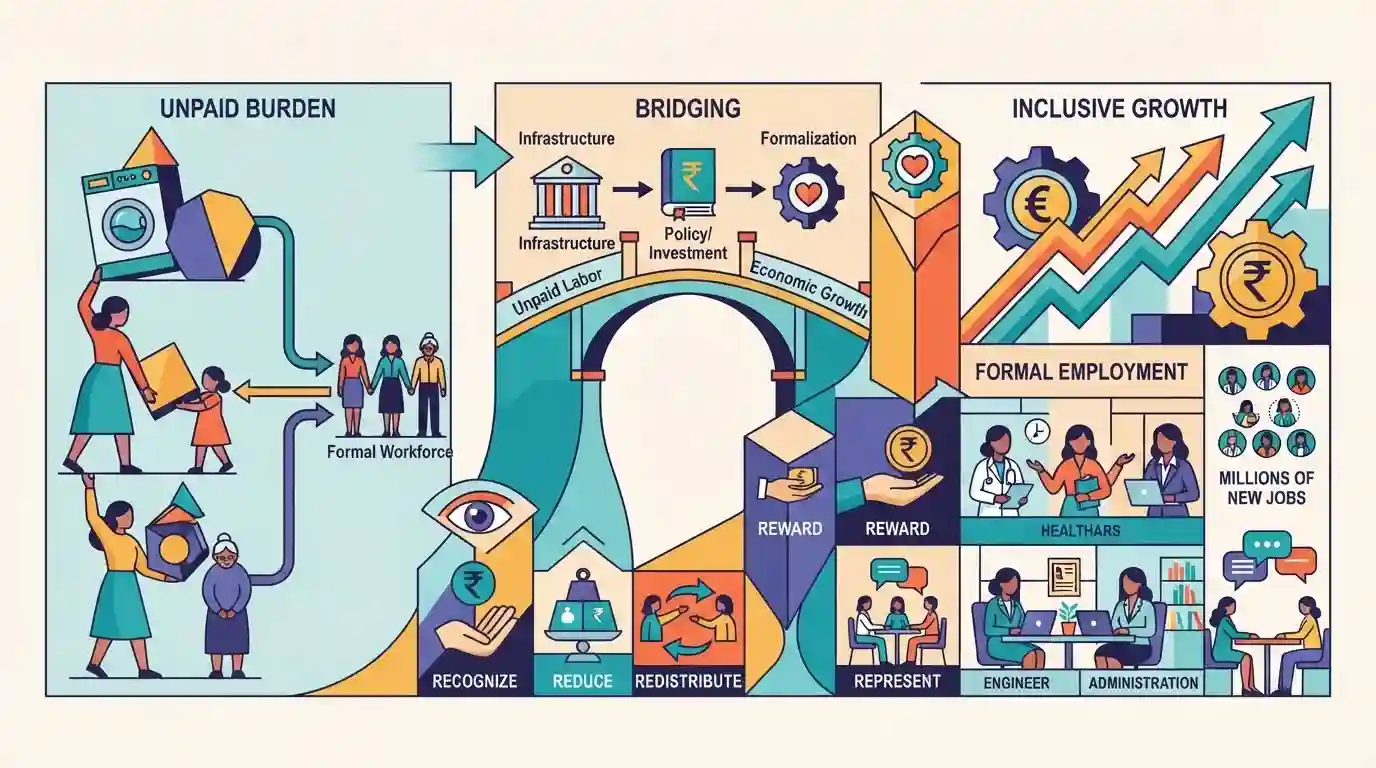
The article argues that the care economy—comprising paid and unpaid care work such as childcare, eldercare, and domestic tasks—should be recognized as a fundamental driver of economic growth rather than just a social welfare concern. In India, the disproportionate burden of unpaid care work falls on women, significantly hindering their participation in the formal labor force. By formalizing and investing in the care sector, countries can create millions of jobs, boost female labor force participation (FLFP), and achieve inclusive GDP growth. The article emphasizes the need to bring the care economy into the monetized economy through robust public policies, infrastructure investment, and adopting frameworks like the 5Rs (Recognize, Reduce, Redistribute, Reward, and Represent) to empower women economically.
मुख्य मुद्दे
- The care economy encompasses both paid and unpaid care work, including childcare, elderly care, and domestic chores, which are disproportionately performed by women.
- Investing in the care sector is not merely a social welfare measure but a fundamental economic growth strategy that can drive GDP growth by creating millions of decent jobs.
- Reducing the burden of unpaid care work on women is crucial for improving India's Female Labour Force Participation (FLFP).
- Formalizing and monetizing the care economy can unlock significant economic value, leading to inclusive growth and women's empowerment.
- Adopting the '5R' framework (Recognize, Reduce, Redistribute, Reward, and Represent care workers) is essential for comprehensive policy development.
महत्त्वाच्या संज्ञा
Care Economy

The sum of paid and unpaid activities providing care and support to individuals, including childcare and eldercare. It is increasingly recognized as a vital economic driver, heavily reliant on women's unpaid labor.
UPSC context
GS-3 (Economy) & GS-1 (Society). Tests understanding of female labor force participation, GDP calculation gaps, and inclusive growth.
International Labour Organization (ILO)
A UN agency promoting social justice and decent work. In the care economy, it advocates the "5R Framework" (Recognize, Reduce, Redistribute, Reward, Represent) to value unpaid work, achieve gender parity, and improve workers' rights.
UPSC context
GS-2 (International Organizations). Highly relevant for Mains essays and answers on labor reforms, women empowerment, and global employment standards.
Maternity Benefit Act
A 1961 labor law (amended in 2017) ensuring paid maternity leave (up to 26 weeks) and mandating crèche facilities in establishments with 50+ employees to protect women's employment during and after pregnancy.
UPSC context
GS-2 (Social Justice). Vital for questions on women's rights, workplace gender disparity, and social security legislation.
Palna Scheme
A centrally sponsored initiative under Mission Shakti providing quality day-care/crèche facilities for children aged 6 months to 6 years. It supports working mothers by offering safe childcare, nutritional support, and early education.
UPSC context
GS-2 (Government Policies). Important for evaluating state interventions aimed at increasing female workforce participation and child welfare.
Anganwadi Services
A flagship early childhood care program under the ICDS umbrella. It provides supplementary nutrition, preschool education, and primary healthcare to children, pregnant women, and lactating mothers through community-based centers.
UPSC context
GS-2 (Welfare Schemes). Tests knowledge of grassroots governance, nutrition interventions, and women's empowerment initiatives.
पूर्वपरीक्षा सापळा
Unpaid domestic and care work by women is included in India's official GDP calculations.
The UN System of National Accounts (SNA) explicitly excludes unpaid domestic and care work from official GDP calculations because it operates outside monetized market transactions.
संबंधित स्थिर संकल्पना
How does the UN System of National Accounts (SNA) treat non-market activities?
- Excluded activities: Unpaid domestic services (cooking, cleaning, childcare) and volunteer work are entirely excluded from official GDP calculations.
- Included activities: Production of goods for own final consumption (like subsistence farming) and imputed rent for owner-occupied housing are included.
What is the Time Use Survey (TUS) in India?
- Nodal Agency: Conducted by the National Statistical Office (NSO) under the Ministry of Statistics and Programme Implementation (MoSPI).
- Core Objective: Measures the time individuals spend on paid and unpaid activities, formally quantifying 'time poverty' and gender disparities in household labor.
आंतर-विषय नमुने
Care Economy + Demographic Transition
As India ages, the dual burden of childcare and eldercare will spike. Formalizing the care sector turns this demographic challenge into a massive formal job-creation engine.
Gig Economy + Urban Care Work
The platformization of urban domestic and care work connects this issue directly to the ongoing debates around social security codes and labor rights for gig and platform workers.

Expect a multi-statement question combining UN SNA's GDP exclusions, the Time Use Survey (NSO), and ILO's 5R framework for care work.
संबंधित PYQ · 2
संबंधित PYQ · 2
- 2023MainsGS3
Distinguish between 'care economy' and 'monetized economy'. How can care economy be brought into monetized economy through women empowerment?
- 2024MainsGS1
Distinguish between gender equality, gender equity and women's empowerment. Why is it important to take gender concerns into account in programme design and implementation?
