First Dalit leader elected to head Catholic church in India
Source:Indian Express ↗
Why It Matters
The article highlights the intersectionality of caste and religion in India, proving that caste identities permeate non-Hindu faiths. This is highly relevant for GS1 (Indian Society, changing forms of caste) and GS2 (welfare of vulnerable sections, SC status demands for Dalit Christians).
Summary
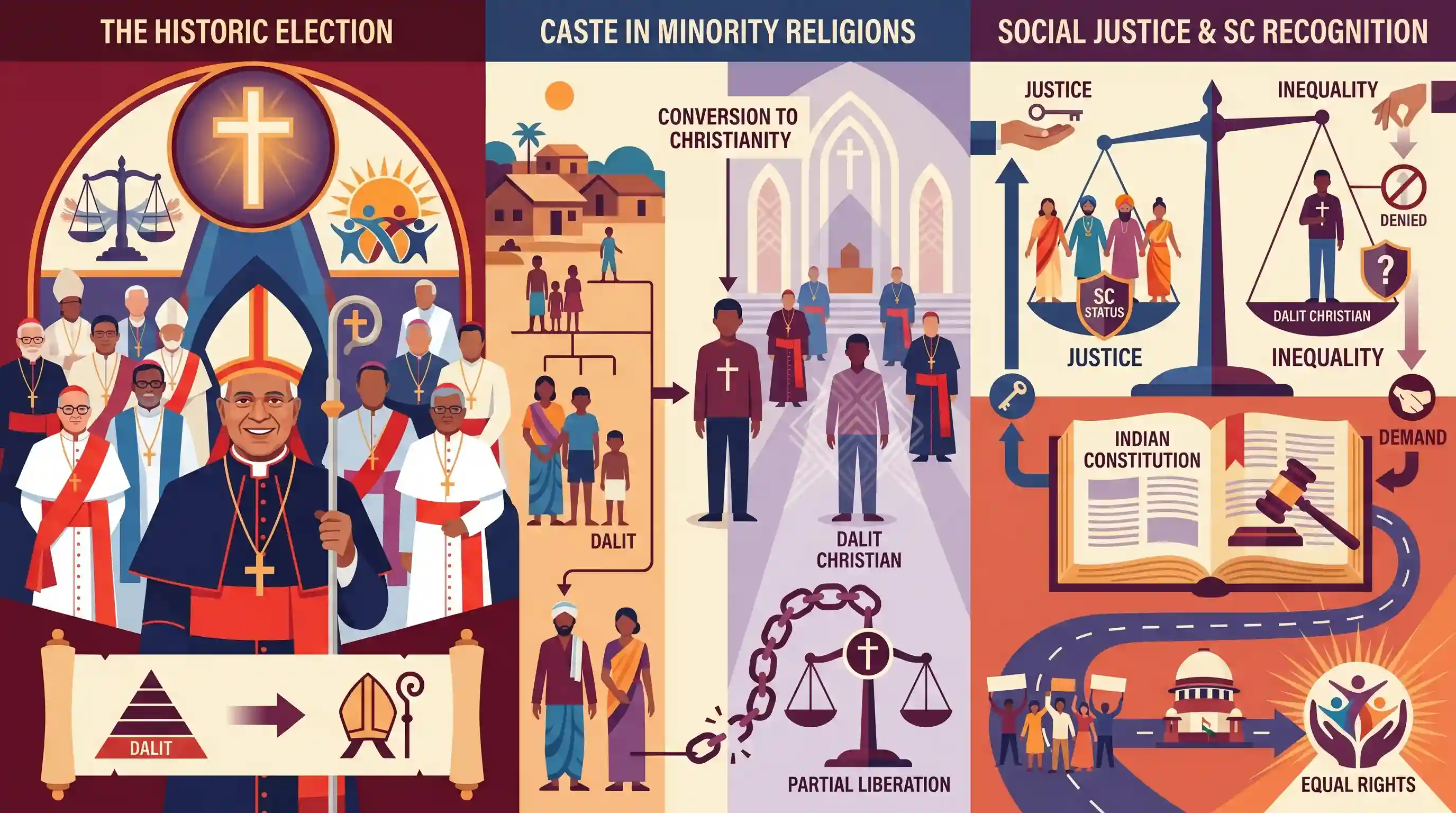
The election of Cardinal Poola Anthony as the President of the Catholic Bishops' Conference of India (CBCI) makes him the first Dalit leader to head the Catholic Church in the country. This historic appointment highlights the ongoing struggle for adequate representation and social justice for Dalit Christians. It serves as a reminder that caste identities and hierarchies exist even within minority religions, reinvigorating discussions around the socio-economic status of Dalit Christians and their demand for formal Scheduled Caste recognition.
Key Points
- Cardinal Poola Anthony has been elected as the President of the Catholic Bishops' Conference of India (CBCI), becoming the first Dalit leader to head the Catholic Church in India.
- His election marks a historic milestone in addressing the long-standing underrepresentation of marginalized Dalit Christians, who form a significant portion of the Catholic demographic in the country.
- The development underscores the reality of caste-based stratification and discrimination persisting within non-Hindu religious minority groups in India.
- It also renews attention to the ongoing socio-legal debate regarding the demand for Scheduled Caste (SC) status for Dalit Christians and Dalit Muslims, currently excluded by the Constitution (Scheduled Castes) Order, 1950.
Important Terms
Catholic Bishops' Conference of India (CBCI)

The permanent association of Catholic bishops in India, established in 1944. It serves as the apex body for coordinating common action on national and supra-ritual matters affecting the Indian Catholic community.
UPSC context
GS-II: Statutory/Regulatory Bodies and Social Justice. Tests knowledge of minority representative institutions and their role in advocating for community rights.
Dalit Christians
Refers to members of the Christian community who identify with Dalit origins. They often face 'double discrimination' from society and within religious structures, and currently lack official Scheduled Caste status.
UPSC context
GS-I & II: Indian Society & Social Justice. Crucial for understanding intersectionality of caste and religion and the debate over reservation for converts.
Catholic Church in India
The primary Christian denomination in India, comprising over 20 million members across three ritual traditions: Latin, Syro-Malabar, and Syro-Malankara. It is the single largest Christian group in the country.
UPSC context
GS-I: Diversity of India & Secularism. Important for understanding religious demography and the historical influence of minority institutions on social welfare.
Constitution (Scheduled Castes) Order, 1950
A landmark presidential decree that specifies which castes are recognized as 'Scheduled Castes'. It currently limits this status only to followers of Hindu, Sikh, and Buddhist religions.
UPSC context
GS-II: Constitution & Polity. Essential for questions on the legal criteria for reservation and the religious restrictions in the Scheduled Caste framework.
Article 341
Empowers the President to notify 'Scheduled Castes' for each State/UT. It is at the heart of the legal battle regarding whether caste benefits can extend beyond certain religions.
UPSC context
GS-II: Indian Constitution. Fundamental for understanding the mechanism of protective discrimination and the role of the President in identifying marginalized groups.
K.G. Balakrishnan Commission
A government-appointed body tasked with examining the possibility of granting Scheduled Caste (SC) status to Dalits who have converted to religions like Christianity and Islam.
UPSC context
GS-II: Welfare Schemes & Social Justice. Relevant for current developments in the reservation debate and policy recommendations for religious minorities.
Prelims Trap
"The Constitution allows Scheduled Caste (SC) status to be granted to marginalized individuals regardless of their current religion."
SC status under the 1950 Presidential Order is strictly limited to Hinduism, Sikhism, and Buddhism. While ST status is religion-neutral, SC status explicitly excludes Christians and Muslims.
Static Concepts Connected
What is the legal framework governing Scheduled Caste (SC) recognition in India?
- Article 341: Empowers the President to specify castes deemed as SCs in relation to a State/UT. Parliament alone can modify this list later.
- 1950 Presidential Order: Originally restricted SC status to Hindus. It was amended to include Sikhs in 1956 and Buddhists in 1990.
- Current Exclusion: Dalit Christians and Muslims are denied SC status based on the premise that their religions historically do not recognize the caste system.
Which key commissions have evaluated the status of Dalit Christians and Muslims?
- Ranganath Mishra (2007): Recommended that SC status be completely delinked from religion and made religion-neutral, similar to the Scheduled Tribes (ST) category.
- K.G. Balakrishnan (2022): Currently tasked by the Union Government to evaluate the social realities and implications of granting SC status to Dalit converts to Christianity and Islam.
Cross-Topic Patterns
Caste continuity post-conversion
The sociological reality that caste survives religious conversion frequently appears in Mains (Society), contradicting the assumption that egalitarian religions like Christianity and Islam automatically erase caste hierarchies.
ST (religion-neutral) vs SC (religion-bound)
Unlike SC status, Scheduled Tribe (ST) recognition under Article 342 is completely religion-neutral. This constitutional asymmetry is a recurring theme in debates over minority reservation and affirmative action.

A Prelims multi-statement question on Article 341, the 1950 SC Order, and the K.G. Balakrishnan Commission is highly probable in 2026.
Linked PYQs · 5
Linked PYQs · 5
- 2018MainsGS2
Whether National Commission for Scheduled Castes (NCSC) can enforce the implementation of constitutional reservation for the Scheduled Castes in the religious minority institutions? Examine.
- 2015MainsGS1
Debate the issue of whether and how contemporary movements for assertion of Dalit identity work towards annihilation of caste.
- 2018MainsGS1
Caste system is assuming new identities and associational forms. Hence, caste system cannot be eradicated in India." Comment.
- 2020MainsGS1
Has caste lost its relevance in understanding the multi-cultural Indian Society? Elaborate your answer with illustrations.
- 2022MainsGS1
Analyse the salience of 'sect' in Indian society vis-a-vis caste, region and religion.
