Indigenous CAR T-Cell Therapy Advances Affordable Cancer Care
Source:The Hindu ↗
Why It Matters
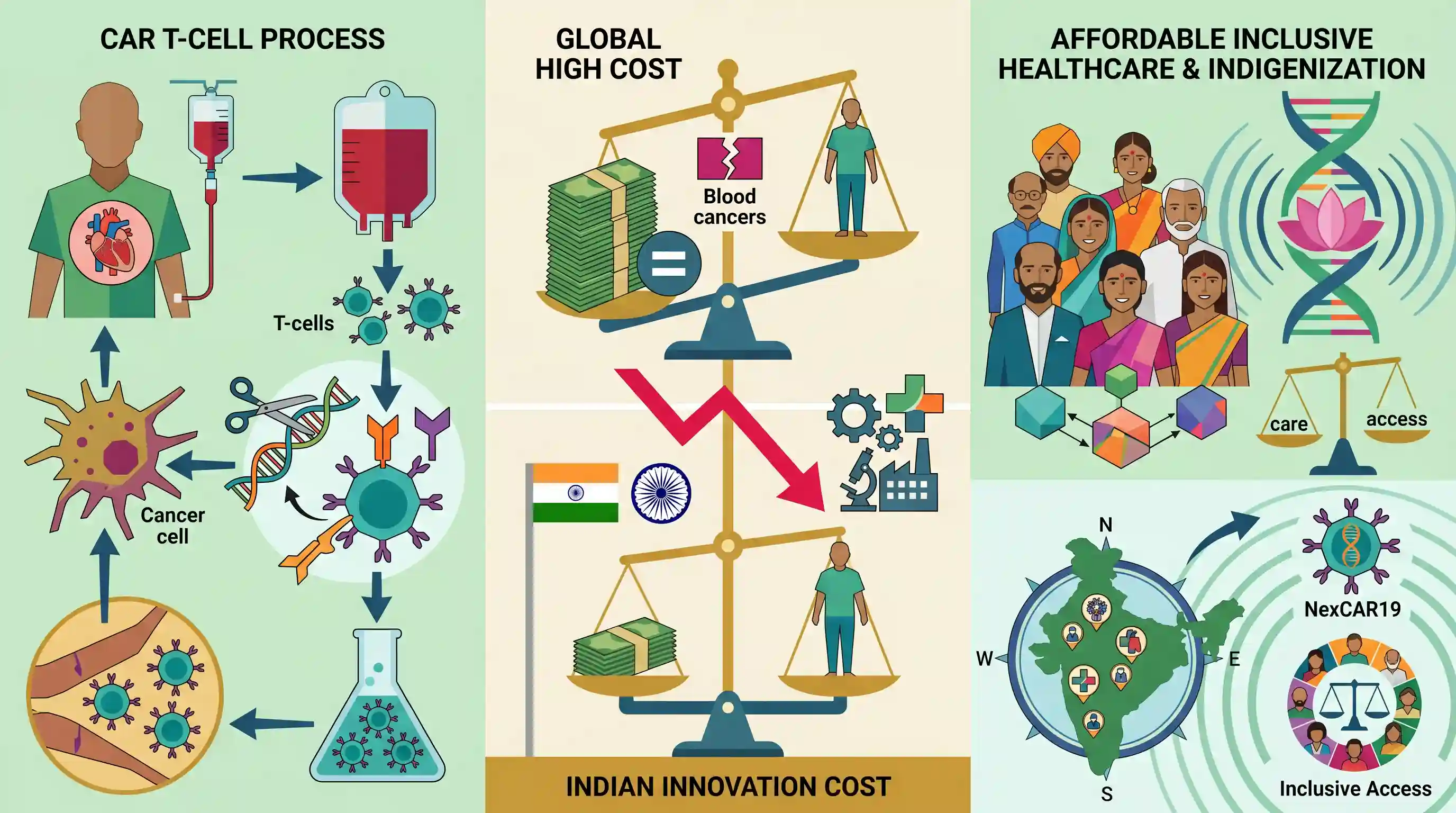
CAR T-cell therapy represents a paradigm shift toward personalized medicine and advanced biotechnology in oncology. The indigenous development of NexCAR19 serves as a classic case study of 'Make in India' in the health sector, bridging the gap between cutting-edge scientific research and accessible, affordable healthcare for the wider population.
Summary
The article highlights the transformative potential of Chimeric Antigen Receptor (CAR) T-cell therapy in cancer treatment. This advanced form of immunotherapy involves extracting a patient’s immune T-cells, genetically engineering them to recognize and attack specific cancer antigens, and infusing them back into the body. While highly effective for certain blood cancers (leukemia and lymphoma), its widespread adoption globally has been hindered by exorbitant costs. However, India's recent development of its first indigenous CAR T-cell therapy, NexCAR19, by ImmunoACT, IIT Bombay, and Tata Memorial Hospital, has drastically reduced the cost from over ₹3-4 crore to approximately ₹40 lakh. This indigenous innovation offers renewed hope for affordable, personalized cancer care and demonstrates India's growing prowess in advanced applied biotechnology.
Key Points
- CAR T-cell therapy is a revolutionary immunotherapy that extracts a patient's own T-cells and genetically modifies them in a lab to target and destroy specific cancer cells.
- The therapy has shown remarkable efficacy in treating blood cancers, such as leukemia and lymphoma, especially when conventional treatments like chemotherapy or radiation fail.
- India has approved its first indigenous CAR T-cell therapy, NexCAR19, developed collaboratively by IIT Bombay, Tata Memorial Centre, and ImmunoACT.
- The indigenous development has drastically slashed the treatment cost from ₹3-4 crore (for imported therapies) to around ₹40 lakh, greatly improving accessibility for Indian patients.
- This breakthrough signifies a major milestone in India's biotechnology sector, advancing the goal of self-reliance (Atmanirbhar Bharat) in cutting-edge, personalized medical treatments.
Important Terms
CAR T-cell therapy

An immunotherapy where a patient’s T-cells are genetically engineered to produce Chimeric Antigen Receptors (CARs), enabling them to identify and destroy specific cancer cells.
UPSC context
GS Paper III (Science & Technology); tests knowledge of advanced biotechnology and gene-based medical interventions.
NexCAR19
India’s first indigenously developed CAR T-cell therapy targeting B-cell lymphomas and leukemia, significantly reducing treatment costs compared to global alternatives.
UPSC context
GS Paper III (Indigenization of Technology); tests awareness of indigenous innovation in critical healthcare sectors.
Central Drugs Standard Control Organisation (CDSCO)
India’s national drug regulatory body under the Ministry of Health & Family Welfare, responsible for approving new drugs and overseeing clinical trials.
UPSC context
GS Paper II (Regulatory Bodies); tests knowledge of the statutory framework governing pharmaceutical safety and health.
ImmunoACT
An IIT Bombay-incubated startup and industry partner that led the development and commercialization of NexCAR19, India's first indigenous cell therapy platform.
UPSC context
GS Paper III (S&T); highlights the role of academic spin-offs and industry-academia collaboration in biotechnology.
Tata Memorial Hospital (TMH)
A premier national cancer treatment and research center under the Department of Atomic Energy, essential in clinical trials and affordable cancer care in India.
UPSC context
GS Paper II (Health); tests knowledge of national institutions providing specialized healthcare and public-sector research.
IIT Bombay
A leading Indian technical institute whose Biosciences & Bioengineering department provided the research foundation and incubation for India's first indigenous CAR T-cell therapy.
UPSC context
GS Paper III (S&T); emphasizes the importance of premier educational institutions in driving national technological breakthroughs.
Prelims Trap
"CAR-T cell therapy is a highly effective and approved treatment for all types of solid tumors."
While highly successful for blood cancers (leukemias and lymphomas), CAR-T therapy currently struggles against solid tumors (like lung or breast cancer) due to hostile tumor microenvironments.
Static Concepts Connected
What is the role of T-cells in the human immune system?
- Origin & Maturation: T-cells are a type of white blood cell (lymphocyte) that originate in the bone marrow and mature in the thymus gland.
- Cytotoxic (Killer) T-cells: They directly attack and destroy infected cells or cancer cells by releasing cytotoxins. CAR-T therapy modifies these specific cells.
- Helper T-cells: They do not kill cells directly but coordinate the immune response by releasing cytokines to activate other immune cells.
How does Immunotherapy fundamentally differ from traditional Chemotherapy?
- Mechanism: Immunotherapy trains or boosts the body's own immune system to detect and destroy cancer cells (e.g., CAR-T, immune checkpoint inhibitors).
- Specificity: Chemotherapy uses toxic drugs to kill fast-growing cells, which indiscriminately damages both cancer cells and healthy cells (like hair follicles and gut lining).
Cross-Topic Patterns
Indigenous Biotech & Import Substitution
NexCAR19 joins Cervavac (HPV) and Gemocovac (mRNA) as prime examples of import substitution in high-end biotechnology, reflecting the shift from generic drug manufacturing to novel therapeutics.
Healthcare Access vs. Patent Monopolies
The drastic cost reduction (₹4 crore to ₹40 lakh) highlights the recurring global tension between prohibitive IP/patent regimes and the need for affordable healthcare access in developing nations.

Expect a 2026 multi-statement question contrasting CAR-T therapy with CRISPR or stem cells, focusing on autologous vs allogeneic methods.
Linked PYQs · 4
Linked PYQs · 4
- 2022PrelimsGS1
Which one of the following statements best describes the role of B cells and T cells in the human body?
- 2021MainsGS3
What are the research and developmental achievements in applied biotechnology? How will these achievements help to uplift the poorer sections of the society?
- 2017MainsGS3
Stem cell therapy is gaining popularity in India to treat a wide variety of medical conditions including Leukaemia, Thalassemia, damaged cornea and severe burns. Describe briefly what stem cell therapy is and what advantages it has over other treatments?
- 2019PrelimsGS1
'RNA interference (RNAi)' technology has gained popularity in the last few years. Why? 1. It is used in developing gene silencing therapies. 2. It can be used in developing therapies for the treatment of cancer. 3. It can be used to develop hormone replacement therapies. 4. It can be used to produce crop plants that are resistant to viral pathogens. Select the correct answer using the code given below.
