Secondary Particulates and Agricultural Ammonia in Delhi Smog
Source:The Hindu ↗
Why It Matters
The article highlights a crucial shift in understanding Delhi's pollution crisis by emphasizing secondary particulates. This requires aspirants to understand the chemical formation of pollutants (PM2.5, sulfates, nitrates) and the unexpected linkage between agricultural practices (ammonia emissions) and urban air quality.
Summary
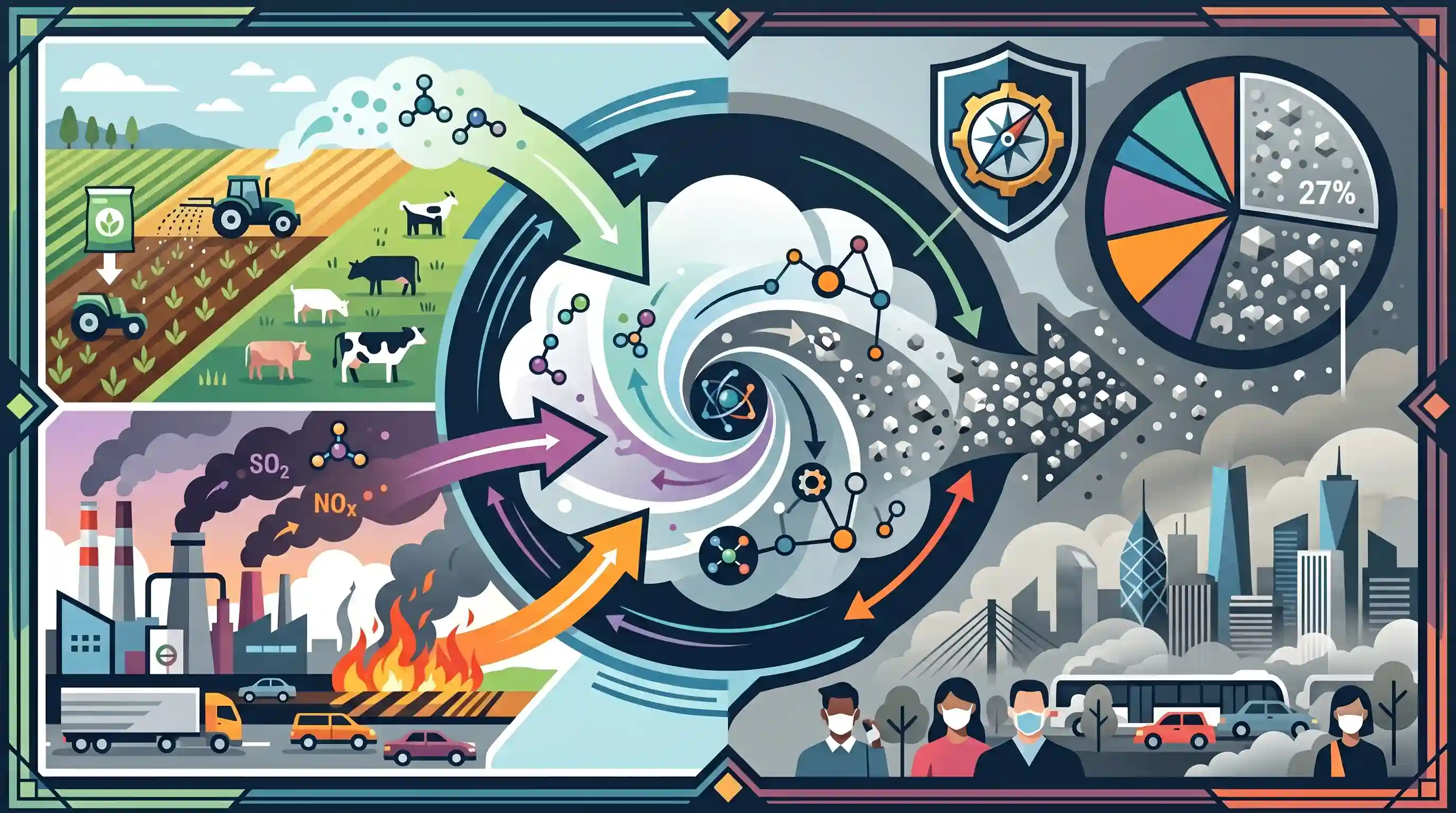
A recent report by the Commission for Air Quality Management (CAQM) identifies 'secondary particulate matter' as the top contributor (27%) to Delhi's winter air pollution, surpassing primary sources like transport and biomass burning. Secondary particulates form when primary emissions like sulfur dioxide and nitrogen oxides chemically react with atmospheric ammonia, largely originating from agricultural fertilizers and livestock. This shifts the focus of air quality management from solely curbing direct emissions to understanding and mitigating complex atmospheric chemistry, establishing a clear link between agricultural ammonia emissions and urban PM2.5 levels.
Key Points
- A CAQM meta-analysis reveals that secondary particulate matter is the leading cause of winter pollution in Delhi, contributing 27% to the overall pollution load.
- Secondary particulates are formed in the atmosphere when primary gaseous pollutants (like SO2 and NOx) interact with ammonia (NH3) to form aerosols such as ammonium sulfate and ammonium nitrate.
- The report marks a paradigm shift, placing secondary PM ahead of primary sources like vehicular emissions (23%), biomass burning (20%), dust (15%), and industry (9%).
- India is a major global emitter of ammonia, primarily due to synthetic fertilizers and livestock excreta, directly linking agricultural practices to urban air pollution.
- These secondary aerosols can constitute up to 25-60% of PM2.5 mass, deeply penetrating human lungs and posing severe health risks.
Important Terms
Commission for Air Quality Management (CAQM)

A statutory body established in 2021 to coordinate and oversee air quality management in the National Capital Region (NCR) and adjoining states, replacing the earlier Environment Pollution (Prevention and Control) Authority (EPCA).
UPSC context
GS Paper III (Environment); key for institutional frameworks and executive measures to tackle Delhi-NCR smog.
Secondary Particulate Matter
Fine particles formed in the atmosphere through chemical reactions between gases like SO2, NOx, and ammonia, rather than being emitted directly from sources like exhausts or chimneys.
UPSC context
GS Paper III (Environment); essential for understanding complex pollution sources beyond visible smoke and dust.
PM2.5
Fine inhalable particles with diameters of 2.5 micrometers or smaller. They can reach deep into the lungs and bloodstream, posing the highest risk to respiratory and cardiovascular health.
UPSC context
GS Paper III (Environment); a critical parameter in the National Air Quality Index (AQI).
Atmospheric Ammonia (NH3)
A gaseous pollutant primarily originating from agricultural fertilizers and livestock waste. In the atmosphere, it acts as a precursor by reacting with acidic gases to form secondary aerosols.
UPSC context
GS Paper III (Agriculture & Environment); links agricultural practices to urban air quality challenges.
Source Apportionment
A scientific methodology used to determine the specific contributions of various pollution sources (e.g., transport, biomass, industry) to the total pollutant concentration in a given area.
UPSC context
GS Paper III (Environment); vital for data-driven policy making and targeted pollution control measures.
Precursor Gases
Primary gases such as Sulfur Dioxide (SO2) and Nitrogen Oxides (NOx) that undergo chemical transformations in the air to produce secondary pollutants like ozone or secondary particulates.
UPSC context
GS Paper III (Environment); highlights the need for a comprehensive "airshed" approach to pollution management.
Prelims Trap
PM2.5 is primarily a direct emission, and secondary pollutants require sunlight to form.
Secondary PM2.5 (ammonium sulfate/nitrate) forms rapidly in cold, sunless winter conditions when industrial SO2/NOx react with agricultural ammonia.
Static Concepts Connected
What differentiates Primary vs Secondary air pollutants?
- Primary pollutants: Emitted directly from a specific source into the atmosphere (e.g., CO, SO2, NOx, direct PM from vehicular exhaust or crop burning).
- Secondary pollutants: Not directly emitted; form via chemical reactions among primary precursors in the atmosphere (e.g., Ground-level Ozone, PAN, secondary PM2.5).
What are the core powers and jurisdiction of the CAQM?
- Statutory backing: Established via the CAQM Act 2021, subsuming the EPCA to provide a unified approach for Delhi and adjoining NCR states.
- Overriding authority: Its orders legally prevail over the respective state pollution control boards of Delhi, Punjab, Haryana, Rajasthan, and Uttar Pradesh.
- Enforcement powers: Empowered to restrict polluting industries, shut down plants, and impose severe penalties for environmental non-compliance.
Cross-Topic Patterns
Fertilizer subsidies & urban smog
Heavy subsidization of urea leads to over-application, increasing ammonia volatilization which drifts to urban centers and creates secondary PM2.5 aerosols.
Cold weather atmospheric chemistry
Unlike summer photochemical smog requiring UV light, Delhi's winter secondary aerosols (ammonium nitrate/sulfate) thrive in cold, stagnant, and humid meteorological conditions.

Expect a 2026 prelims question linking urea subsidies, ammonia volatilization, and secondary PM2.5 formation during Delhi winters.
Linked PYQs · 3
Linked PYQs · 3
- 2019PrelimsGS1
Consider the following statements: 1. Agricultural soils release nitrogen oxides into environment. 2. Cattle release ammonia into environment. 3. Poultry industry releases reactive nitrogen compounds into environment. Which of the statements given above is/are correct?
- 2022MainsGS3
Discuss in detail the photochemical smog emphasizing its formation, effects and mitigation. Explain the 1999 Gothenburg Protocol.
- 2022PrelimsGS1
In the context of WHO Air Quality Guidelines, consider the following statements: 1. The 24-hour mean of PM2.5 should not exceed 15 µg/m³ and annual mean of PM2.5 should not exceed 5 µg/m³. 2. In a year, the highest levels of ozone pollution occur during the periods of inclement weather. 3. PM10 can penetrate the lung barrier and enter the bloodstream. 4. Excessive ozone in the air can trigger asthma. Which of the statements given above are correct?
