Molecular Thermal Storage Offers Emission Free Solar Energy
Source:The Hindu ↗
Why It Matters
Overcoming the intermittency of renewable energy is a critical hurdle in the global transition away from fossil fuels. Understanding novel storage solutions like MOST is important for UPSC aspirants as it bridges basic chemistry (isomerisation, chemical bonds) with applied environmental technology and India's long-term decarbonization goals.
Summary
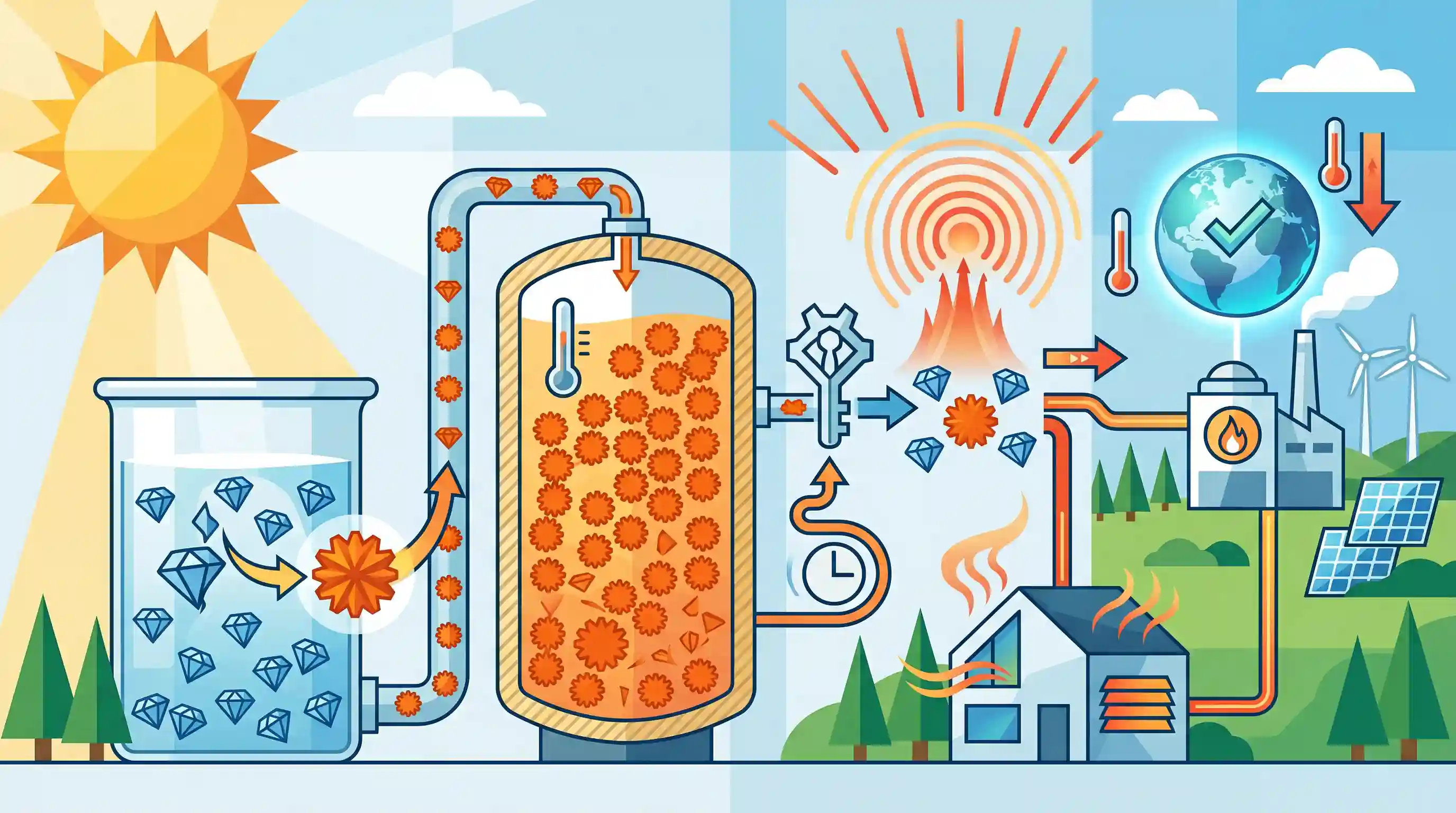
The article discusses an innovative technology known as Molecular Solar Thermal (MOST) energy storage, which captures and stores solar energy in the form of chemical bonds. By exposing specially designed liquid molecules to sunlight, the molecules change their structural shape into an energy-rich isomer. This allows solar energy to be stored indefinitely at room temperature without the degradation or self-discharge seen in conventional batteries. When energy is required, a catalyst is used to revert the molecule to its original state, releasing the stored energy as heat. This closed-loop, emission-free technology addresses the intermittent nature of solar power and holds massive potential for decarbonizing residential and industrial heating.
Key Points
- The article highlights a breakthrough in energy storage, commonly referred to as Molecular Solar Thermal (MOST) energy storage systems, which conceptually capture \'sunlight in a bottle\'.
- Unlike traditional solar panels that convert sunlight into electricity, MOST uses specialized photosensitive liquid molecules that undergo a structural change (isomerisation) when exposed to solar radiation, trapping the energy in chemical bonds.
- This energy-rich isomer can be stored at room temperature for extended periods (potentially up to 18 years) without significant energy loss, solving the self-discharge issues of conventional batteries.
- When heat is needed, the liquid is passed through a specialized catalyst that triggers the molecule to return to its original state, releasing the stored energy as usable heat with zero greenhouse gas emissions.
- The technology presents a highly sustainable, closed-loop solution for the intermittency of solar energy, with future applications ranging from residential space heating to industrial processes.
Prelims Trap
"MOST systems convert sunlight directly into electricity, or store it physically as thermal heat for long durations."
MOST does NOT generate electricity directly, nor does it store energy as physical heat. It stores energy purely in chemical bonds (as an isomer), releasing it as heat later.
Static Concepts Connected
What are isomers and the process of isomerisation?
- Definition: Molecules that share the same chemical formula but have completely different structural arrangements of atoms.
- Varying Energy States: The structural rearrangement alters the molecule's physical and chemical properties, allowing it to exist in higher or lower energy states.
- Applications: Historically vital in petrochemicals (fuel refining) and pharmacology, now being leveraged to trap solar energy via light-induced structural shifts.
How do thermal, chemical, and electrochemical energy storage fundamentally differ?
- Electrochemical Storage: Like Li-ion batteries, store energy via reversible chemical reactions that release and absorb electrons to generate electricity.
- Thermal Storage: Like molten salt in Concentrated Solar Power (CSP), store energy directly by capturing physical heat (sensible or latent heat).
- Thermochemical Storage: Like MOST, capture energy by altering chemical bonds without immediately changing temperature, releasing the stored energy later upon catalysis.
Cross-Topic Patterns
Overcoming Critical Mineral Dependency
MOST offers a chemical-structural alternative to Li-ion batteries, helping bypass geopolitical bottlenecks tied to the Quad and China's dominance over lithium, cobalt, and nickel supply chains.
Green heat for hard-to-abate sectors
While PV solar solves electricity decarbonization, industrial manufacturing requires massive thermal energy. MOST directly supplies zero-emission heat, targeting 'hard-to-abate' sectors like cement and metallurgy.

Expect a 2026 S&T question contrasting MOST with PV cells and Li-ion batteries, focusing on 'isomerisation' and chemical bond storage.
Linked PYQs · 3
Linked PYQs · 3
- 2024PrelimsGS1
Recently, the term "pumped-storage hydropower" is actually and appropriately discussed in the context of which one of the following?
- 2020MainsGS3
Describe the benefits of deriving electric energy from sunlight in contrast to the conventional energy generation. What are the initiatives offered by our Government for this purpose?
- 2014PrelimsGS1
Which one of the following is the process involved in photosynthesis?
