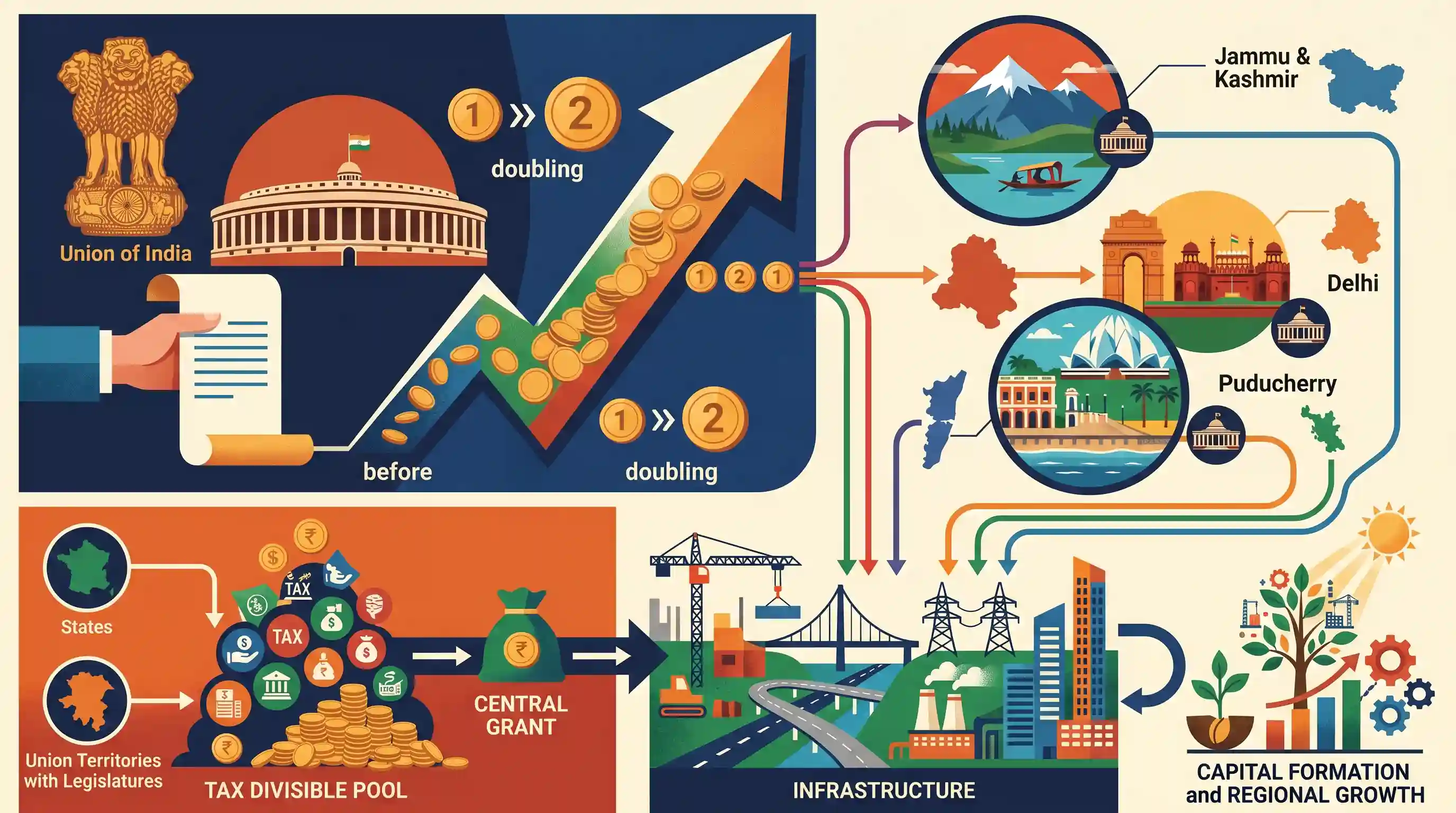
विधानमण्डल वाले केन्द्रशासित प्रदेशों के लिए केपिटल ट्रांसफर दुगुने किए गए
स्रोत:इंडियन एक्सप्रेस ↗
क्यों मायने रखता है
It highlights the financial dependency of UTs on the Centre (as they fall outside standard Finance Commission devolution) and underscores the government's push for infrastructure-led growth through targeted capital expenditure.
सारांश
The Union Budget has more than doubled the capital transfers to three Union Territories with legislatures—Delhi, Puducherry, and Jammu & Kashmir. This substantial increase is aimed at boosting infrastructure development and capital expenditure in these regions. Since UTs do not receive a share of the central tax divisible pool under Finance Commission recommendations, they depend on central grants to fund their development projects. This move underscores the Centre's strategy to spur regional growth through capital formation while highlighting the unique fiscal and administrative relationship between the Union government and UTs with legislative assemblies.
मुख्य बिंदु
- Capital transfers from the Centre to three Union Territories with legislatures (Delhi, Puducherry, and J&K) have been more than doubled to accelerate infrastructure development.
- Unlike full states, UTs are excluded from the divisible pool of central taxes recommended by the Finance Commission, making them heavily reliant on direct Union Budget grants.
- The increased allocation aligns with the central government's macroeconomic strategy of prioritizing capital expenditure (capex) and asset creation over revenue expenditure.
- This development brings attention to the unique fiscal and administrative relationship between the Union Government and UTs under Articles 239A and 239AA.
महत्वपूर्ण शब्द
Union Budget

Under Article 112, the 'Annual Financial Statement' detailing the government's estimated receipts and expenditure for a financial year. It serves as a roadmap for fiscal policy and resource allocation.
UPSC context
GS Paper 3 (Economy). Tests understanding of fiscal policy, deficit management, and government priorities like infrastructure and regional development.
Union Government
The national authority of India, also called the Central Government. Legally the 'Union of India' (Article 300), it administers the country and directly governs Union Territories through appointed administrators.
UPSC context
GS Paper 2 (Polity). Tests knowledge of federal structure, Union-State relations, and the administrative setup of Union Territories.
Ministry of Finance
भारत की अर्थव्यवस्था, कराधान और वित्तीय विधानों का प्रबंधन करने वाला एक प्रमुख मंत्रालय। इसका आर्थिक कार्य विभाग केंद्रीय बजट तैयार करता है और राज्यों तथा केंद्र शासित प्रदेशों को होने वाले वित्तीय हस्तांतरण का प्रबंधन करता है।
UPSC context
GS Paper 3 (Economy). Tests understanding of institutional roles in budget preparation, fiscal management, and inter-governmental financial transfers.
Finance Commission
A constitutional body (Article 280) that recommends the distribution of tax revenues between the Centre and States. It addresses vertical and horizontal fiscal imbalances in India's federal structure.
UPSC context
GS Paper 2 (Polity/Federalism). Tests understanding of fiscal federalism, revenue devolution, and the distinction between States and Union Territories.
प्रारंभिक ट्रैप
Like full states, UTs with legislative assemblies receive a mandated share of the central tax divisible pool.
UTs are completely excluded from the divisible pool under Article 270. Even those with legislatures (Delhi, J&K, Puducherry) depend entirely on direct grants from the Union Budget.
संबंधित अवधारणाएँ
Why are Union Territories excluded from the Finance Commission's divisible pool?
- Article 270: Under Article 270 of the Constitution, the divisible pool only mandates tax distribution between the Union and full States, structurally omitting UTs.
- Direct Budget Dependency: Since UTs are centrally administered, their financial requirements—including capital expenditure—are met directly through Union Budget allocations and grants, rather than constitutional devolution.
How does Delhi's constitutional status differ from J&K and Puducherry?
- Article 239AA vs 239A: Delhi is uniquely governed by Article 239AA (added by 69th Amendment), while Puducherry and Jammu & Kashmir derive their legislative powers from Article 239A.
- Exempted Subjects: The Delhi assembly is explicitly barred from legislating on Public Order, Police, and Land (State List subjects), cementing stricter Central control than a standard state.
अंतर-विषय पैटर्न
FC Devolution & J&K Reorganization
The reorganization of J&K from a state to a UT directly reduced the vertical tax devolution share from 42% to 41% to accommodate the Union's new financial burden.
Capex Push & Fiscal Federalism
Tying fund transfers to capital expenditure rather than revenue grants reflects the Centre's strategy to enforce long-term asset creation over populist day-to-day spending in state/UT administrations.

A multi-statement 2026 question on the 16th Finance Commission will likely feature a trap claiming UTs with legislatures get tax devolution.
संबद्ध PYQ · 4
संबद्ध PYQ · 4
- 2024MainsGS2
What changes has the Union Government recently introduced in the domain of Centre-State relations ? Suggest measures to be adopted to build the trust between the Centre and the States and for strengthening federalism.
- 2025MainsGS2
Examine the evolving pattern of Centre-State financial relations in the context of planned development in India. How far have the recent reforms impacted the fiscal federalism in India?
- 2021MainsGS3
Distinguish between Capital Budget and Revenue Budget. Explain the components of both these Budgets.
- 2020MainsGS3
Explain the meaning of investment in an economy in terms of capital formation. Discuss the factors to be considered while designing a concession agreement between a public entity and a private entity.
