Centre Chandigarh Land Allotment Triggers Punjab Opposition
Source:Indian Express ↗
Why It Matters
The Chandigarh dispute is a classic case study of unresolved inter-state boundaries and capital-sharing issues stemming from state reorganization. It is highly relevant for GS2 questions on federalism, the role of the Centre in Union Territories, and political frictions between national and regional parties.
Summary
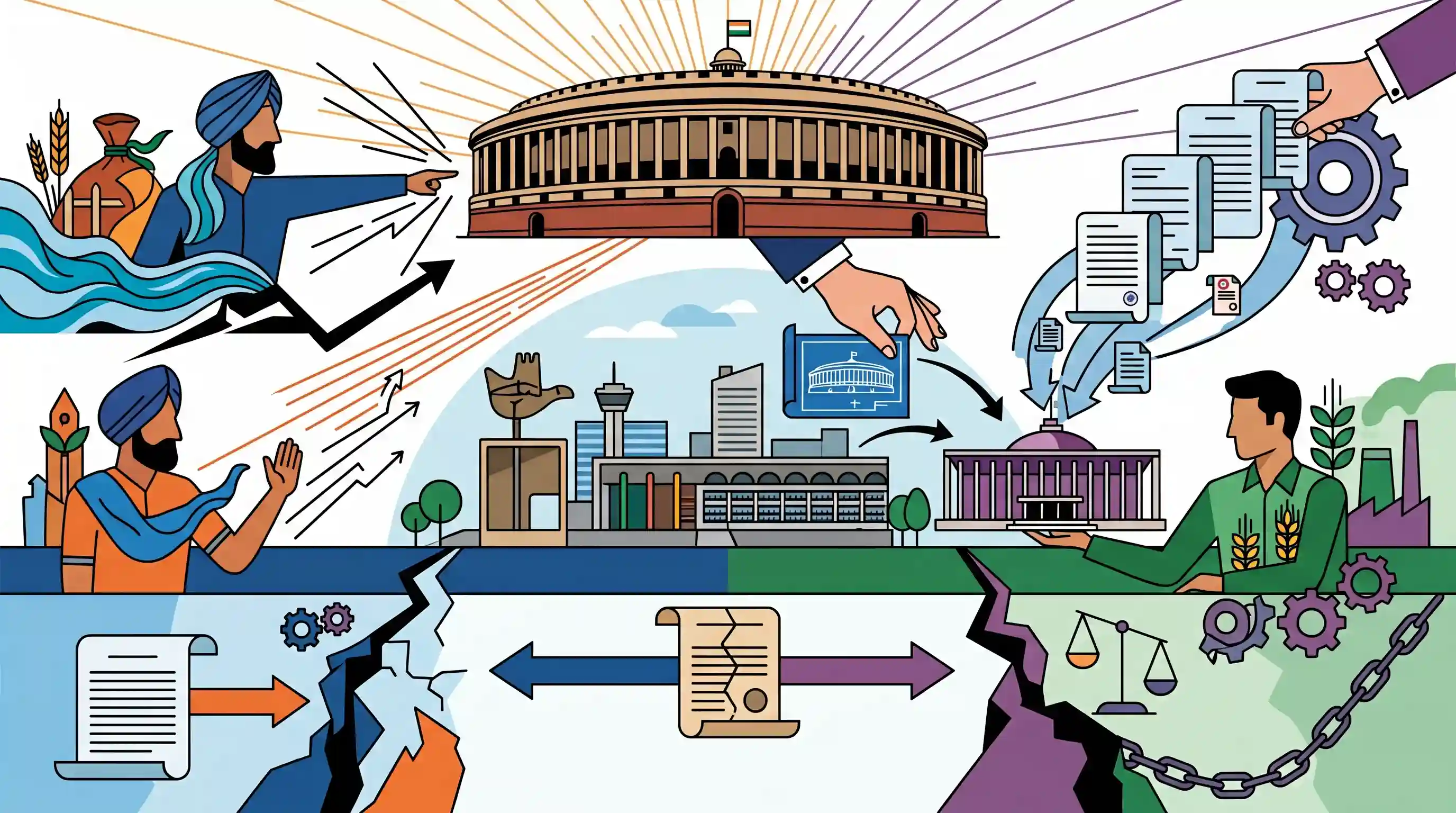
The article examines the escalating tensions between Punjab and the Centre over the status of Chandigarh, which serves as the joint capital of Punjab and Haryana. The immediate trigger is the Centre's clearance of land allotment to Haryana for building its own legislative assembly in Chandigarh. Punjab views this, alongside the earlier implementation of central service rules for UT employees, as a systematic dilution of its rightful claim over the city established during the state's reorganization in 1966. The ongoing dispute sheds light on the complex federal dynamics, inter-state rivalries, and the friction in Centre-State relations when administering a shared Union Territory.
Key Points
- The Union Government's decision to clear land allotment for Haryana to construct a separate Vidhan Sabha building in Chandigarh has triggered strong objections from Punjab.
- Punjab historically claims exclusive rights over Chandigarh, arguing that allocating land to Haryana dilutes this claim and violates the spirit of the Punjab Reorganisation Act, 1966.
- Recent moves by the Centre, including the imposition of central service rules for Chandigarh Union Territory employees, are perceived by Punjab as an erosion of its stake in the joint capital.
- The issue underscores deepening fault lines in federalism, highlighting the friction between a regional party-led state government and the Centre over inter-state disputes and Union Territory administration.
Important Terms
Punjab Reorganisation Act, 1966

1966 legislation that bifurcated the former State of Punjab into Punjab and Haryana on linguistic lines and created Chandigarh as a Union Territory serving as their joint capital.
UPSC context
GS-II (Polity/Federalism). Tests knowledge of historical state reorganization and subsequent inter-state boundary disputes.
Central Civil Services Rules
Service regulations for central employees; their 2022 extension to Chandigarh UT (replacing Punjab rules) is viewed as diluting Punjab's administrative link to the city.
UPSC context
GS-II (Governance/Civil Services). Tests understanding of administrative changes in Union Territories and federal friction.
Union Government
The supreme executive authority of India; in this context, it manages Chandigarh via an Administrator and acts as a mediator in Punjab-Haryana territorial disputes.
UPSC context
GS-II (Polity). Tests the constitutional role of the Centre in administering UTs and resolving inter-state conflicts.
Haryana Vidhan Sabha
The legislative body of Haryana, currently seeking land in Chandigarh for an additional complex, a move Punjab claims violates the 1966 Act's temporary capital arrangement.
UPSC context
GS-II (State Legislatures). Relevant for understanding administrative logistics and territorial claims in shared capital cities.
Punjab Vidhan Sabha
The legislative body of Punjab, which has passed numerous resolutions asserting the state’s exclusive right to Chandigarh as its capital under historical and legal frameworks.
UPSC context
GS-II (State Legislatures). Highlights the role of state assemblies in asserting regional interests within the federal structure.
Prelims Trap
The Constitution mandates that the Governor of a state must ex-officio act as the Administrator of its adjoining shared Union Territory.
Article 239(2) empowers the President to appoint a Governor as the Administrator of an adjoining UT. It is a discretionary appointment, not a mandatory ex-officio requirement.
Static Concepts Connected
How is the administration of a Union Territory structured under Article 239?
- Presidential Rule: UTs are administered directly by the President of India, acting through an appointed Administrator.
- Adjoining Governors: Under Article 239(2), the President can optionally appoint the Governor of a state as the Administrator of an adjoining Union Territory.
- Independent Functions: When functioning as a UT Administrator, a Governor exercises these administrative duties independently of their state's Council of Ministers.
What are the primary mechanisms for resolving inter-state disputes in India?
- Original Jurisdiction: Article 131 empowers the Supreme Court to exclusively adjudicate disputes between the Centre and States or between two or more States.
- Inter-State Council: Article 263 allows the President to establish a constitutional body to investigate, discuss, and advise on disputes between states.
- Zonal Councils: Statutory bodies established under the States Reorganisation Act, 1956, chaired by the Union Home Minister, designed to promote cooperative federalism and resolve regional conflicts.
Cross-Topic Patterns
UT autonomy vs. Central control
The Chandigarh friction mirrors the GNCTD vs Centre tussle in Delhi, highlighting a broader UPSC theme: the constitutional grey area in administering UTs with overlapping state political interests.
Unresolved legacies of State Reorganisation
The 1966 Punjab Reorganisation Act resolved linguistic divides but left geographical (Chandigarh) and resource (SYL canal) disputes open. UPSC frequently tests the historical downstream consequences of the Reorganisation Acts.

Expect a 2026 multi-statement Prelims question comparing Zonal Councils (statutory) with the Inter-State Council (constitutional).
Linked PYQs · 4
Linked PYQs · 4
- 2024MainsGS2
What changes has the Union Government recently introduced in the domain of Centre-State relations ? Suggest measures to be adopted to build the trust between the Centre and the States and for strengthening federalism.
- 2022MainsGS2
“While the national political parties in India favour centralisation, the regional parties are in favour of State autonomy.” Comment.
- 2025PrelimsGS1
With reference to India, consider the following: I. The Inter-State Council II. The National Security Council III. Zonal Councils How many of the above were established as per the provisions of the Constitution of India?
- 2016MainsGS2
Discuss the essentials of the 69th Constitutional Amendment Act and anomalies, if any, that have led to recent reported conflicts between the elected representatives and the institution of the Lieutenant Governor in the administration of Delhi. Do you think that this will give rise to a new trend in the functioning of the Indian federal politics?
