Central Armed Police Forces Bill and Federal Structure Debates
Source:Indian Express ↗
Why It Matters
Highlights the constitutional tension that arises when legislative frameworks are introduced to bypass judicial verdicts. It also underscores critical issues in internal security management, specifically the leadership structure, promotional bottlenecks, and morale of the Central Armed Police Forces.
Summary
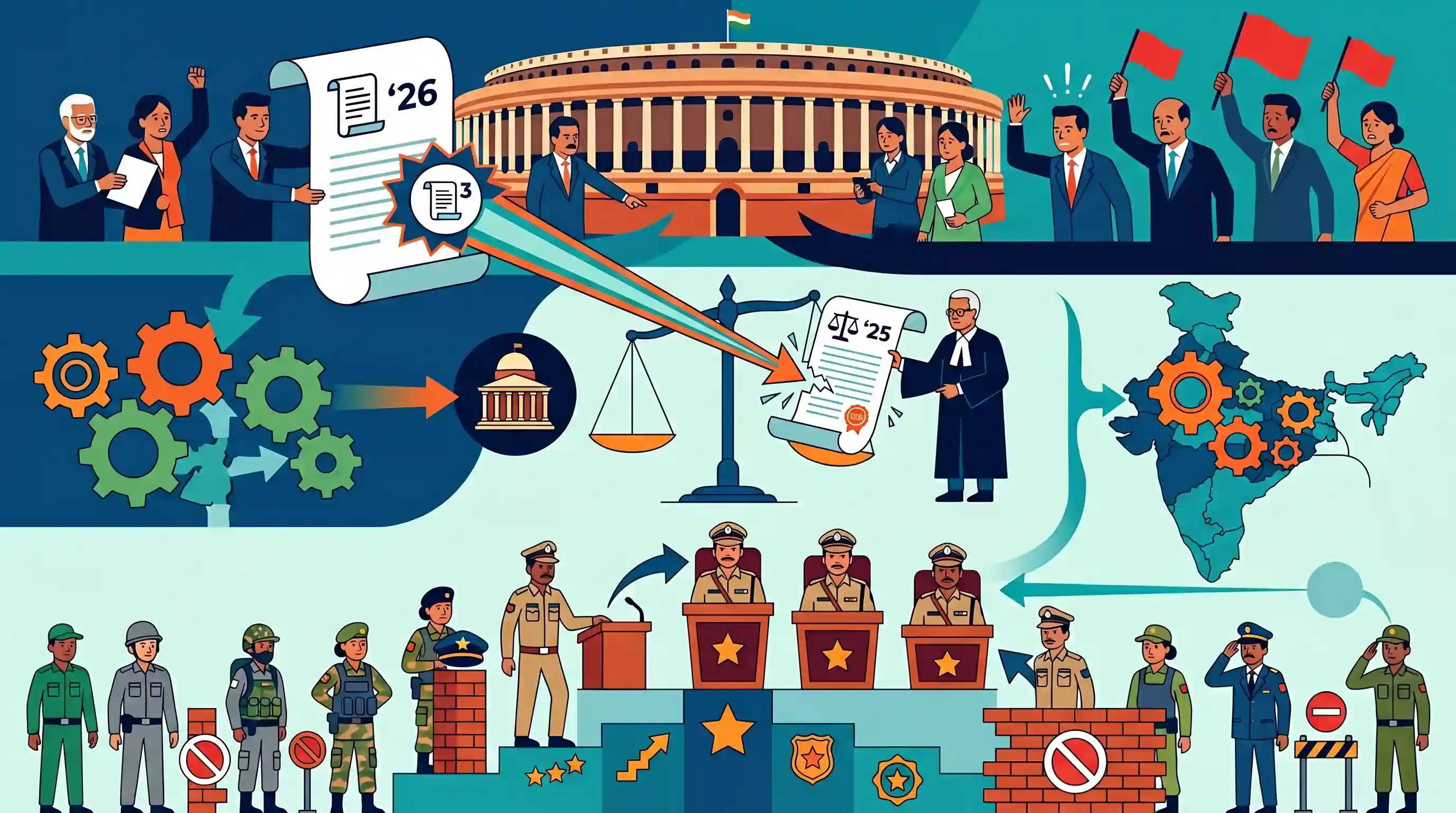
The Central Armed Police Forces (General Administration) Bill, 2026, faced strong opposition in the Rajya Sabha over concerns that it undermines the legislature, ignores the judiciary, and violates the constitutional federal structure. The Bill seeks to heavily earmark top CAPF positions—up to 100% of DG and Special DG posts—for IPS officers on deputation. Critics argue this move effectively nullifies a 2025 Supreme Court directive that ordered the government to phase out such deputations and conduct a cadre review. Opposition MPs emphasized that the Bill unfairly hinders the career progression and morale of dedicated CAPF personnel, while also raising constitutional alarms over Clause 3, which allegedly grants the Centre sweeping rule-making powers to negate judicial mandates.
Key Points
- The CAPF (General Administration) Bill, 2026 mandates filling 50% of IG, 67% of ADG, and all Special DG/DG posts with IPS officers on deputation.
- The Opposition claims the Bill nullifies a May 2025 Supreme Court order that required the government to reduce IPS deputation quotas and review the CAPF cadre.
- Critics argue the Bill severely impacts the morale and career progression of CAPF personnel, who face much slower promotion rates compared to IPS officers.
- The legislative move sparked constitutional debates over the separation of powers, with MPs arguing that it bypasses judicial review through broad executive rule-making powers (Clause 3).
Important Terms
Central Armed Police Forces (CAPF)

Umbrella term for India's internal security forces (e.g., CRPF, BSF, CISF) under the Ministry of Home Affairs, primarily responsible for border guarding and assisting states in law and order.
UPSC context
GS Paper III: Internal Security; essential for understanding the management and morale of India's primary domestic security apparatus.
Central Armed Police Forces (General Administration) Bill, 2026
A 2026 legislation aimed at unifying service rules across different CAPFs while formalizing high-level leadership reservations for IPS officers, sparking concerns over legislative-judicial friction.
UPSC context
GS Paper II: Governance/Legislative Process; tests knowledge of recent security reforms and their impact on institutional autonomy.
Organised Group ‘A’ Service (OGAS)
A civil service classification that ensures structured career progression, periodic cadre reviews, and non-functional financial upgrades; granted to CAPF cadre officers by the Supreme Court to reduce stagnation.
UPSC context
GS Paper II: Civil Services; vital for questions on service reforms, parity among services, and administrative stagnation.
IPS Deputation
The practice of appointing All India Service (IPS) officers to senior leadership roles in CAPFs, often leading to promotional bottlenecks for internal cadre officers.
UPSC context
GS Paper III: Security Forces; relates to the command structure and leadership conflicts within paramilitary organizations.
Separation of Powers
A constitutional principle ensuring the Executive, Legislature, and Judiciary operate within their own domains; relevant when laws are perceived as bypassing specific judicial mandates.
UPSC context
GS Paper II: Constitution/Polity; a core concept frequently tested regarding institutional checks and balances.
Federal Structure
The division of powers between the Union and States; in this context, it involves the Centre's control over forces deployed within state jurisdictions.
UPSC context
GS Paper II: Polity; key for analyzing Union-State relations and the constitutional validity of central legislations.
Prelims Trap
"CAPF officers belong to the All India Services created under Article 312 of the Constitution."
CAPF officers are Organised Group 'A' Central Services. Only IAS, IPS, and IFoS are All India Services. The friction stems precisely from IPS (AIS) officers occupying apex posts in Central Services.
Static Concepts Connected
How can Parliament legally override a Supreme Court judgment?
- Altering the basis: Parliament cannot merely declare a ruling invalid. It must prospectively or retrospectively enact legislation that changes the underlying legal basis upon which the Court delivered its judgment.
- Judicial Review: The overriding law cannot be arbitrary. It remains fully subject to judicial review and can be struck down if it violates fundamental rights or the Basic Structure doctrine.
What differentiates All India Services (IPS) from Central Armed Police Forces?
- Constitutional status: IPS is an All India Service under Article 312, serving both Centre and States. CAPF cadres are Organised Group 'A' Central Civil Services exclusively under the Union government.
- OGAS Status: Granting OGAS status to CAPFs ensures standardized promotions and Non-Functional Financial Upgradation (NFFU) to prevent career stagnation, a principle the SC recognized to protect CAPF morale.
Cross-Topic Patterns
Legislative overruling of judicial mandates
The CAPF Bill mirrors the CEC/EC Appointment Act, showing a repeated GS-2 pattern where Parliament enacts laws to alter or bypass specific Supreme Court directives on executive appointments.
CAPF cadre morale and Internal Security
Links GS-2 service rules with GS-3 internal security. Career stagnation and leadership disconnects in CAPFs directly impact operational efficiency in border management and anti-insurgency operations.

Mains 2026 will likely test the constitutional limits of legislative overruling, contrasting the CAPF Bill with Basic Structure limits.
Linked PYQs · 3
Linked PYQs · 3
- 2020MainsGS2
Judicial Legislation is antithetical to the doctrine of separation of powers as envisaged in the Indian Constitution. In this context justify the filing of large number of public interest petitions praying for issuing guidelines to executive authorities.
- 2020MainsGS3
Analyze internal security threats and transborder crimes along Myanmar, Bangladesh and Pakistan borders including Line of Control (LoC). Also discuss the role played by various security forces in this regard.
- 2024MainsGS2
What changes has the Union Government recently introduced in the domain of Centre-State relations ? Suggest measures to be adopted to build the trust between the Centre and the States and for strengthening federalism.
