Fiscal Prudence and Capital Expenditure Strategy in Union Budget
Source:The Hindu ↗
Why It Matters
Crucial for understanding India's macro-economic management, balancing public debt sustainability with growth-enhancing capital expenditure in infrastructure.
Summary
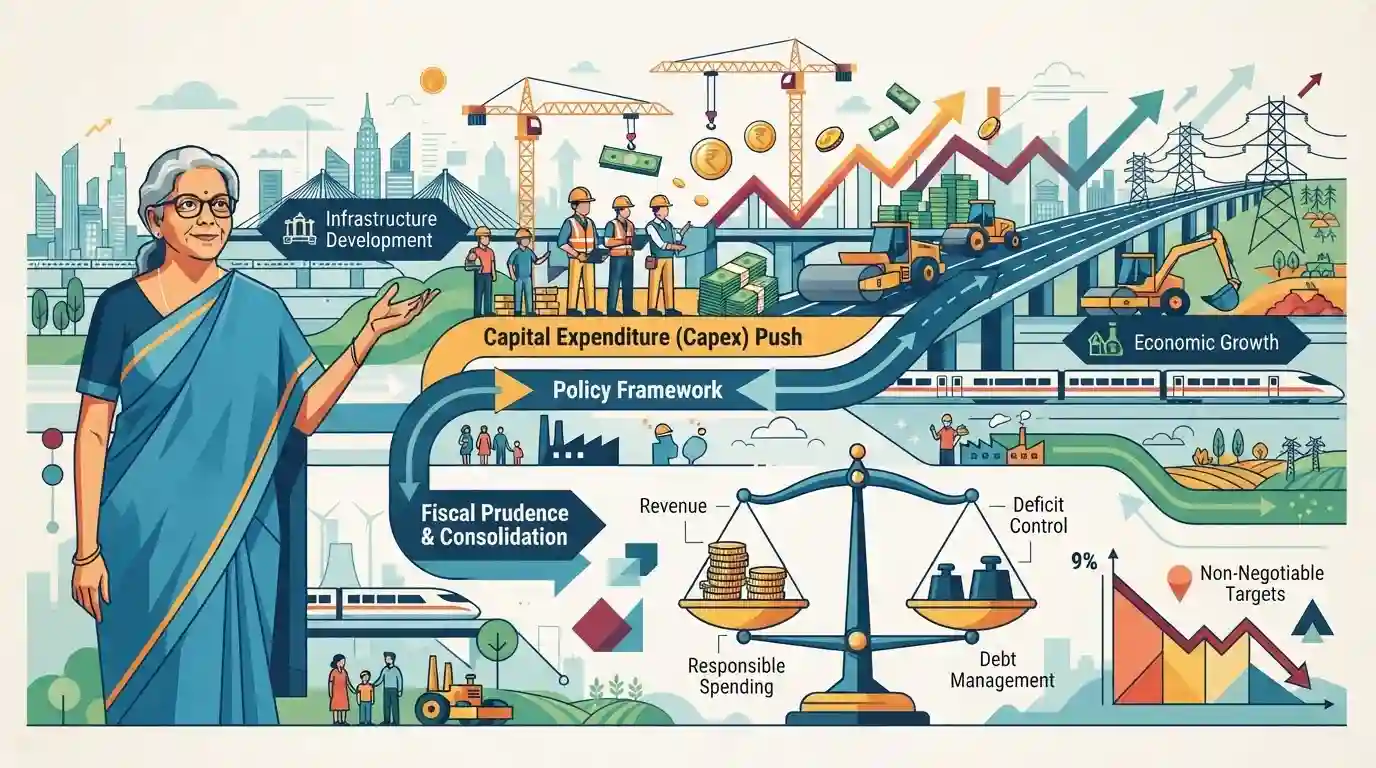
Union Finance Minister Nirmala Sitharaman highlighted that India's policy framework will continue its push towards capital expenditure (capex) to boost infrastructure and economic growth, while ensuring that fiscal prudence and consolidation targets remain non-negotiable.
Key Points
- The Finance Minister emphasized maintaining a balance between sustained capital expenditure (capex) push and strict fiscal prudence.
- Infrastructure spending remains a core driver for long-term economic growth and crowd-in private investments.
- Fiscal consolidation roadmap aims to lower fiscal deficits responsibly while keeping growth momentum intact.
Important Terms
Union Budget

The annual financial statement of the Government of India presented under Article 112, outlining estimated receipts and expenditures for the upcoming fiscal year, including capital and revenue allocations.
UPSC context
UPSC GS Paper III (Indian Economy & Budgeting): Essential for questions on fiscal policy, resource allocation, and capital expenditure targets.
Ministry of Finance
The apex ministry of the central government responsible for economic policy, public finance, taxation, financial markets, and preparing the annual Union Budget.
UPSC context
UPSC GS Paper II (Governance) & GS Paper III (Economy): Tests institutional roles in framing fiscal consolidation and managing macroeconomic stability.
Government of India
The central constitutional authority administering the Union of India, consisting of the executive, legislature, and judiciary under the framework of parliamentary democracy.
UPSC context
UPSC GS Paper II (Indian Polity): Fundamental for understanding governance structures, executive powers, and policy formulation mechanisms.
Prelims Trap
Fiscal prudence and fiscal consolidation targets imply an inevitable reduction in capital expenditure allocations.
Aspirants often assume that fiscal consolidation requires cutting capital expenditure, ignoring that governments often prioritize protecting capex while rationalizing revenue expenditure.
Static Concepts Connected
What are the key components and statutory targets under the Fiscal Responsibility and Budget Management (FRBM) Act?
- Deficit Glide Path: Targeted reduction of the fiscal deficit to a sustainable level over a specified multi-year roadmap.
- Debt & Revenue: Mandates elimination of the revenue deficit and prudent debt-to-GDP ratio management for the Centre.
- Escape Clauses: Permits escape clauses under exceptional circumstances such as national security, severe structural reforms, or national calamities.
Cross-Topic Patterns
Capex Multipliers vs. FRBM Fiscal Consolidation
Sustained public capex requires careful balancing with the FRBM Act targets, testing the government's commitment to debt-to-GDP reduction without starving growth.

Expect a multi-statement Prelims question pairing FRBM Act deficit glide paths with the economic multiplier effect of public capex.
Linked PYQs · 3
Linked PYQs · 3
- 2021MainsGS3
Distinguish between Capital Budget and Revenue Budget. Explain the components of both these Budgets.
- 2021MainsGS3
“Investment in infrastructure is essential for more rapid and inclusive economic growth.” Discuss in the light of India's experience.
- 2019MainsGS3
The public expenditure management is a challenge to the Government of India in the context of budget making during the post-liberalization period. Clarify it.
