Mohan Bhagwat Urges Segregation of Extremists From Indian Muslims
Source:Indian Express ↗
Why It Matters
The article highlights prominent socio-political perspectives on communal harmony, pluralism, and the critical distinction between religious identity and fundamentalism. This is highly relevant for GS1 (Indian Society, Communalism vs. Secularism) and GS2 (Role and regulation of civil society organizations/bodies of individuals).
Summary
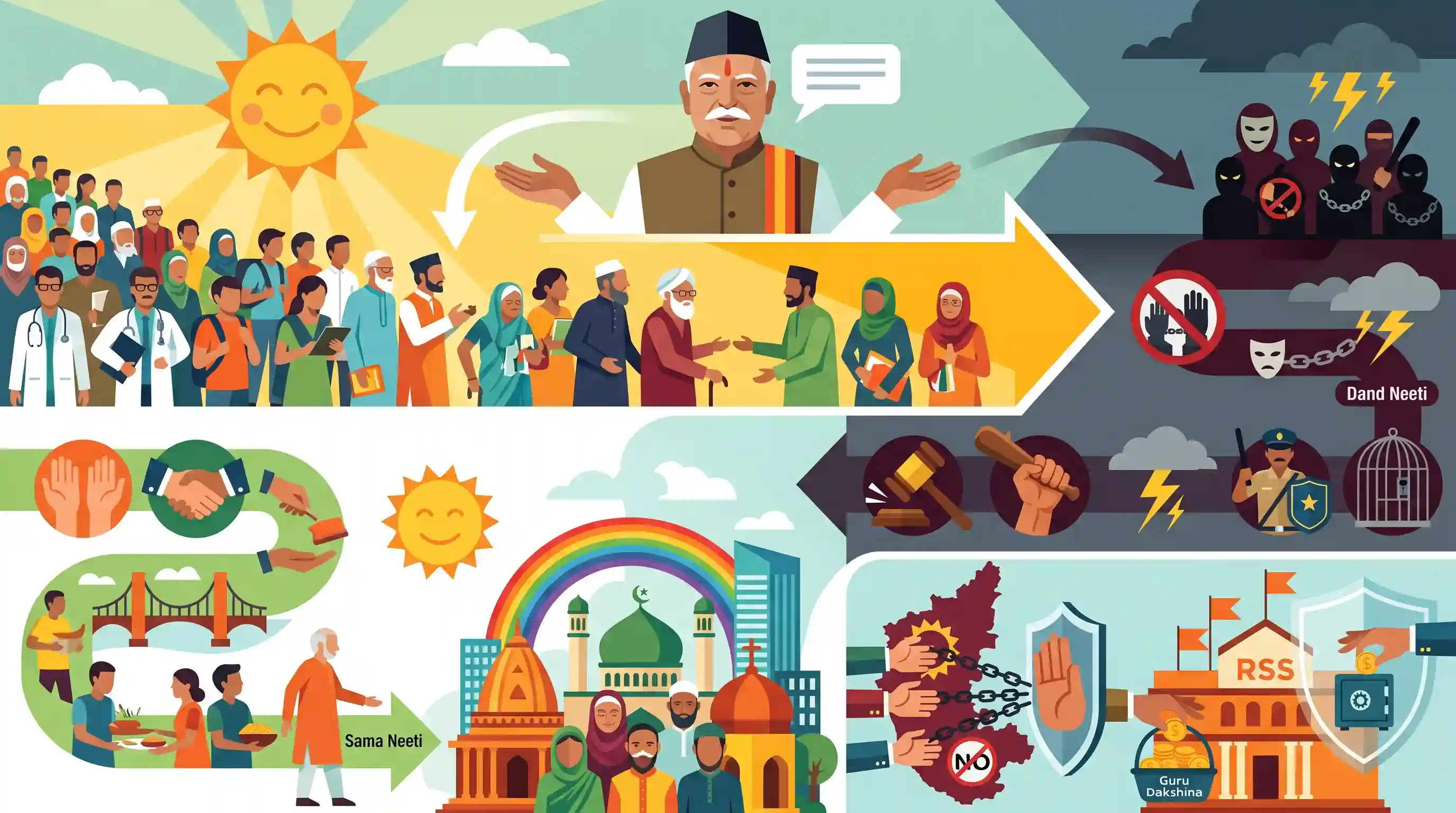
RSS Chief Mohan Bhagwat stated that the majority of Indian Muslims do not support radical concepts such as 'love jihad' or 'Ghazwa-e-Hind', urging society to differentiate between ordinary citizens and a minority of fundamentalists. He proposed a strategy combining 'sama neeti' (conciliation) for good individuals and 'dand neeti' (punishment) for extremists to maintain communal harmony. Furthermore, Bhagwat addressed the legal standing of the RSS, clarifying its status as a recognized 'body of individuals' with tax-exempt 'guru dakshina', while dismissing recent political demands in Karnataka to regulate the organization's activities.
Key Points
- RSS Chief Mohan Bhagwat urged against stereotyping the entire Muslim community, noting that the majority do not support radical agendas like 'love jihad' or 'Ghazwa-e-Hind'.
- He highlighted the need to segregate ordinary, well-meaning citizens from a subset of fundamentalists ('kattarpanthis').
- Bhagwat advocated a dual approach: 'sama neeti' (conciliation) to engage good individuals and 'dand neeti' (punishment) to deal with extremists.
- Addressing questions on the RSS's legal status, he clarified that courts recognize the RSS as a 'body of individuals' and that its 'guru dakshina' contributions are tax-exempt.
- He dismissed calls by a Karnataka minister to regulate RSS activities, asserting that criticism ultimately boosts the organization's visibility.
Important Terms
Rashtriya Swayamsevak Sangh (RSS)

A Hindu nationalist volunteer organization founded in 1925 by K.B. Hedgewar. It promotes Hindutva and operates through a network of 'shakhas' for character-building and social service.
UPSC context
GS Paper 1 (Indian Society/Communalism) and GS Paper 2 (Role of Civil Society). Essential for understanding political-cultural dynamics.
Income Tax Department
The apex agency under the Ministry of Finance responsible for administering direct taxes. It enforces the Income Tax Act, 1961, and regulates tax exemptions for various entities.
UPSC context
GS Paper 3 (Indian Economy/Taxation) and GS Paper 2 (Statutory/Regulatory Bodies). Covers fiscal policy and governance.
Ghazwa-e-Hind
A concept propagated by radical groups regarding a prophesied battle for the Indian subcontinent. It is often exploited for militant recruitment and ideological radicalisation.
UPSC context
GS Paper 3 (Internal Security/Radicalisation). Significant for analyzing extremist narratives and security threats.
Dand Neeti
A concept in ancient Indian statecraft (notably by Kautilya and Manu) referring to the 'policy of punishment' or use of force to maintain order and righteousness (Dharma).
UPSC context
GS Paper 4 (Ethics) and PSIR Optional. Tests understanding of classical Indian approaches to governance and ethics.
Body of Individuals (BOI)
A legal status under the Income Tax Act, 1961, where individuals join together for a common purpose without a formal partnership or incorporation.
UPSC context
GS Paper 2/3 (Taxation/NGO Regulation). Relates to the legal and tax standing of non-registered organizations in India.
Radicalisation
The process by which individuals adopt extreme political, social, or religious ideals that challenge the status quo and may lead to violence.
UPSC context
GS Paper 3 (Internal Security). A key challenge for internal stability and social cohesion in a diverse nation.
Communalism
An ideology emphasizing religious identity as the primary basis of social and political belonging, often leading to conflict between different religious groups.
UPSC context
GS Paper 1 (Social Issues). A core topic for understanding secularism and social challenges in the Indian context.
Prelims Trap
A 'Body of Individuals' (BOI) under Indian tax laws can include corporate entities and artificial juridical persons.
Under the Income Tax Act, a Body of Individuals (BOI) strictly comprises only natural persons. An Association of Persons (AOP) can include companies or artificial juridical persons.
Static Concepts Connected
What are Kautilya's four Upayas (strategies) for conflict resolution and statecraft?
- Sama (Conciliation): Using peaceful negotiation, persuasion, and diplomacy to resolve conflicts and manage allies or subjects without hostility.
- Dana (Incentive): Offering gifts, economic incentives, or political concessions to win over or appease potential opponents.
- Bheda (Dissension): Exploiting divisions, sowing seeds of discord, or creating internal rifts within enemy or opposition ranks.
- Danda (Force): The ultimate resort to physical punishment, coercion, military force, or severe state sanctions when other methods fail.
What distinguishes a 'Body of Individuals' (BOI) from an 'Association of Persons' (AOP)?
- Composition constraint: A BOI consists exclusively of individuals (natural persons). An AOP can include non-individuals like companies, firms, or trusts alongside individuals.
- Intent and formation: An AOP typically implies a voluntary combination of entities for a common income-producing purpose, whereas a BOI might merely earn income jointly without a formal mutual agreement.
Cross-Topic Patterns
Ancient Statecraft in Modern Security
Kautilyan strategies (Upayas) frequently anchor GS-3 internal security answers, framing how states use conciliation (surrender/rehabilitation policies) alongside force (kinetic operations) against armed insurgencies.
Civil Society vs Radicalisation
Grassroots de-radicalisation strategies heavily rely on prominent civil society voices and community leaders to organically segregate ordinary citizens from fundamentalists, isolating terror propaganda.

Expect a GS-3 or GS-4 mains question asking to apply ancient Indian statecraft (Sama, Bheda, Danda) to modern counter-radicalisation.
Linked PYQs · 4
Linked PYQs · 4
- 2022MainsGS1
Are tolerance, assimilation and pluralism the key elements in the making of an Indian form of secularism? Justify your answer.
- 2017MainsGS1
Distinguish between religiousness/religiosity and communalism giving one example of how the former has got transformed into the latter in independent India.
- 2018MainsGS1
Communalism arises either due to power struggle or relative deprivation.' Argue by giving suitable illustrations.
- 2021MainsGS2
Can Civil Society and Non-Governmental Organizations present an alternative model of public service delivery to benefit the common citizen? Discuss the challenges of this alternative model.
