Canara Bank credit outreach loans for financial inclusion in AP
Source:indian-masterminds ↗
Why It Matters
It serves as a practical example of how Public Sector Banks drive financial inclusion, implement priority sector lending targets, and undertake corporate social responsibility at the grassroots level, which is frequently tested in banking and economy sections of the syllabus.
Summary
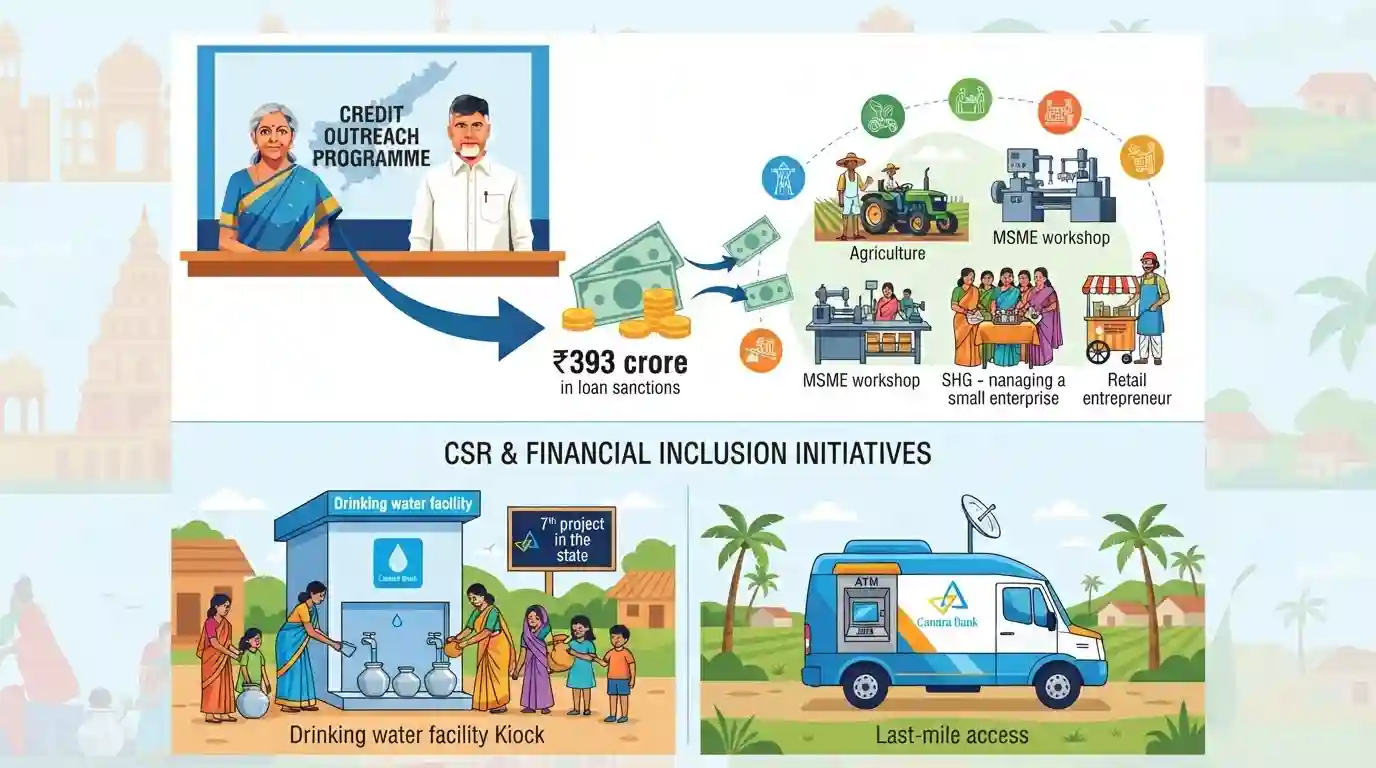
Union Finance Minister Nirmala Sitharaman and Andhra Pradesh Chief Minister N. Chandrababu Naidu attended a significant Credit Outreach Programme organized by Canara Bank in Palnadu district, Andhra Pradesh. During the event, the public sector bank sanctioned loans worth ₹393 crore to various beneficiaries, including farmers, MSMEs, Self-Help Groups (SHGs), and retail entrepreneurs. The initiative heavily emphasized deepening financial inclusion and meeting priority sector lending (PSL) goals to foster local livelihoods. Additionally, Canara Bank inaugurated its seventh Corporate Social Responsibility (CSR) project in the state—a drinking water facility in a local village—and launched a mobile ATM van to improve last-mile banking access in rural areas.
Key Points
- Canara Bank sanctioned ₹393 crore in loans during a major Credit Outreach Programme in Palnadu district, Andhra Pradesh.
- The credit deployment focuses on priority sectors, including MSMEs, agricultural farmers, Self-Help Groups (SHGs), and local entrepreneurs to promote financial inclusion.
- Union Finance Minister Nirmala Sitharaman and AP Chief Minister N. Chandrababu Naidu handed over the loan sanction letters to beneficiaries.
- The bank also initiated a CSR project to provide clean drinking water in the region and deployed a mobile ATM van to expand rural banking access.
- This outreach illustrates the ongoing efforts of Public Sector Banks (PSBs) to fulfill rural credit targets and support local economic livelihoods.
Important Terms
Priority Sector Lending (PSL) guidelines

Regulations issued by the Reserve Bank of India (RBI) mandating commercial banks to direct a specific percentage of credit to crucial socio-economic sectors like agriculture, MSMEs, education, and housing.
UPSC context
GS Paper III: Indian Economy. Crucial for questions on credit access, banking reforms, and addressing regional disparities in financial growth.
Corporate Social Responsibility (CSR) Framework
A statutory mandate under Section 135 of the Companies Act, 2013, requiring eligible companies to allocate at least 2% of their average net profits to social and environmental projects.
UPSC context
GS Paper II & III: Governance and Economy. Evaluates corporate governance, public-private partnerships, and welfare initiatives.
Financial Inclusion
The process of ensuring universal, affordable access to formal financial products and services—such as savings, credit, insurance, and payments—specifically for vulnerable and low-income populations.
UPSC context
GS Paper III: Inclusive Growth. Central to topics like poverty alleviation, direct benefit transfer (DBT), and digital public infrastructure.
Self-Help Groups (SHGs)
Small, informal, and voluntary associations of people (primarily rural women) who pool resources to offer mutually agreed collateral-free microloans and foster livelihood development.
UPSC context
GS Paper II & III: Governance and Inclusive Growth. Tests grassroots empowerment, microfinance models, and women-led development.
Prelims Trap
Banks receive higher weightage for Priority Sector Lending in districts with already high per capita credit flow.
The RBI assigns a lower weightage (90%) to high-credit districts and a higher weightage (125%) to credit-starved districts to correct spatial disparities.
Static Concepts Connected
How does the RBI's differential weightage framework for Priority Sector Lending (PSL) work?
- Spatial parity: The framework is designed by the RBI to address and correct regional imbalances in bank credit distribution.
- Deficit districts: Districts with low per capita credit flow (below ₹9,000) receive an incentivized 125% weightage for fresh PSL loans.
- Surplus districts: Districts with high per capita credit flow (above ₹42,000) are assigned a reduced 90% weightage.
What are the core mechanisms of the Lead Bank Scheme (LBS)?
- Origin & purpose: Introduced in 1969 (Gadgil/Nariman committees) to enable decentralized, district-level credit coordination.
- Three-tier system: Block Level Bankers' Committees (BLBCs) act as the foundational base for grassroots credit planning.
- CD Ratio benchmark: Mandates a minimum 60% Credit-Deposit (CD) ratio for rural and semi-urban bank branches nationwide.
Cross-Topic Patterns
SHG-Bank Linkage + NRLM
Credit outreach often leverages SHGs, linking RBI's formal banking mandates with the Ministry of Rural Development's DAY-NRLM to foster decentralized rural enterprise.
PSBs + EASE Reforms
Financial inclusion drives align with the EASE (Enhanced Access and Service Excellence) reform agenda, exclusively designed to make Public Sector Banks competitive and socially impactful.

Expect a 2026 question testing the RBI's 125%/90% differential PSL weightage framework or the strict 60% rural CD ratio under LBS.
Linked PYQs · 2
Linked PYQs · 2
- 2024APPSC_PRELIMSGS1
Which of the following statement/statements is/are valid in connection with Enhanced Access and Service Excellence (EASE) Reforms? I. EASE Reforms are governed by a board of directors, who are heads of premier Financial Institutions in India. II. EASE Next programme had just one (01) priority - the Common Reforms Agenda. III. Delivering excellence in customer service with digital enablement is one of the four themes conceptualized as part of EASE 6.0. IV. EASE Reforms are intended for both Public Sector Banks (PSBs) as well as NBFCs. Select the correct answer using the codes given below:
- 2024APPSC_PRELIMSGS1
Which of the following feature/features is/are correct regarding Stand-Up India Scheme ? I. This scheme covers brownfield enterprises along with greenfield enterprises. II. Non-Individual enterprises are also eligible to avail the benefit of this scheme provided certain conditions are complied with. III. For drawal of Working Capital up to ₹ 10 lakh, the same may be sanctioned by way of Cash Credit Limit. IV. Besides Primary Security, the loan may be secured by a guarantee of Credit Guarantee Fund Scheme for Stand-Up India Loans (CGFISIL) as decided by the banks. Select the correct answer using the codes given below :
