Canara Bank Sanctions Priority Sector Loans at Credit Outreach Event
Source:elets-bfsi ↗
ఇది ఎందుకు ముఖ్యం
Highlights the operationalization of Priority Sector Lending (PSL) and the role of the State Level Bankers' Committee (SLBC) in coordinating financial inclusion efforts. It also touches upon the statutory obligations of Public Sector Banks regarding Corporate Social Responsibility (CSR).
సారాంశం
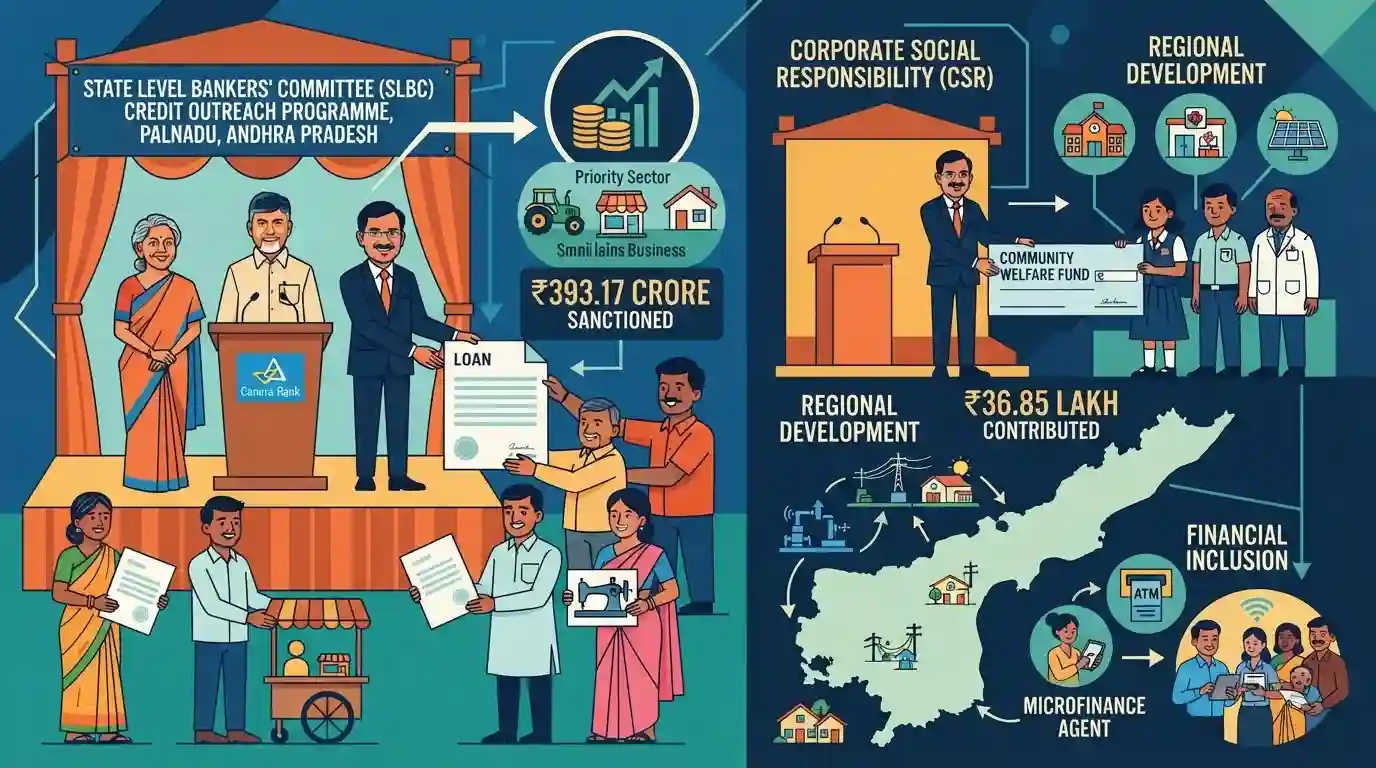
Canara Bank participated in the State Level Bankers' Committee (SLBC) Credit Outreach Programme in Palnadu, Andhra Pradesh, sanctioning ₹393.17 crore in loans directed at priority sectors. The event was graced by Union Finance Minister Nirmala Sitharaman and Andhra Pradesh Chief Minister N. Chandrababu Naidu. Representing Canara Bank, MD & CEO Brajesh Kumar Singh distributed the loan sanction letters. Additionally, the bank contributed ₹36.85 lakh toward community welfare as part of its Corporate Social Responsibility (CSR) initiatives, highlighting the role of Public Sector Banks in financial inclusion and regional development.
ముఖ్య అంశాలు
- Canara Bank sanctioned loans worth ₹393.17 crore across priority sectors during the SLBC Credit Outreach Programme in Andhra Pradesh.
- The event was held in Palnadu and attended by Union Finance Minister Nirmala Sitharaman and Andhra Pradesh CM N. Chandrababu Naidu.
- The State Level Bankers' Committee (SLBC) is a crucial inter-institutional forum designed to coordinate banking activities and credit flow in priority sectors at the state level.
- Under its Corporate Social Responsibility (CSR), Canara Bank extended ₹36.85 lakh for community welfare initiatives.
ముఖ్యమైన పదాలు
Priority Sector Lending (PSL)

A mandatory RBI framework requiring banks to allocate a specific portion of their credit to sectors crucial for inclusive growth, such as agriculture, MSMEs, housing, and education.
UPSC context
Crucial for GS Paper 3 (Economy). Tests knowledge of financial inclusion, RBI guidelines, and targeted credit market interventions.
Corporate Social Responsibility (CSR)
A statutory obligation under the Companies Act, 2013, requiring qualifying profitable companies to spend at least 2% of their average net profit over three years on notified social, environmental, and developmental initiatives.
UPSC context
Highly relevant for GS Papers 2, 3, and 4. Tests corporate governance, ethical business practices, and private sector roles in development.
State Level Bankers' Committee (SLBC)
An apex coordination body in each state, convened by a designated lead bank. It aligns state government policies with banking services to implement schemes, monitor priority credit deployment, and drive financial inclusion.
UPSC context
Important for GS Paper 3 (Economy). Tests understanding of the Lead Bank Scheme, rural development, and institutional coordination for inclusive growth.
Reserve Bank of India (RBI)
India's central bank and apex regulatory authority, established in 1935. It formulates monetary policy, issues currency, manages foreign exchange, and sets lending frameworks like PSL to ensure financial stability.
UPSC context
Core GS Paper 3 topic. Tests knowledge of central banking functions, monetary policy, and regulatory oversight of the Indian economy.
ప్రిలిమ్స్ ఉచ్చు
"The State Level Bankers' Committee (SLBC) is chaired by the RBI Governor or the State Finance Minister."
SLBCs are actually chaired by the Chairman, Managing Director, or Executive Director of the designated Convenor Bank for that state, not by RBI officials.
అనుసంధానమైన స్థిర భావనలు
What is the structure of the Lead Bank Scheme (LBS) and SLBC?
- Origin: Introduced in 1969 based on the 'Area Approach' recommended by the Gadgil Study Group and Nariman Committee.
- SLBC Role: The State Level Bankers' Committee (SLBC) acts as the apex inter-institutional forum to coordinate state-level credit flow.
- Convenor Bank: A specific commercial bank is designated as the convenor for each state to lead this coordination.
How are Priority Sector Lending (PSL) shortfalls managed by the RBI?
- PSL Target: Domestic Scheduled Commercial Banks must allocate at least 40% of their Adjusted Net Bank Credit (ANBC) to priority sectors.
- Shortfall Penalty: Shortfall amounts must be deposited into the Rural Infrastructure Development Fund (RIDF) or other RBI-notified funds (e.g., SIDBI, NHB).
- RIDF Management: The RIDF is managed by NABARD to finance ongoing rural infrastructure projects by state governments.
అంతర-అంశ నమూనాలు
PSL vs. CSR statutory mandates
UPSC often mixes RBI's Priority Sector Lending mandates (credit direction based on ANBC) with the Ministry of Corporate Affairs' CSR rules (2% net profit philanthropic spending under the Companies Act).
Financial federalism via SLBCs
SLBCs represent decentralized financial planning, requiring state governments, the RBI, and commercial banks to collaboratively align regional credit flows outside traditional constitutional federal bodies.

Expect a prelims statement mixing up PSL shortfall penalties (routed to RIDF via NABARD) with CSR spending rules under the Companies Act.
అనుసంధాన PYQలు · 2
అనుసంధాన PYQలు · 2
- 2023APPSC_PRELIMSGS1
Statutory Liquidity Ratio is to be maintained by banks in the form of I. Cash. II. Gold. III. Unencumbered investments in specified instruments. IV. Priority sector loans. Choose the correct answer using the codes given below :
- 2024APPSC_PRELIMSGS1
Which of the following statement/statements is/are valid in connection with Enhanced Access and Service Excellence (EASE) Reforms? I. EASE Reforms are governed by a board of directors, who are heads of premier Financial Institutions in India. II. EASE Next programme had just one (01) priority - the Common Reforms Agenda. III. Delivering excellence in customer service with digital enablement is one of the four themes conceptualized as part of EASE 6.0. IV. EASE Reforms are intended for both Public Sector Banks (PSBs) as well as NBFCs. Select the correct answer using the codes given below:
