राष्ट्रों के बीच द्विपक्षीय व्यापार वार्ता और आर्थिक कूटनीति
स्रोत:द हिंदू ↗
क्यों मायने रखता है
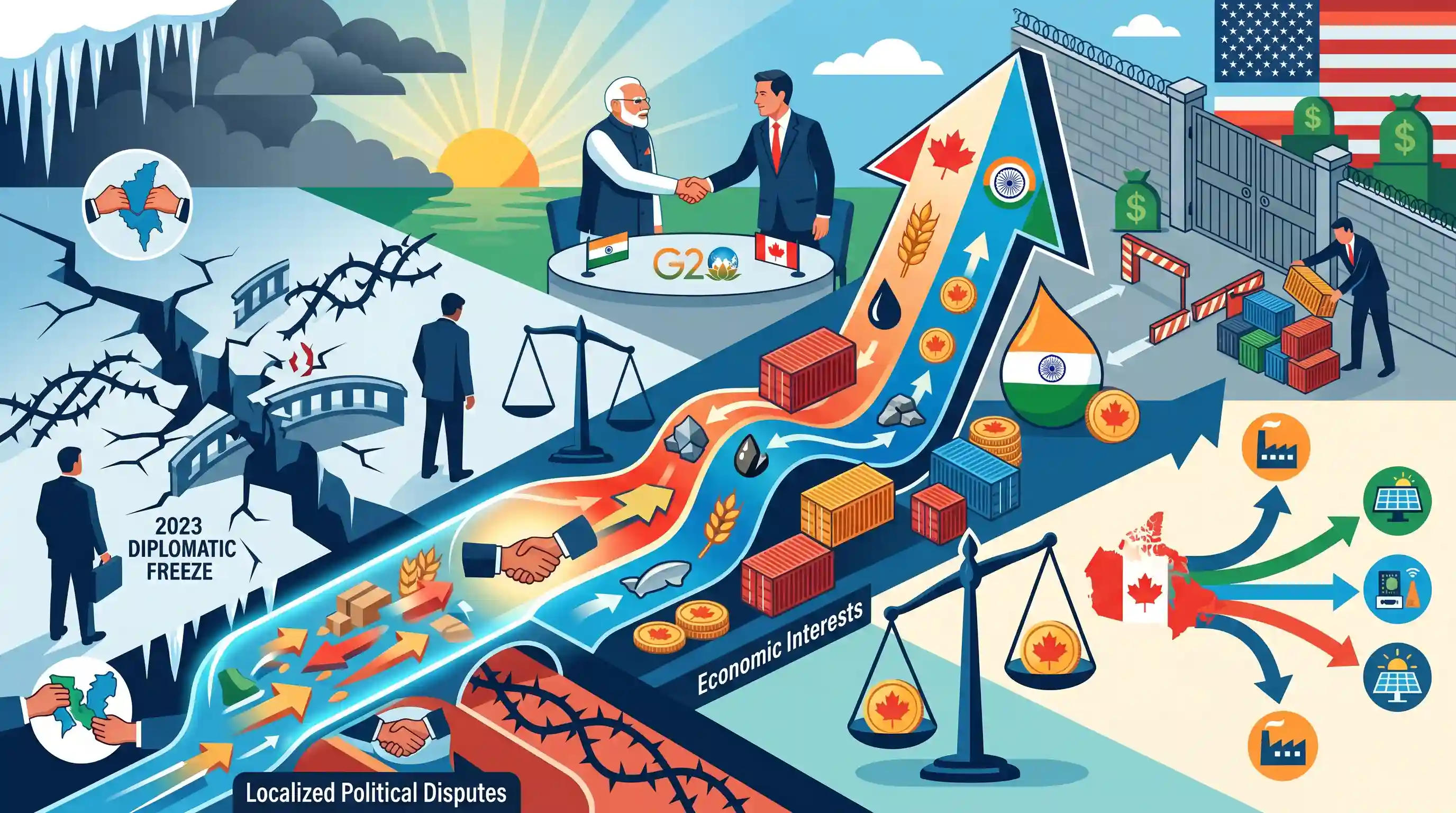
The article provides a real-world example of how countries compartmentalize relations—pursuing economic cooperation despite severe political friction. It also illustrates how changing US policies (protectionism) create ripple effects, forcing middle powers like Canada to strengthen bilateral ties with India.
सारांश
Canada has announced its intention to fast-track negotiations for a comprehensive bilateral trade deal with India, seeking to double bilateral trade to $50 billion by 2030. The resumption of talks—agreed upon by PM Narendra Modi and Canadian envoy Mark Carney at the G20 summit—marks a pragmatic shift following the 2023 diplomatic freeze triggered by the Hardeep Singh Nijjar assassination row. This diplomatic recalibration is largely driven by Ottawa's urgent need to diversify its trade portfolio in anticipation of increased protectionism and tariff barriers from the incoming US administration. The move underscores the separation of strategic economic interests from localized political disputes.
मुख्य बिंदु
- Canada is expediting efforts to advance a stalled bilateral trade deal with India, aiming to double bilateral trade to $50 billion by 2030.
- Trade talks had been suspended in 2023 following a severe diplomatic row over Canada's allegations of Indian involvement in the assassination of Khalistani leader Hardeep Singh Nijjar.
- The agreement to restart negotiations was reached between Indian PM Narendra Modi and Canadian envoy Mark Carney during the G20 summit in South Africa.
- Canada's renewed push for the India trade deal is strategically timed to diversify its economic partnerships and insulate itself against potential trade protectionism from the incoming US administration under Donald Trump.
- Despite political friction, the economic relationship remains robust, with Canada standing as India's seventh-largest trading partner for goods and services.
महत्वपूर्ण शब्द
Free Trade Agreement (FTA)

A bilateral agreement where two or more countries provide preferential market access by reducing or eliminating tariffs and non-tariff barriers on most goods and services traded between them.
UPSC context
GS-3 (Economy); GS-2 (International Relations). Tests understanding of trade liberalisation and its impact on domestic industries.
Early Progress Trade Agreement (EPTA)
An interim trade deal focusing on a limited set of high-priority sectors (e.g., agriculture, minerals) designed to build momentum and achieve early benefits before a full-scale trade agreement.
UPSC context
GS-2 (Bilateral Relations). Relevant for India-Canada and India-UK negotiations as a phased approach to diplomacy.
व्यापक आर्थिक साझेदारी समझौता (CEPA)
A broad trade pact covering goods, services, investment, intellectual property, and regulatory standards. It is more expansive than a standard FTA, aiming for deep economic integration.
UPSC context
GS-3 (External Sector). Tests knowledge of different levels of trade integration (PTA vs FTA vs CEPA).
Protectionism
Economic policy of restricting imports through tariffs, quotas, or subsidies to shield domestic industries from foreign competition. It is often a response to global economic volatility or geopolitical shifts.
UPSC context
GS-3 (Indian Economy). Relevant for analyzing global trade wars and their impact on India's export-led growth.
Trade Diversification
A strategic effort to expand a nation's trading partners and export basket to reduce economic vulnerability and over-dependence on a single market or region.
UPSC context
GS-2 (International Relations). Key concept in India’s 'Atmanirbhar Bharat' and diversifying away from specific traditional partners.
G20 (Group of Twenty)
The premier international forum for economic cooperation, comprising 19 countries and two regional unions. It serves as a critical platform for bilateral 'sideline' diplomacy and global consensus-building.
UPSC context
GS-2 (International Institutions). Tests knowledge of global governance and India’s leadership role in multilateral forums.
प्रारंभिक ट्रैप
"Bilateral trade between India and Canada was officially suspended in 2023 following the diplomatic freeze over the Nijjar row."
While formal FTA negotiations and diplomatic talks were suspended, actual private-sector trade was 'ring-fenced' and continued robustly without structural suspension.
संबंधित अवधारणाएँ
What distinguishes an Early Harvest Scheme, FTA, and a CEPA?
- Early Harvest Scheme: A precursor pact focusing on rapid tariff reductions for a limited list of goods to build trust and negotiating momentum.
- Standard FTA: A binding treaty that primarily focuses on eliminating or significantly reducing customs duties on the majority of traded goods.
- CEPA / CECA: A comprehensive pact extending beyond goods to include services, investments, intellectual property, and deep regulatory cooperation.
How does diaspora politics influence a host country's foreign policy?
- Vote-bank politics: Large, concentrated immigrant communities can pressure host governments to adopt specific foreign policy stances to secure domestic electoral support.
- Bilateral friction: Domestic appeasement of radical diaspora factions can severely strain diplomatic relations with the diaspora's home country.
- Soft power bridge: Conversely, a well-integrated diaspora acts as an economic and cultural bridge, facilitating trade, remittances, and bilateral goodwill.
अंतर-विषय पैटर्न
US Tariffs & Middle-Power Realignment
Anticipated US protectionism forces middle powers like Canada to override domestic political disputes and aggressively secure structural trade access in resilient emerging markets like India.
Economic Ring-Fencing in Diplomacy
India's relations with both Canada and China showcase a maturing diplomacy where essential economic trade continues robustly despite severe border clashes or high-level diplomatic standoffs.

GS2 2026: Expect a question on how US protectionism forces middle powers to decouple diaspora politics from economic ties with India.
संबद्ध PYQ · 2
संबद्ध PYQ · 2
- 2025MainsGS3
What are the challenges before the Indian economy when the world is moving away from free trade and multilateralism to protectionism and bilateralism? How can these challenges be met?
- 2023MainsGS2
Indian diaspora has scaled new heights in the West. Describe its economic and political benefits for India.
