India-Canada Comprehensive Economic Partnership Negotiations
Source:The Hindu ↗
Why It Matters
The article highlights a major strategic pivot in India-Canada relations, moving from diplomatic friction to deep economic and technological integration. For UPSC aspirants, it is a prime example of economic diplomacy, illustrating how shared interests in energy security (uranium, SMRs) and emerging tech (critical minerals) can stabilize and drive bilateral ties.
Summary
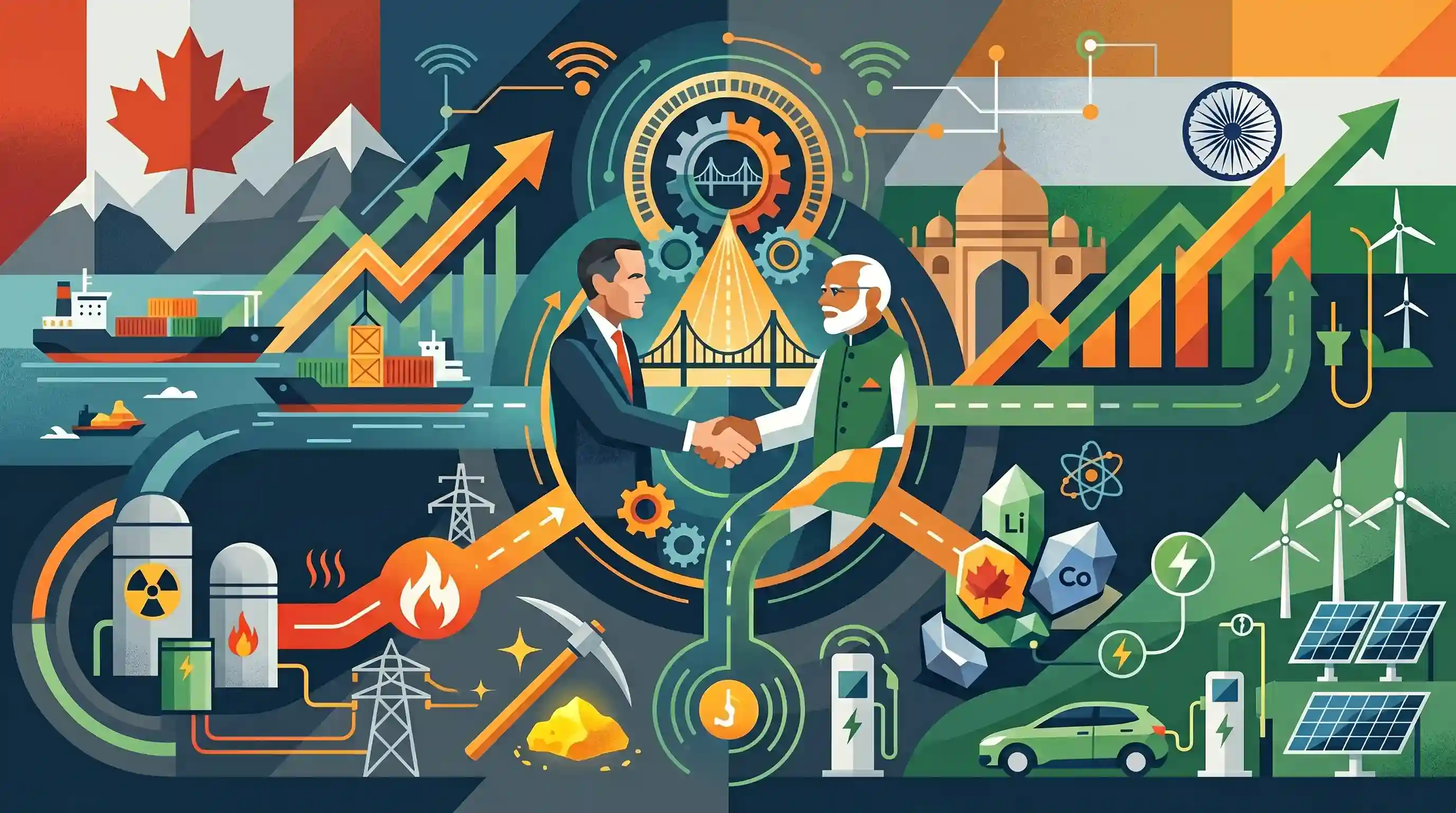
Canadian Prime Minister Mark Carney, during the Canada-India Growth and Investment Forum in Mumbai, announced that the two nations are negotiating a Comprehensive Economic Partnership Agreement (CEPA) aimed at doubling bilateral trade by 2030. Marking a diplomatic reset after recent tensions, the countries have agreed on a shared workplan focusing on national security, energy, technology, and critical minerals. Key areas of renewed cooperation include nuclear energy—specifically uranium supply and Small Modular Reactors (SMRs)—and securing critical mineral supply chains essential for green technology and EV batteries.
Key Points
- Canada and India are actively negotiating a Comprehensive Economic Partnership Agreement (CEPA) to double their two-way trade by the year 2030.
- A new shared workplan has been agreed upon to guide bilateral cooperation across national security, energy, technology, and critical minerals.
- The countries are renewing their nuclear energy partnership, which includes Canadian uranium exports to India and collaboration on Small Modular Reactors (SMRs).
- Securing supply chains for critical minerals, essential for green technologies and electric vehicles, is a primary focus of the new technology partnership.
- The economic and strategic re-engagement indicates a diplomatic reset, moving past recent bilateral friction to capitalize on mutual growth potential.
Important Terms
Comprehensive Economic Partnership Agreement (CEPA)

A comprehensive free trade agreement covering goods, services, investment, and intellectual property. It aims for deeper economic integration than a standard Free Trade Agreement (FTA).
UPSC context
GS Paper II: Bilateral Relations. Tests understanding of India's trade architecture and strategic economic partnerships with major G7 economies.
Small Modular Reactors (SMRs)
Advanced nuclear reactors with a capacity of up to 300 MW(e) per unit. They are factory-built, portable, and designed for quicker deployment than traditional large-scale reactors.
UPSC context
GS Paper III: Energy and Science & Technology. Essential for India’s 2070 net-zero targets and decentralized clean energy infrastructure.
Critical Minerals
Minerals essential for modern technologies (EVs, clean energy, defense) that face high supply risks. India has identified 30 such minerals, including lithium, cobalt, and nickel.
UPSC context
GS Paper III: Economy and Infrastructure. Focuses on supply chain resilience and securing resources for the green energy transition.
Bilateral Trade
The total value of goods and services exchanged between two nations. It includes both exports and imports, serving as a primary indicator of economic cooperation.
UPSC context
GS Paper II: International Relations. Measures the health of diplomatic ties through the lens of economic interdependence.
Economic Diplomacy
The use of a country's economic power and financial tools to achieve its foreign policy objectives and strengthen international relations.
UPSC context
GS Paper II: India and its Neighborhood- Relations. Tests the ability to link economic interests with geopolitical strategies.
Energy Security
The uninterrupted availability of energy sources at an affordable price, involving both long-term investments and short-term ability to respond to supply changes.
UPSC context
GS Paper III: Infrastructure: Energy. A core theme in bilateral energy dialogues and India's strategic autonomy.
Prelims Trap
CEPA agreements are restricted to trade in goods and exclude trade in services, investments, and intellectual property.
This is a common trap. Standard FTAs primarily target goods, whereas CEPAs are much broader, explicitly covering services, investments, regulatory cooperation, and intellectual property.
Static Concepts Connected
How does a CEPA differ from a standard Free Trade Agreement (FTA)?
- Scope of FTA: Generally focuses on the reduction or elimination of tariffs and customs duties on a defined list of traded goods.
- Broader CEPA Scope: Goes beyond goods to comprehensively integrate trade in services, investments, trade facilitation, and intellectual property rights.
- Existing Examples: India has successfully negotiated and signed comprehensive CEPAs with countries like the UAE, Japan, and South Korea.
What are Small Modular Reactors (SMRs) and their advantages?
- Capacity & Size: Advanced nuclear reactors with a power capacity of up to 300 MW(e) per unit, roughly one-third of traditional power reactors.
- Modular Assembly: They can be factory-manufactured in standardized modules and transported to sites, significantly reducing capital costs and construction delays.
- Passive Safety: SMRs frequently rely on natural phenomena like gravity and convection rather than active mechanical pumps, making them inherently safer.
Cross-Topic Patterns
Critical Minerals + FTAs + China De-risking
Securing critical minerals (lithium, cobalt) is now a central pillar in India’s recent FTAs (like with Australia and Canada) to reduce import dependence on China for green technologies.
SMRs + Energy Security + Net Zero
Collaborating on SMRs helps India secure stable, low-carbon baseload power, which is essential to complement intermittent renewables and meet its 2070 net-zero emissions commitments.

Prelims 2026 will likely feature a multi-statement question testing the exact distinctions between CEPA, CECA, and FTAs.
Linked PYQs · 4
Linked PYQs · 4
- 2011MainsGS2
Compared to the South Asian Free Trade Area (SAFTA), the Bay of Bengal Initiative for Multisectoral Technical and Economic Cooperation Free Trade Area (BIMSTEC FTA) seems to be more promising." Critically evaluate.
- 2020PrelimsGS1
In India, why are some nuclear reactors kept under "IAEA Safeguards" while others are not?
- 2025PrelimsGS1
In the context of electric vehicle batteries, consider the following elements : I. Cobalt II. Graphite III. Lithium IV. Nickel How many of the above usually make up battery cathodes?
- 2025PrelimsGS1
Consider the following statements : Statement I: Some rare earth elements are used in the manufacture of flat television screens and computer monitors. Statement II : Some rare earth elements have phosphorescent properties. Which one of the following is correct in respect of the above statements?
