Canada Immigration Policy Reforms and Indian Student Impact
Source:Indian Express ↗
Why It Matters
These changes directly impact the Indian diaspora and student population, which represent the largest demographic of immigrants in Canada. Under GS2, understanding immigration policy reforms in host countries is essential to evaluating the diaspora's political/economic leverage and bilateral ties. Additionally, it highlights international labor and educational migration trends (GS1/GS3).
Summary
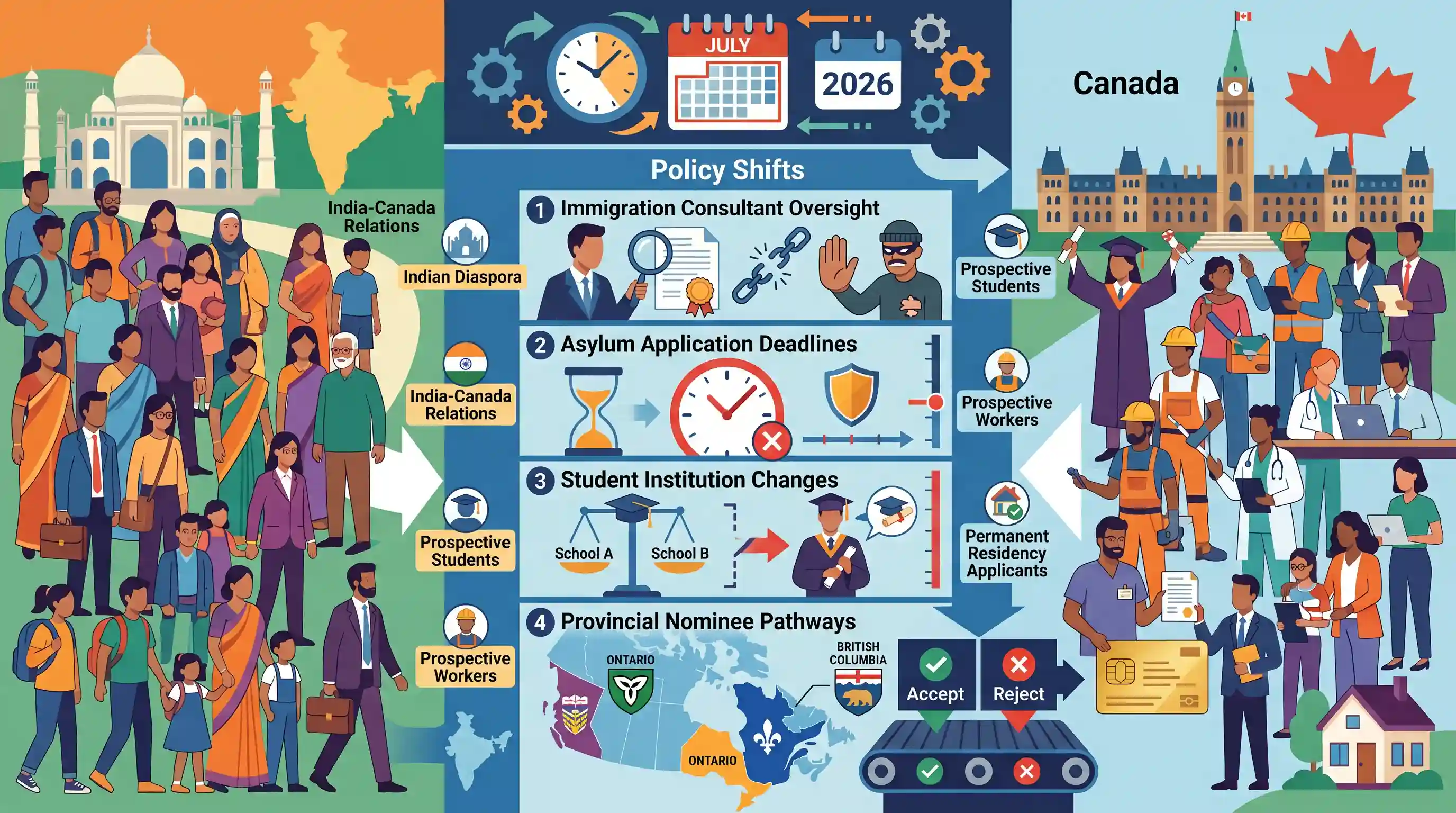
Canada is rolling out substantial mid-year immigration policy updates in July 2026 across its federal and provincial levels. These changes include tighter oversight on immigration consultants, proposed asylum application deadlines, updated rules for international students changing learning institutions under the national cap, and revamped provincial nominee pathways in Ontario, Quebec, and British Columbia. Given that Indian nationals constitute the largest group of international students and economic migrants to Canada, these policy shifts significantly affect prospective students, workers, and permanent residency (PR) applicants.
Key Points
- Immigration Consultant Regulations: Effective July 15, 2026, licensed consultants face enhanced scrutiny by the CICC. Those engaging in dishonest conduct backdated to November 2021 will face disciplinary actions and financial penalties to compensate affected clients.
- Asylum Process Reforms: Canada has proposed tightening the asylum application timeline, requiring applicants to submit all documents (such as Basis of Claim forms and ID) within 60 days. It also proposes offering open work permits immediately upon referral acceptance.
- International Student Guidelines: Students transferring between Designated Learning Institutions (DLIs) must now apply for a study permit extension and potentially secure a new Provincial/Territorial Attestation Letter (PAL/TAL). The overall study permit cap introduced in 2024 remains active.
- Ontario OINP Redesign: Ontario has replaced eight employer streams with a unified 'Workforce Priority Stream' divided into three pathways (TEER 0-3, TEER 4-5, and self-employed physicians).
- British Columbia Rural Pathway: BC has opened a temporary, highly targeted rural health support initiative restricted to 250 nominations in cleaning and security roles for public health authorities in remote areas.
- Spousal Work Permits in Quebec: Spouses of skilled workers under the PSTQ program are temporarily eligible for open work permits with an expedited 30-day processing standard.
Important Terms
Immigration, Refugees and Citizenship Canada (IRCC)

The federal department of the Canadian government responsible for managing immigration, regulating refugee protection, and granting citizenship.
UPSC context
GS Paper II (Indian Diaspora); tests knowledge of international migration policies and bilateral administrative developments affecting Indian citizens abroad.
Ontario Immigrant Nominee Program (OINP)
Ontario's provincial economic immigration program that allows the province to nominate foreign workers, international students, and entrepreneurs for permanent residency.
UPSC context
GS Paper II (Indian Diaspora); covers regional immigration pathways that shape employment opportunities for India's overseas skilled workforce.
Quebec Skilled Worker Selection Program (PSTQ)
Quebec’s provincial economic immigration program that selects skilled workers for permanent residency using its own criteria, emphasizing French-language proficiency.
UPSC context
GS Paper II (Indian Diaspora); examines sub-national immigration models that influence global labor mobility and language requirements for Indian migrants.
Temporary Resident to Permanent Resident (TR-to-PR) pathway
A transitional Canadian immigration pathway enabling eligible temporary foreign workers and international graduates already in the country to transition to permanent residence.
UPSC context
GS Paper II (Indian Diaspora); analyzes transitional immigration mechanisms that impact the security, stability, and settlement of Indian expatriates.
College of Immigration and Citizenship Consultants (CICC)
The official self-regulatory body in Canada that licenses and regulates immigration and citizenship consultants and international student advisors.
UPSC context
GS Paper II (Indian Diaspora); tests measures to prevent exploitation, fraud, and illegal consulting targeting Indian students and visa aspirants.
Prelims Trap
GCC countries continue to account for more than 50% of India's inward remittances as of 2026.
The share of remittances from high-income advanced economies (US, UK, Canada) has risen sharply, now accounting for over half of India's inflows, eclipsing traditional GCC dominance.
Static Concepts Connected
What are the major drivers and economic impacts of India's inward remittances?
- Global leader: India is the largest global recipient of remittances, consistently exceeding $100 billion annually to support foreign reserves.
- Structural shift: Migration has transitioned from low-skilled GCC labor to high-skilled white-collar workers in advanced economies like the US, UK, and Canada.
- Current account support: These inflows act as a crucial counter-cyclical cushion, mitigating India's trade deficit and stabilizing the Indian Rupee.
How does 'Brain Circulation' differ from traditional 'Brain Drain' in diaspora studies?
- Brain Drain: This represents the unidirectional loss of highly skilled, subsidized intellectual resources from developing nations to advanced western economies.
- Brain Circulation: A modern phenomenon of multi-directional flow, where skilled diaspora return or actively reinvest knowledge, capital, and technology back to India.
- Diaspora diplomacy: Consists of leveraging overseas nationals to influence host country policy, promote bilateral trade, and foster strategic bilateral partnerships.
Cross-Topic Patterns
Diaspora policies + Current Account deficit
Changes in Western immigration rules directly impact high-skilled migration patterns, subsequently influencing India's remittance volumes and its balance of payments stability.
Federalism + International migration
Canada's Provincial Nominee Programs parallel global debates on sub-national involvement in immigration, matching local labor deficits with regional demographic needs.

Bilateral migration curbs and the structural shift in India's remittance sources from GCC to OECD will likely feature in Mains 2026.
Linked PYQs · 3
Linked PYQs · 3
- 2023MainsGS2
Indian diaspora has scaled new heights in the West. Describe its economic and political benefits for India.
- 2020MainsGS2
Indian diaspora has a decisive role to play in the politics and economy of America and European Countries'. Comment with examples.
- 2015MainsGS1
Discuss the changes in the trends of labour migration within and outside India in the last four decades.
