आर्कटिक तनाव के बीच कनाडा और फ्रांस ने ग्रीनलैंड में वाणिज्य दूतावास खोले
स्रोत:द हिंदू ↗
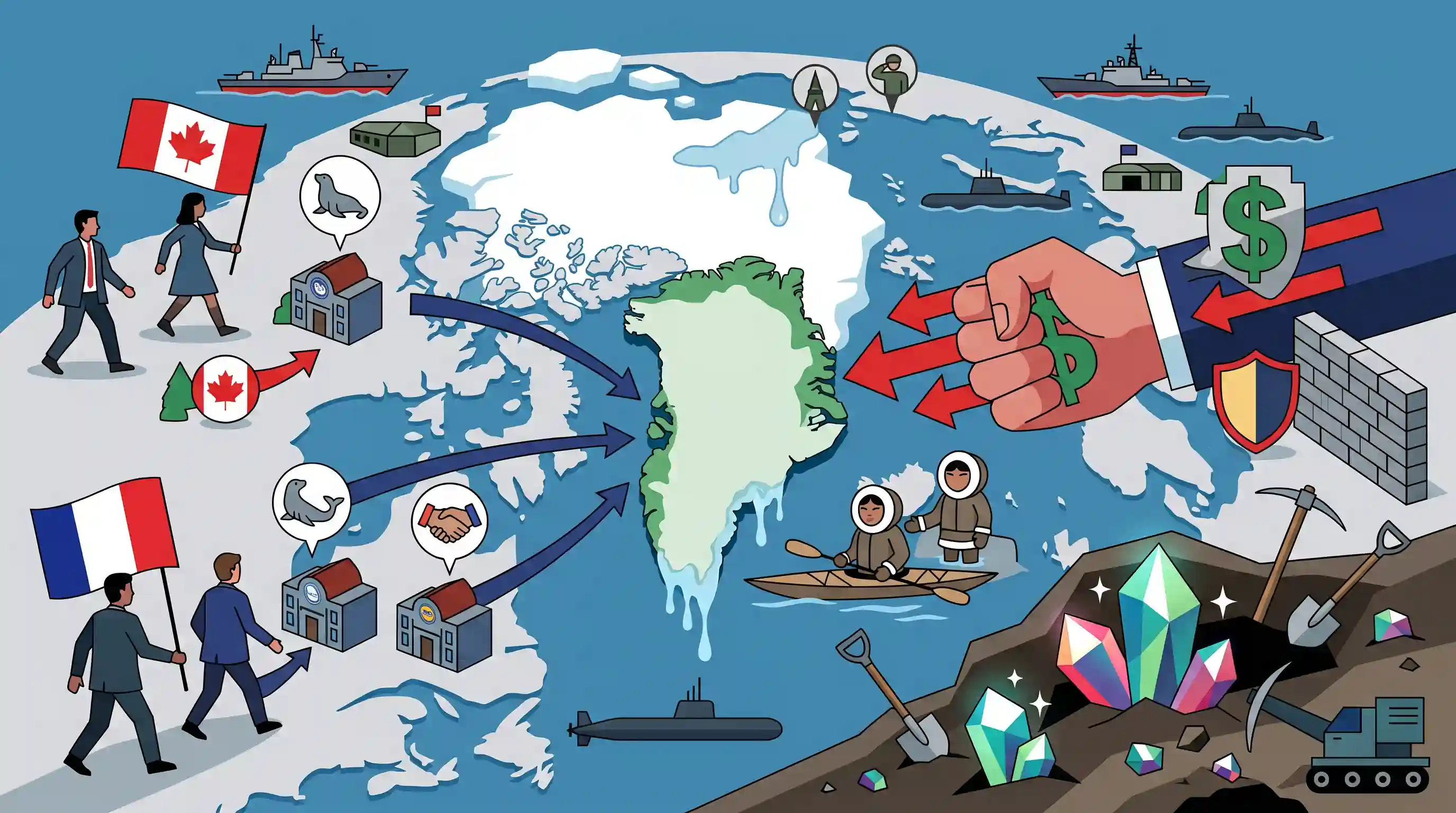
क्यों मायने रखता है
The Arctic region is becoming a focal point of global geopolitical competition as melting ice reveals new shipping routes and critical mineral deposits. This directly connects to UPSC themes involving great power rivalry, energy security, and the environmental/geographic shifts affecting global trade and indigenous communities.
सारांश
Canada and France are opening consulates in Greenland, a semiautonomous Danish territory, amid escalating geopolitical tensions in the Arctic. This diplomatic expansion follows aggressive efforts by the U.S., led by President Donald Trump, to assert influence over Greenland through proposed security deals and tariff threats. The surging international interest is driven by Greenland's vast deposits of critical minerals and rare earth elements, which are becoming more accessible as climate change accelerates Arctic ice melt. This unfolding strategic rivalry highlights the intersection of resource security, climate change, and the rights of indigenous Inuit populations in a rapidly militarizing region.
मुख्य बिंदु
- कनाडा और फ्रांस तेजी से बदलते आर्कटिक क्षेत्र में राजनयिक संबंधों को बढ़ाने और रणनीतिक हितों को सुरक्षित करने के लिए ग्रीनलैंड में वाणिज्य दूतावास स्थापित कर रहे हैं।
- The diplomatic moves come in response to aggressive U.S. efforts under President Donald Trump to secure access to Greenland's mineral wealth, including tariff threats against Denmark and proposals for an Arctic security deal.
- Greenland's vast reserves of rare earth elements and critical minerals are increasingly accessible due to climate change and ice melt, sparking a global resource rush.
- The shifting geopolitical landscape in the Arctic impacts the indigenous Inuit populations, who face both environmental disruptions from climate change and political pressures from international competition.
महत्वपूर्ण शब्द
Arctic security deal

A developing framework for enhanced military and surveillance cooperation in the High North between the U.S., Denmark, and Greenland to counter Russian and Chinese influence.
UPSC context
GS-II (IR) and GS-III (Security). Tests understanding of regional security architectures and great-power rivalry in the Arctic.
Critical Minerals
Minerals essential for modern technology and green energy (e.g., Rare Earths, Lithium) whose supply is at risk; Greenland holds significant deposits vital for global supply chains.
UPSC context
GS-I (Resources) and GS-III (Economy/Environment). Central to discussions on energy transition and resource diplomacy.
Semiautonomous territory
A political status where a region, like Greenland, governs its internal affairs but remains part of a sovereign state (Denmark) for defense and foreign policy.
UPSC context
GS-II (Polity/Governance). Tests concepts of sovereignty, federalism, and asymmetric devolution in international systems.
Inuit self-determination
The right of Greenland's indigenous majority to control their political status and resources, as protected by international law and the UN Charter.
UPSC context
GS-II (Social Justice/IR). Relevant for questions on indigenous rights, sovereignty, and the human dimension of resource extraction.
Pituffik Space Base
The northernmost U.S. military installation in Greenland, critical for global ballistic missile early warning, space surveillance, and NATO’s northern defense perimeter.
UPSC context
GS-III (Security). Highlights Arctic militarization and the strategic assets of global powers in the High North.
GIUK Gap
The strategic maritime chokepoint between Greenland, Iceland, and the UK, vital for monitoring naval movements from the Arctic into the North Atlantic.
UPSC context
GS-I (सामरिक भूगोल)। समुद्री सुरक्षा, नौसैनिक प्रतिस्पर्धा और अटलांटिक व्यापार मार्ग की सुरक्षा को समझने के लिए आवश्यक।
प्रारंभिक ट्रैप
ग्रीनलैंड एक संप्रभु राष्ट्र और आर्कटिक काउंसिल का एक स्वतंत्र मतदान करने वाला सदस्य है।
Greenland is an autonomous territory within the Kingdom of Denmark. Denmark holds ultimate sovereignty and represents Greenland's interests in international forums like the Arctic Council.
संबंधित अवधारणाएँ
What is the Arctic Council's mandate and who are its core member states?
- Origin & Mandate: Formed by the 1996 Ottawa Declaration to promote cooperation on environmental protection and sustainable development. It explicitly excludes military security issues.
- Core Members: Eight states holding Arctic territory: Canada, Denmark (including Greenland), Finland, Iceland, Norway, Russia, Sweden, and the USA.
- भारत की भूमिका: India holds Observer status (since 2013), focusing on scientific research, climate studies, and the Himadri station in Svalbard.
Why are Rare Earth Elements (REEs) critical and how are they geopolitically distributed?
- Composition: A set of 17 metallic elements (15 lanthanides plus scandium and yttrium) with unique magnetic and phosphorescent properties.
- Strategic Use: Essential for manufacturing EV motors, wind turbines, flat screens, and advanced defense and aerospace systems.
- Supply Chain: China heavily dominates global processing and refining of REEs, prompting Western nations to secure alternative reserves in places like Greenland and Australia.
अंतर-विषय पैटर्न
Mineral Security Partnership (MSP) & REEs
The diplomatic rush for Greenland's REEs connects directly to the Mineral Security Partnership (MSP), a US-led grouping India recently joined to secure critical mineral supply chains outside Chinese control.
Arctic Ice Melt & New Maritime Routes
Accelerated ice melt opens the Northwest Passage and Northern Sea Route, drastically reducing shipping times between Asia and Europe while bypassing traditional maritime chokepoints like the Suez Canal.

Expect a 2026 Prelims question linking Arctic Council membership (Denmark/Greenland) with global rare earth element reserves.
संबद्ध PYQ · 4
संबद्ध PYQ · 4
- 2011MainsGS2
As regards the increasing rates of melting of Arctic Sea ice, the interests of the Arctic Council nations may not coincide with those of the wider world." Explain.
- 2021MainsGS1
How do the melting of the Arctic ice and glaciers of the Antarctic differently affect the weather patterns and human activities on the Earth? Explain.
- 2025PrelimsGS1
Consider the following statements : Statement I: Some rare earth elements are used in the manufacture of flat television screens and computer monitors. Statement II : Some rare earth elements have phosphorescent properties. Which one of the following is correct in respect of the above statements?
- 2020PrelimsGS1
The term 'West Texas Intermediate', sometimes found in news, refers to a grade of
