Digital Services Tax Dispute and US Trade Protectionism
Source:Indian Express ↗
Why It Matters
This topic provides crucial context on the intersection of the digital economy and international trade. It is highly relevant for GS3 questions regarding domestic resource mobilization, BEPS, and the digital economy, as well as GS2 questions on the impact of US protectionism on global trade architectures.
Summary
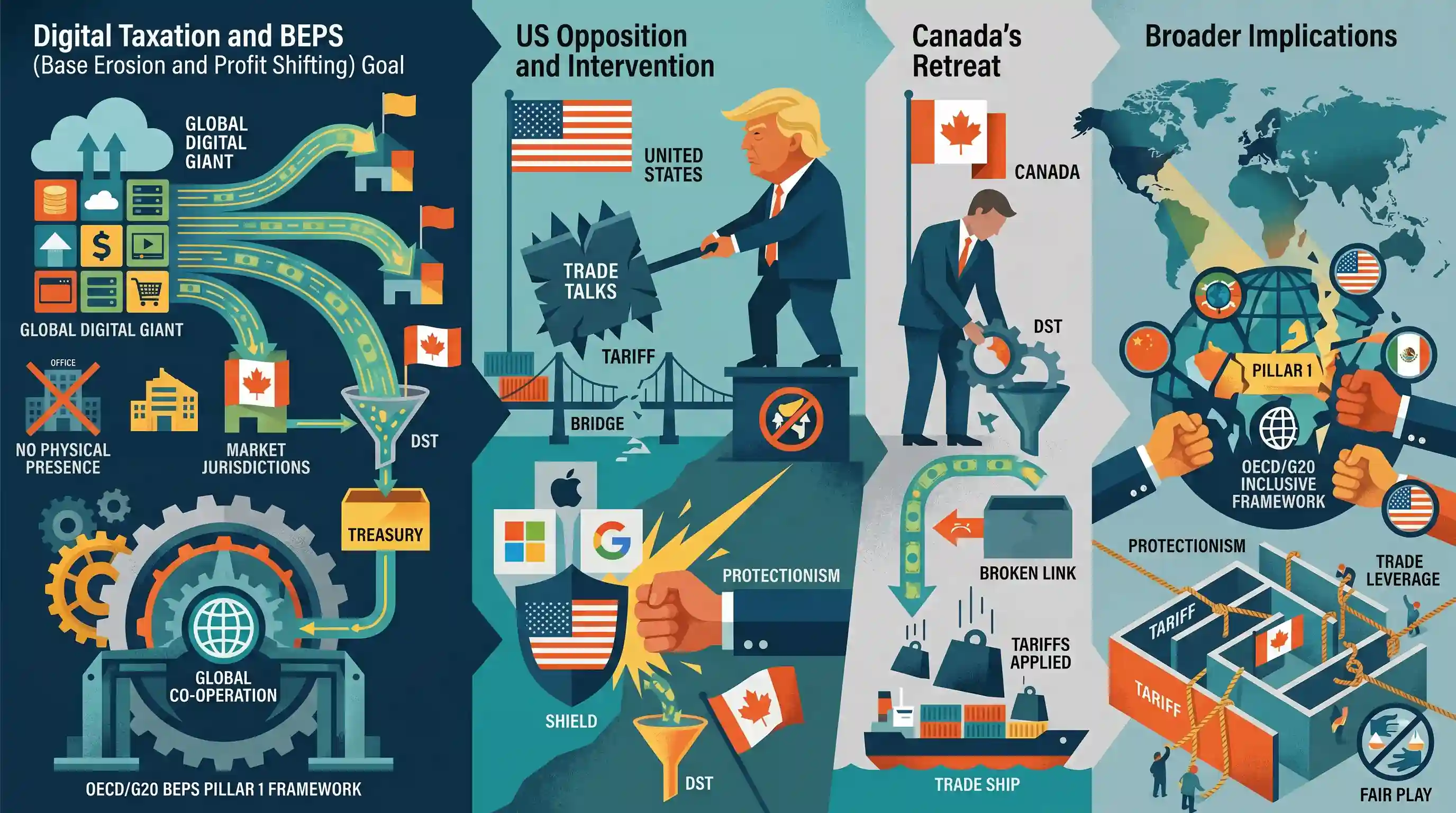
Canada recently scrapped its proposed Digital Services Tax (DST) following threats from US President Donald Trump to terminate ongoing trade talks and impose tariffs. The DST was designed to ensure global digital giants pay their fair share of taxes in jurisdictions where they generate revenue, independent of physical presence, which aligns with the global push to address Base Erosion and Profit Shifting (BEPS). However, the US views unilateral DSTs as discriminatory against American tech firms. This development underscores the challenges of finalizing a global digital taxation framework (OECD BEPS Pillar 1) and highlights the increasing use of protectionist threats and trade leverage in modern international relations.
Key Points
- Canada has scrapped its proposed Digital Services Tax (DST) on multinational tech companies following threats from US President Donald Trump to terminate critical trade negotiations and impose tariffs.
- The DST aimed to tax large digital corporations based on revenue generated from local users, addressing loopholes where tech giants pay minimal taxes in jurisdictions where they have a significant user base but no physical presence.
- The US strongly opposes unilateral DSTs, arguing that they disproportionately and unfairly target American technology giants like Google, Amazon, and Meta.
- The development reflects the broader geopolitical challenge of implementing the OECD/G20 Inclusive Framework on BEPS (Pillar 1), which seeks a coordinated global digital tax regime rather than unilateral levies.
- The incident highlights the growing trend of leveraging trade agreements (like the USMCA review) and protectionist tariff threats to coerce strategic partners on sovereign taxation issues.
Important Terms
Digital Services Tax (DST)

A tax on revenues earned by large digital companies from services like advertising or data sales, applied regardless of physical presence to ensure local revenue is taxed.
UPSC context
GS Paper III (Economy); tests knowledge of digital taxation and global trade disputes.
Base Erosion and Profit Shifting (BEPS)
Tax avoidance strategies where multinational companies shift profits to low-tax jurisdictions by exploiting gaps in tax rules, eroding the tax base of higher-tax nations.
UPSC context
GS Paper III (Economy); tests understanding of international tax cooperation and corporate governance.
Pillar One (OECD/G20 Framework)
A global framework to reallocate taxing rights over large, highly profitable multinationals to 'market jurisdictions' where their customers are located, replacing unilateral digital taxes.
UPSC context
GS Paper II/III; tests awareness of multilateral agreements and global economic governance.
Equalisation Levy
India's version of a digital tax, imposed on payments made to non-resident entities for online advertising and e-commerce services to level the domestic playing field.
UPSC context
GS Paper III (Economy); tests knowledge of India's specific fiscal policies for the digital economy.
USMCA
A trilateral trade deal between the United States, Mexico, and Canada (successor to NAFTA) that modernizes rules on digital trade, labor, and intellectual property.
UPSC context
GS Paper II (IR); tests understanding of regional trade blocs and bilateral trade dynamics.
Prelims Trap
"India continues to impose a 2% Equalisation Levy on non-resident e-commerce companies operating in the country."
India actually withdrew its 2% e-commerce levy in August 2024 and the 6% online ad levy effective April 2025 to align with the OECD global tax framework.
Static Concepts Connected
What are Pillar 1 and Pillar 2 of the OECD BEPS framework?
- Pillar 1: Reallocates taxing rights over large multinational enterprises to 'market jurisdictions' where consumers are located, regardless of physical presence, replacing unilateral DSTs.
- Pillar 2: Establishes a 15% Global Minimum Corporate Tax (GMCT) to prevent profit shifting to tax havens and end the global 'race to the bottom'.
How did India tax digital giants before the OECD consensus?
- Equalisation Levy: Introduced in 2016 as a 6% tax on online advertising revenues of non-resident digital companies, often dubbed the 'Google Tax'.
- Scope Expansion: Expanded in 2020 to include a 2% levy on non-resident e-commerce operators, which has now been phased out to comply with the OECD Two-Pillar solution.
Cross-Topic Patterns
Digital taxation as a trade weapon
The weaponization of trade agreements (like USMCA) to force sovereign tax compliance highlights how modern Free Trade Agreements increasingly restrict domestic fiscal policy autonomy and regulatory space.
Evolution of 'Permanent Establishment'
Traditional tax treaties require a physical 'Permanent Establishment' to tax a firm. The digital economy forced a shift toward 'Significant Economic Presence' based purely on user data and digital revenue.

Expect a Prelims statement contrasting OECD Pillar 1 (market rights) vs Pillar 2 (15% min tax) alongside India's Equalisation Levy repeal.
Linked PYQs · 2
Linked PYQs · 2
- 2016PrelimsGS1
The term 'Base Erosion and Profit Shifting' is sometimes seen in the news in the context of
- 2018MainsGS2
What are the key areas of reform if the WTO has to survive in the present context of "Trade War', especially keeping in mind the interest of India?
