Supreme Court examines Enforcement Directorate freeze on party funds
Source:lawbeat ↗
Why It Matters
The freezing of a political party's bank accounts by a central agency under the PMLA raises crucial constitutional and political questions. It is important for WBCS Prelims candidates to understand the powers of the Enforcement Directorate, provisions of the PMLA, and the legal aspects of political party funding and functioning.
Summary
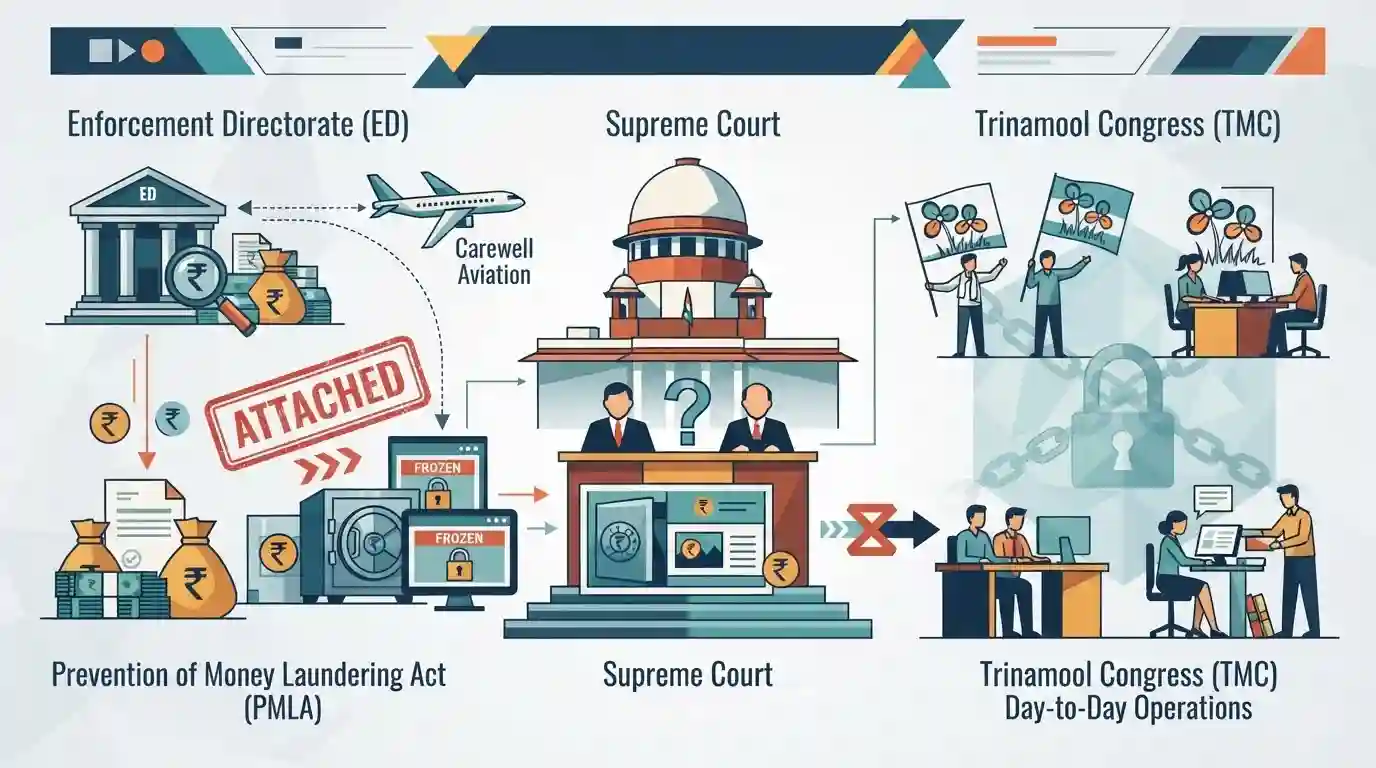
The Supreme Court has asked the Enforcement Directorate (ED) to clarify its stance on allowing the Trinamool Congress (TMC) to access funds from its frozen bank accounts for day-to-day operations. The ED had attached these accounts under the Prevention of Money Laundering Act (PMLA), alleging that illegal funds were routed through them, particularly for payments to Carewell Aviation for aircraft usage. The TMC argues that the complete freezing of accounts impairs its functioning as a political party. This legal battle emphasizes the intersection of the PMLA, powers of the ED, and the financial regulation of political parties in India.
Key Points
- The Supreme Court of India is examining whether frozen bank accounts of the Trinamool Congress (TMC) can be utilized for day-to-day party expenses.
- The accounts were attached by the Enforcement Directorate (ED) in connection with alleged money laundering.
- The ED alleges that ill-gotten money was routed through these accounts, citing transactions related to the purchase of an aircraft via Carewell Aviation.
- The TMC seeks partial release of funds to manage basic party expenditures and daily operations.
- The case highlights issues surrounding the Prevention of Money Laundering Act (PMLA) and the operations of political parties.
Important Terms
Prevention of Money Laundering Act (PMLA)

A key Indian legislation enacted in 2002 to prevent money laundering, enable provisional attachment and confiscation of proceeds of crime from scheduled offences, and establish adjudicating mechanisms.
UPSC context
Relevant for GS Paper II (Polity) and GS III (Internal Security); tests financial crime laws, federal dynamics, and fundamental rights concerns.
Enforcement Directorate
A multi-disciplinary law enforcement and economic intelligence agency under the Ministry of Finance, mandated to enforce economic laws, principally PMLA, FEMA, and FEOA in India.
UPSC context
Crucial for GS Paper II (Statutory/Regulatory Bodies) and GS III; tests institutional frameworks combating economic offences and operational transparency.
Supreme Court of India
The apex judicial body in India under Part V, Chapter IV of the Constitution, functioning as the final interpreter of laws and guardian of fundamental rights.
UPSC context
Central to GS Paper II (Judiciary); tests separation of powers, judicial review, fundamental rights protection, and legal safeguards in investigative processes.
Trinamool Congress
A major Indian political party primarily based in West Bengal, which was recognized as a national party until its status was revoked in 2023.
UPSC context
Relevant for GS Paper II (Polity); tests the financial regulation of political parties and the criteria for recognition as national/state parties.
Prelims Trap
The Election Commission of India has sole jurisdiction over freezing the bank accounts of registered political parties during financial investigations.
Under PMLA, the Enforcement Directorate has sole statutory jurisdiction to attach/freeze bank accounts. The ECI regulates party registration under the RPA but has no criminal investigative powers.
Static Concepts Connected
How are political parties registered and financially regulated in India?
- Statutory registration: Parties register under Section 29A of RPA 1951; this registration does not grant immunity from criminal economic laws like the PMLA.
- ECI de-registration: The Election Commission has no statutory power to de-register a political party for financial irregularities, except under extremely narrow constitutional exceptions.
- Tax exemption rules: Section 13A of Income Tax Act exempts party income if they maintain books of accounts and report donations exceeding ₹20,000 to the ECI.
What are the key search, seizure, and attachment powers of the ED under PMLA?
- Provisional attachment: Section 5 of PMLA allows ED to provisionally attach properties (including bank accounts) for up to 180 days to prevent dispersal of crime proceeds.
- Presumption of guilt: Unlike standard criminal law, Section 24 reverses the burden of proof, placing it on the accused to prove assets are not proceeds of crime.
Cross-Topic Patterns
PMLA vs Electoral Level Playing Field
Integrates criminal asset seizure with the constitutional mandate of "free and fair elections," testing if economic laws can impair political competition.
Federalism and central investigating agencies
Links ED’s sweeping PMLA powers to tensions in cooperative federalism, especially when regional political parties are targeted by central enforcement directorates.

GS-II 2026 could ask whether freezing political party bank accounts under PMLA violates the democratic 'level playing field' principle.
Linked PYQs · 2
Linked PYQs · 2
- 2024WBCS_PRELIMSGS1
Which of the following is matched incorrectly?
- 2021WBCS_PRELIMSGS1
The Election Commission is constructed by the
