Presidential Reference and Binding Precedents of Supreme Court
Source:The Hindu ↗
Why It Matters
Understanding the distinction between the Supreme Court's advisory jurisdiction and its binding precedents is crucial for constitutional law questions in UPSC, especially regarding the finality of judicial rulings and the scope of executive references.
Summary
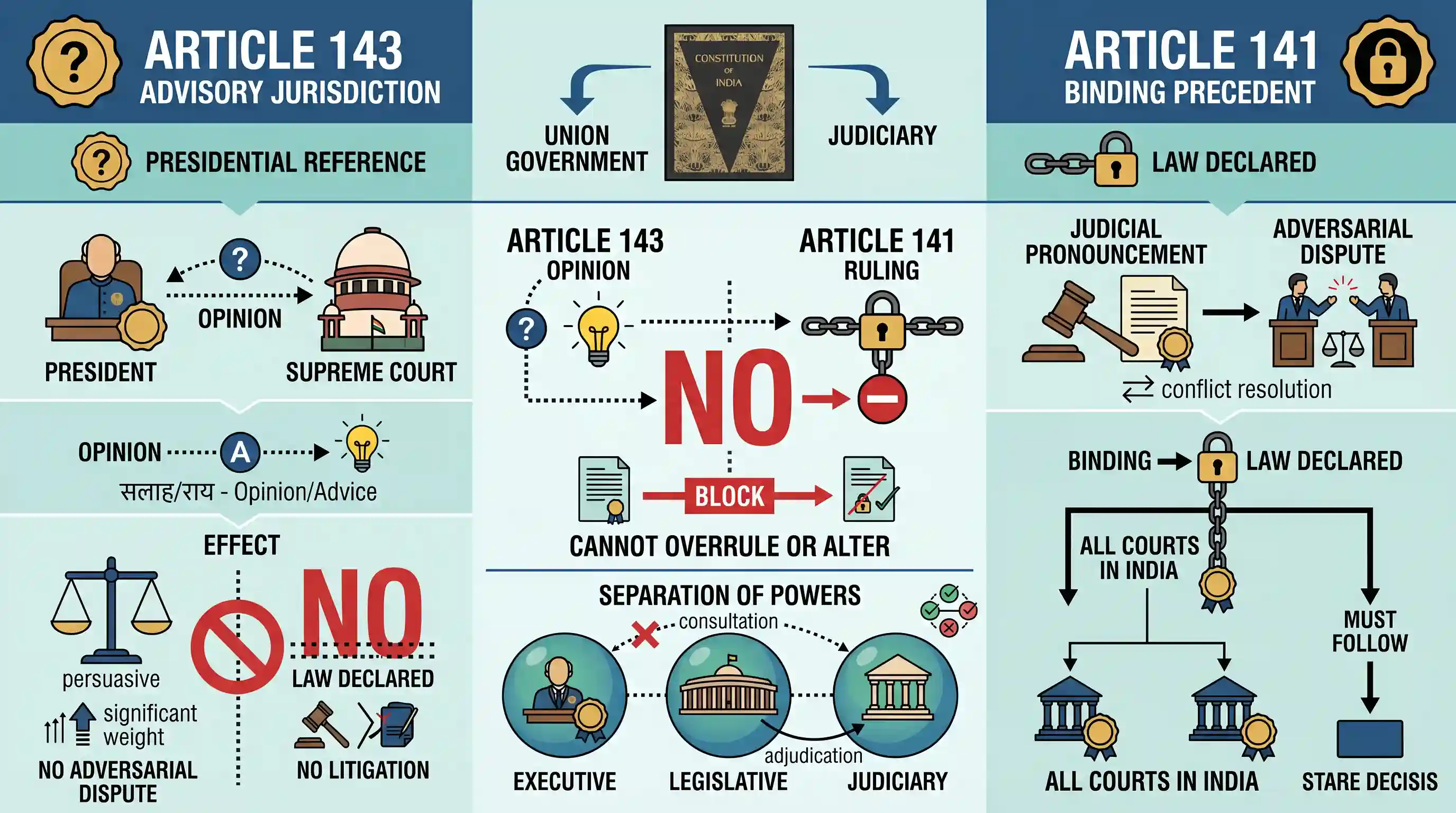
The article examines the constitutional distinction between the Supreme Court's advisory jurisdiction (Article 143) and its binding precedents (Article 141). It discusses whether an advisory opinion given on a Presidential Reference can overrule a prior judicial pronouncement. Constitutional jurisprudence holds that while an advisory opinion carries significant persuasive weight, it does not constitute 'law declared' under Article 141, as it does not resolve an adversarial dispute. Therefore, it cannot formally overrule or alter a prior settled ruling of the Supreme Court.
Key Points
- Article 143 empowers the President of India to consult the Supreme Court on questions of law or public importance, invoking its advisory jurisdiction.
- Under Article 141, the 'law declared' by the Supreme Court in contentious litigation is binding on all courts within India.
- An advisory opinion given by the Supreme Court does not stem from an adversarial dispute and is thus not technically considered a binding precedent.
- Consequently, a Presidential Reference cannot be used as an instrument to formally overrule or alter an existing judicial ruling of the Supreme Court, though it holds high persuasive value.
Important Terms
Article 143

Empowers the President to seek the Supreme Court's opinion on questions of law or fact of public importance. This advisory opinion is not legally binding on the President or the Court.
UPSC context
GS Paper II (Polity); tests knowledge of the Supreme Court's special advisory jurisdiction and executive-judicial consultative mechanisms.
Article 141
Mandates that the 'law declared' by the Supreme Court is binding on all courts within India. It establishes the principle of judicial precedent and ensures national legal uniformity.
UPSC context
GS Paper II (Judiciary); critical for understanding the doctrine of precedent and the authoritative status of Supreme Court judgments.
Presidential Reference
A formal request by the President under Article 143 for judicial advice. It enables the executive to resolve constitutional ambiguities without an active adversarial dispute or litigation.
UPSC context
GS Paper II (Constitution); relevant for Prelims (procedural requirements) and Mains (inter-branch cooperation and judicial boundaries).
Supreme Court of India
The apex judicial body and final interpreter of the Constitution. It exercises original, appellate, and advisory jurisdictions to protect fundamental rights and maintain the rule of law.
UPSC context
GS Paper II (Judiciary); a core topic involving the powers, functions, and independence of the highest court.
Separation of Powers
A constitutional principle dividing government functions among the legislature, executive, and judiciary to ensure a system of checks and balances and prevent power concentration.
UPSC context
GS Paper II (Basic Structure); tests the functional limits and intersections between state organs in a democracy.
Prelims Trap
"An advisory opinion given by the Supreme Court under Article 143 is binding on all lower courts."
Advisory opinions hold immense persuasive value but do not resolve adversarial disputes, meaning they are not 'law declared' under Article 141.
Static Concepts Connected
How does Article 143 divide the Supreme Court's advisory jurisdiction?
- Article 143(1): President can consult SC on public importance matters. SC has discretion to decline answering (e.g., the 1993 Ram Janmabhoomi reference).
- Article 143(2): President can refer disputes arising from pre-Constitution treaties and agreements. The SC is bound to give its opinion to the President.
- Non-binding nature: The opinion given is strictly advisory. It does not bind the President who sought it, nor the subordinate courts.
What is the scope of 'law declared' under Article 141?
- Binding Precedent: Judgments by the SC in contentious litigation bind all courts in India under the doctrine of Stare Decisis.
- SC Excluded: The SC itself is not bound by its own previous decisions and can overrule them via a larger bench.
- Adversarial Requirement: Only decisions arising from adversarial litigation or formal suo motu cognisance qualify as binding law.
Cross-Topic Patterns
Art 143 vs Review Petitions (Art 137)
The Executive cannot use a Presidential Reference as a backdoor 'appeal' to alter settled judgments, which formally require review or curative petitions under Article 137.
Original Jurisdiction (Art 131) vs Advisory Opinions
Unlike Article 131 (Original Jurisdiction) which formally resolves binding Centre-State disputes, Article 143 only offers non-binding legal opinions to the Executive.

A 2026 Prelims question will likely test if Article 143 advisory opinions qualify as 'law declared' under Article 141.
Linked PYQs · 2
Linked PYQs · 2
- 2014PrelimsGS1
The power of the Supreme Court of India to decide disputes between the Centre and the States falls under its
- 2021PrelimsGS1
With reference to Indian judiciary, consider the following statements : 1. Any retired judge of the Supreme Court of India can be called back to sit and act as a Supreme Court judge by the Chief Justice of India with prior permission of the President of India. 2. A High Court in India has the power to review its own judgement as the Supreme Court does. Which of the statements given above is/are correct?
