Biofortified Potato Variety and Addressing Hidden Hunger in India
Source:The Hindu ↗
Why It Matters
It directly addresses food and nutritional security, hidden hunger, and the role of agricultural biotechnology and biofortified crops in public welfare in India.
Summary
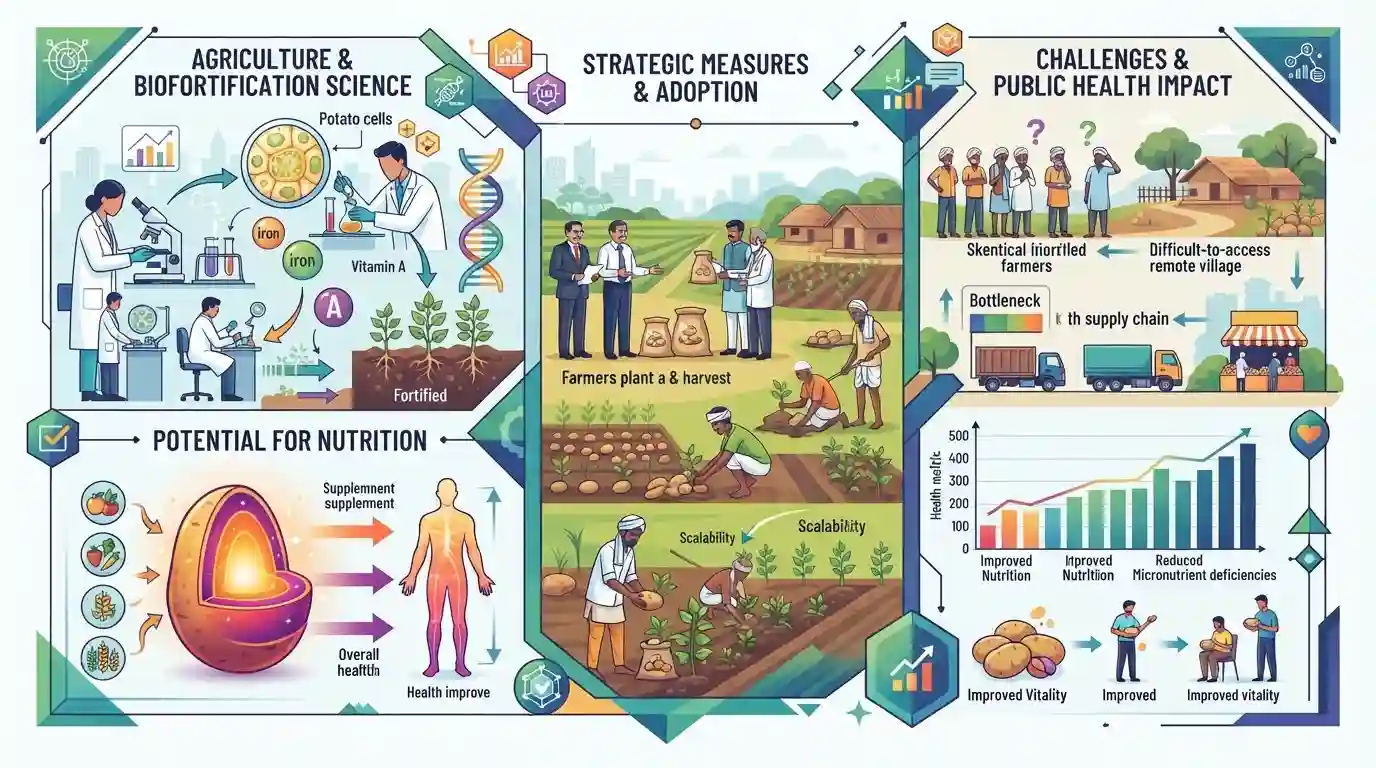
The article examines the promotion of a new fortified potato variety by the Centre as a strategic measure to combat India's persistent 'hidden hunger' (micronutrient malnutrition). It highlights the science of biofortification, the potential of staple crops like potatoes to bridge nutritional gaps, and the associated challenges in adoption, agricultural scalability, and public health impact.
Key Points
- The Centre is promoting a new biofortified potato variety to tackle India's 'hidden hunger' problem (micronutrient deficiencies).
- Biofortification involves breeding crops to increase their nutritional value, offering a sustainable tool alongside dietary diversity and supplementation.
- Potatoes are widely consumed across India, making them an effective vehicle for delivering essential vitamins and minerals to vulnerable populations.
- Challenges remain regarding consumer acceptance, agronomic traits, processing qualities, and ensuring equitable reach to marginalized communities.
Important Terms
Hidden Hunger

A form of undernutrition where a person consumes adequate calories but lacks essential vitamins and minerals like iron, zinc, and Vitamin C, leading to severe health consequences.
UPSC context
UPSC Mains GS Paper II & III: Crucial for topics relating to poverty, hunger, malnutrition, and public health delivery systems.
Biofortification
The agricultural process of breeding staple crops to increase their nutritional value, either through conventional selective breeding or genetic modification, without sacrificing agricultural yield.
UPSC context
UPSC Mains GS Paper III (Agriculture & Science & Technology): Important for food security, crop biotechnology, and nutrition policies.
Kufri Jamunia
A biofortified purple potato variety developed by the ICAR-Central Potato Research Institute, rich in anthocyanins, iron, zinc, and Vitamin C to combat micronutrient malnutrition.
UPSC context
UPSC Prelims & Mains: Tests awareness of indigenous agricultural innovations and government strategies to achieve nutrition security.
Indian Council of Agricultural Research (ICAR)
Apex body for coordinating agricultural research and education in India, operating under the Ministry of Agriculture and Farmers Welfare and creator of specialized crop varieties.
UPSC context
UPSC Prelims & Mains GS Paper III: Frequently tested institutional framework for agricultural R&D, institutional bodies, and food security.
Prelims Trap
Biofortification is the process of artificially adding vitamins and minerals to processed food items before retail packaging.
Biofortification enhances nutritional value during plant growth through breeding or agronomy, whereas fortification involves adding micronutrients during post-harvest food processing or manufacturing.
Static Concepts Connected
What is the difference between biofortification and conventional food fortification?
- Nutrient integration: Breeding approach: Biofortification breeds nutrients directly into crops during plant growth using conventional or biotechnological methods.
- Industrial addition: Processing approach: Conventional fortification adds synthetic micronutrients to processed foods (like iodised salt or fortified oil) at manufacturing plants.
- Targeted delivery: Rural access: Biofortification reaches rural subsistence farmers directly through seed supply chains without requiring industrial processing infrastructure.
Cross-Topic Patterns
Biofortification bridging agriculture and public health
Biofortified staple crops bridge agricultural science and public health schemes like POSHAN Abhiyaan, shifting policy focus from mere caloric sufficiency to comprehensive nutritional security.
Agronomic scaling and intellectual property rights
Deploying genetically modified or conventionally bred nutrient-rich varieties requires navigating strict regulatory frameworks under the EPA and PPV&FR Act to protect farmer rights and biosafety.

Biofortification vs supplementation, ICAR's mandate, and the shift from food to nutrition security are prime multi-statement prelims themes.
Linked PYQs · 2
Linked PYQs · 2
- 2024MainsGS3
Explain the role of millets for ensuring health and nutritional security in India.
- 2019MainsGS3
How can biotechnology help to improve the living standards of farmers?
