Transforming rural education to curb distress youth migration
Source:The Hindu ↗
Why It Matters
Distress migration puts tremendous pressure on urban infrastructure while depleting the human capital of rural areas. Understanding how education and skill development can act as a counter-measure is crucial for formulating policies that promote inclusive growth and effectively harness India's demographic dividend.
Summary
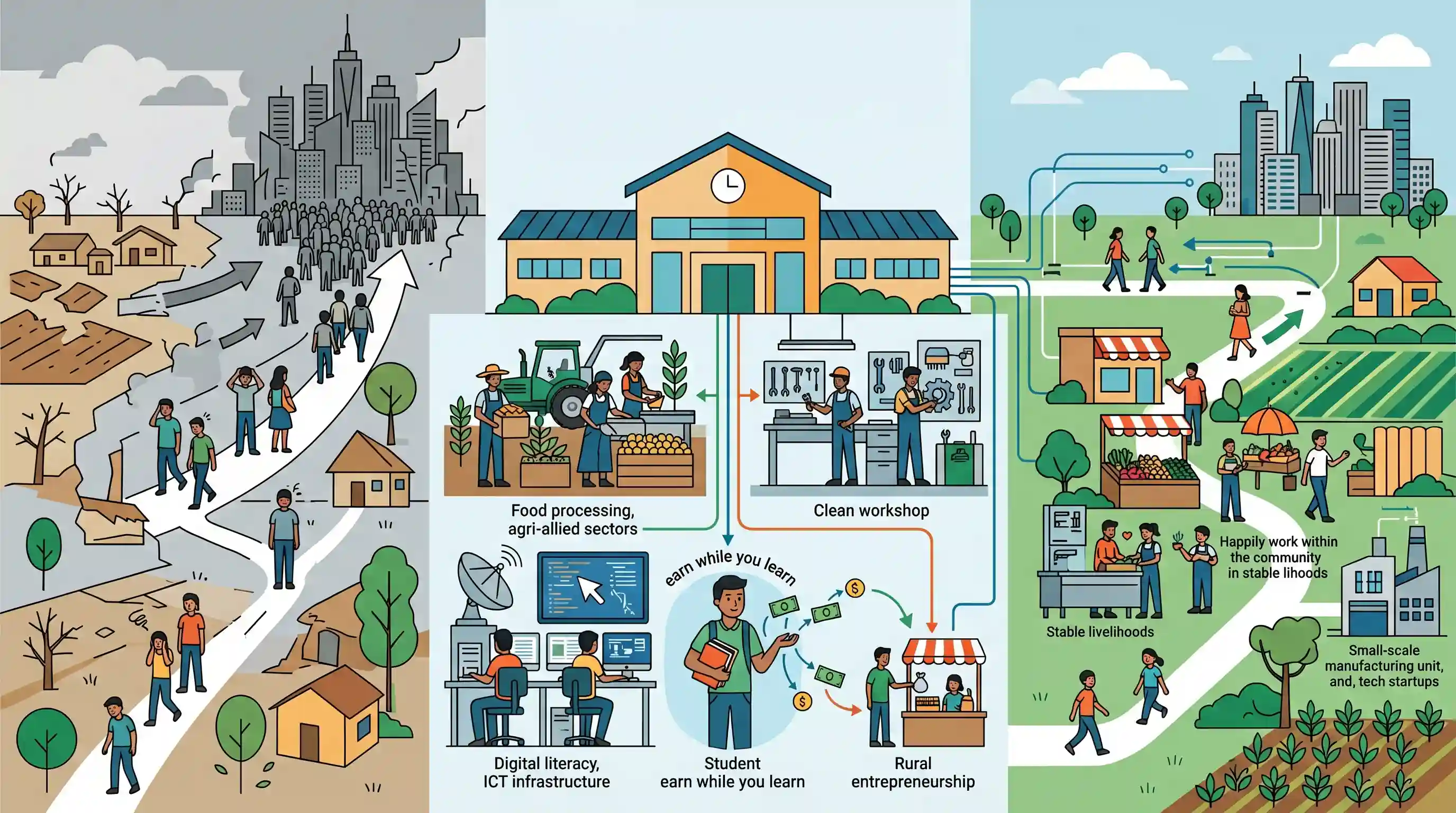
The article explores the potential of rural education and skill development in curbing the mass migration of youth to urban centers. By shifting the educational paradigm to focus on vocational training, digital literacy, and localized skill-sets (such as food processing, allied agricultural sectors, and rural entrepreneurship), rural areas can transform into hubs of economic opportunity. Bridging the rural-urban divide requires policy interventions that integrate education with employment—like strengthening 'earn while you learn' initiatives and enhancing ICT infrastructure—allowing rural youth to find viable livelihoods and preventing the overcrowding of metropolises.
Key Points
- Youth migration from rural to urban areas is largely driven by a lack of quality education, skill development, and employment opportunities in home regions.
- Re-imagining rural education involves shifting from traditional rote learning to vocational training, digital literacy, and localized skill sets (e.g., modern agriculture, food processing).
- Bridging the digital divide and enhancing ICT accessibility in rural areas can enable youth to participate in the remote work and gig economy, reducing the need for physical migration.
- Promoting rural entrepreneurship through micro-enterprises, better credit access, and 'earn while you learn' models can create robust local job markets.
- Strengthening rural institutions and integrating education with market-relevant skill development is crucial to halting distress migration and preventing urban overcrowding.
Important Terms
National Education Policy (NEP) 2020

India's first 21st-century education policy, replacing the 1986 version. It integrates vocational training from Grade 6 and emphasizes holistic, multidisciplinary, and regional-language-based learning to enhance employability.
UPSC context
GS Paper II (Education) and GS III (Employment). Essential for discussing structural reforms to bridge the rural-urban divide.
Skill India Mission
A flagship initiative launched in 2015 to create a skilled workforce. It focuses on industry-relevant training, vocational certification, and entrepreneurship through schemes like PMKVY and SANKALP.
UPSC context
GS Paper III (Economy/Employment). Tests strategies for human capital development and leveraging the demographic dividend.
Panchayati Raj Institutions (PRIs)
The constitutionalized three-tier system (73rd Amendment, 1992) for rural local self-government. They are pivotal for decentralized planning and the local implementation of education and employment schemes.
UPSC context
GS Paper II (Governance/Decentralization). Key for analyzing grassroots implementation of development policies to curb migration.
Self Help Groups (SHGs)
Informal village-level associations, often women-led, that pool savings for collective lending. They promote rural entrepreneurship, micro-finance, and socio-economic empowerment at the community level.
UPSC context
GS Paper II (Social Justice) and GS III (Inclusive Growth). Focuses on community-led poverty alleviation and rural development.
Ministry of Skill Development and Entrepreneurship (MSDE)
The nodal ministry established in 2014 to coordinate all skill development efforts across India. It oversees the National Skill Development Mission and creates frameworks for vocational training.
UPSC context
GS Paper II (Government Policies). Evaluates institutional frameworks driving the national skilling and employment agenda.
Prelims Trap
"Rural-to-urban migration constitutes the largest absolute share of internal migration in India."
Rural-to-rural migration actually dominates internal migration volume in India, primarily driven by female marriage migration, significantly outnumbering rural-to-urban economic migration.
Static Concepts Connected
What are the Push and Pull factors defining internal migration in India?
- Push Factors: Driven by distress, including systemic unemployment, agricultural stagnation, poverty, and lack of quality educational/health infrastructure in source regions.
- Pull Factors: Driven by opportunity, encompassing urban industrial and service jobs, higher comparative wages, and access to modern urban amenities.
How does NEP 2020 envision the integration of vocational education?
- Early Integration: Introduces vocational exposure and 'bagless days' starting from Grade 6, including practical internships with local artisans and businesses.
- Coverage Target: Mandates that at least 50% of all learners through the school and higher education system shall have exposure to vocational education by 2025.
- Resource Sharing: Promotes a hub-and-spoke model where schools lacking infrastructure collaborate with ITIs, polytechnics, and local industries for skill training.
Cross-Topic Patterns
Agro-processing + Disguised Unemployment
Localized skilling in food processing absorbs excess agricultural labor, directly tackling disguised unemployment while capturing higher value in the agricultural supply chain.
Gig Economy + Rural Infrastructure
Expanding BharatNet and bridging the rural digital divide enables rural youth to participate in the gig economy, shifting migration from physical relocation to digital integration.

Expect a Mains 2026 GS3 question evaluating how localized vocational skilling (NEP 2020) can absorb rural disguised unemployment.
Linked PYQs · 5
Linked PYQs · 5
- 2024MainsGS1
Why do large cities tend to attract more migrants than smaller towns? Discuss in the light of conditions in developing countries.
- 2023MainsGS2
Skill development programmes have succeeded in increasing human resources supply to various sectors. In the context of the statement analyse the linkages between education, skill and employment.
- 2021MainsGS2
Has digital illiteracy, particularly in rural areas, coupled with lack of Information and Communication Technology (ICT) accessibility hindered socio-economic development? Examine with justification.
- 2021MainsGS2
“Earn while you learn' scheme needs to be strengthened to make vocational education and skill training meaningful.” Comment.
- 2015MainsGS3
Livestock rearing has a big potential for providing non-farm employment and income in rural areas. Discuss suggesting suitable measures to promote this sector in India.
