West Bengal Allocated Central Funds for School Infrastructure Upgrade
Source:indiatoday ↗
Why It Matters
The development illustrates the practical functioning of Centre-State fiscal federalism in the education sector (a Concurrent List subject). Furthermore, implementing a geo-referenced attendance app highlights technology-driven governance (e-governance) aimed at resolving systemic welfare leakages.
Summary
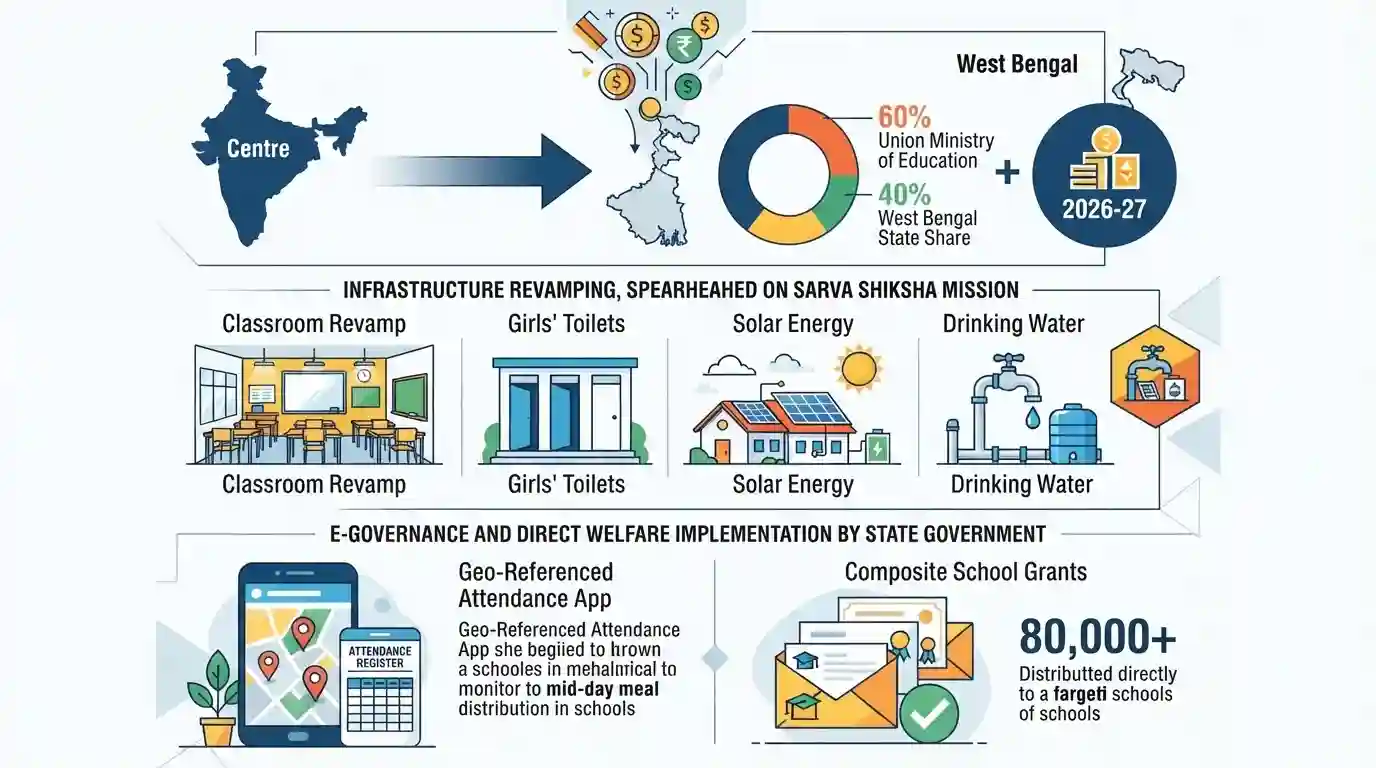
West Bengal is slated to receive an allocation of nearly Rs 2,700 crore for the 2026-27 fiscal year under the Union Ministry of Education's Project Approval Board (PAB), following a 60:40 Centre-State funding formula. Spearheaded by the Sarva Shiksha Mission, the funds are intended to revamp fundamental school infrastructure, including classrooms, girls' toilets, solar energy, and drinking water pipelines (earmarked at Rs 500 crore). Concurrently, the state government has introduced a geo-referenced mobile app for attendance tracking to minimize mid-day meal leakages, while distributing composite school grants to over 80,000 schools.
Key Points
- West Bengal is set to receive approximately Rs 2,700 crore for school infrastructure under the Union Ministry of Education's Project Approval Board (PAB) for 2026-27.
- The funding follows a 60:40 Centre-State sharing pattern and will target basic upgrades like additional classrooms, girls' toilets, handrails, and solar energy.
- Rs 500 crore is specifically designated for installing drinking water pipelines in schools, and sanitary napkin-vending machines will be deployed in around 9,000 senior secondary schools.
- Chief Minister Suvendu Adhikari disbursed Rs 296.64 crore as a 'composite school grant' directly to 80,375 state-run and state-aided schools.
- To curb leakages in the mid-day meal scheme and avoid the high costs of conventional biometrics, the state government launched a geo-referenced mobile application for monitoring teacher and student attendance.
Important Terms
Samagra Shiksha

An overarching centrally sponsored scheme extending from pre-school to class 12, aiming to provide equitable quality education by subsuming previous missions like the Sarva Shiksha Abhiyan.
UPSC context
Crucial for WBCS Paper V (Economy & Social Development), assessing knowledge of flagship central government education schemes.
Mid-day Meal Scheme
A flagship welfare program providing free, hot-cooked meals to children in government and aided schools to combat malnutrition and improve attendance and retention rates.
UPSC context
Highly relevant for WBCS Paper IV (Current Affairs) and Paper V (Welfare Schemes) regarding public health and education.
Project Approval Board (PAB)
A committee under the Union Ministry of Education responsible for appraising and approving state-submitted annual work plans and budgets before disbursing central education funds.
UPSC context
Important for WBCS Paper V (Centre-State Relations and Public Finance) to understand how federal grants are authorized.
Sarva Shiksha Mission
The designated state-level nodal agency in West Bengal that implements central educational frameworks like Samagra Shiksha, focusing on basic school infrastructure and learning outcomes.
UPSC context
Vital for the WBCS exam, testing knowledge of West Bengal's specific institutional frameworks and state-level educational governance.
Composite School Grant
An annual fund provided to government schools based on student enrollment to cover recurring operational expenses, minor repairs, maintenance, and day-to-day administrative needs.
UPSC context
Tests understanding of grassroots educational funding mechanisms, relevant to WBCS Paper V (Social Sector Spending).
Prelims Trap
Samagra Shiksha and PM-POSHAN are Central Sector schemes fully funded by the Union Government.
They are Centrally Sponsored Schemes, not Central Sector. For general category states like West Bengal, the funding burden is shared in a 60:40 ratio between the Centre and the State.
Static Concepts Connected
How did Education become a Concurrent Subject?
- Original Status: Education was originally placed in the State List (List II) of the 7th Schedule.
- 42nd Amendment: The 42nd Constitutional Amendment Act of 1976 transferred Education, along with four other subjects, to the Concurrent List (List III).
- Legislative Supremacy: Both Parliament and State legislatures can make laws on it, but Central laws prevail in cases of direct conflict (Article 254).
What distinguishes Centrally Sponsored Schemes (CSS) from Central Sector Schemes?
- Central Sector: These are 100% funded and directly implemented by the Union Government.
- Centrally Sponsored: These are jointly funded by the Centre and States (e.g., 60:40) but are implemented by the respective State Governments. Samagra Shiksha is a CSS.
Cross-Topic Patterns
Geo-tagging replaces expensive welfare biometrics
West Bengal's geo-referenced app for PM-POSHAN attendance highlights a scalable, low-capex e-governance alternative to hardware-heavy biometric systems to plug welfare leakages.
CSS conditionalities and federal friction
The 60:40 disbursement of Project Approval Board (PAB) funds tests cooperative federalism, as states must allocate matching grants and adhere to Union branding to unlock their share.

Expect multi-statement MCQs combining the 42nd Amendment (Education transfer), Samagra Shiksha's 60:40 funding, and PM-POSHAN governance.
Linked PYQs · 3
Linked PYQs · 3
- 2021WBCS_PRELIMSGS1
Sabooj-Sathi is a scheme for distribution of Bicycles to students of Government/Government Aided Schools/Madrasahs reading in
- 2024WBCS_PRELIMSGS1
Which of the following correctly describes the relationship between the Union and the States under the Constitution of India?
- 2022WBCS_PRELIMSGS1
For the purpose of legislation, education is enlisted in the
