Supreme Court Asks Delhi High Court on Senior Advocate Reassessment
Source:Indian Express ↗
Why It Matters
The designation of Senior Advocates by High Courts and the Supreme Court highlights issues of internal judicial administration, transparency, and fairness. It ties into broader UPSC themes regarding the regulation of the legal profession, institutional accountability, and ensuring merit-based recognition within the judicial system.
Summary
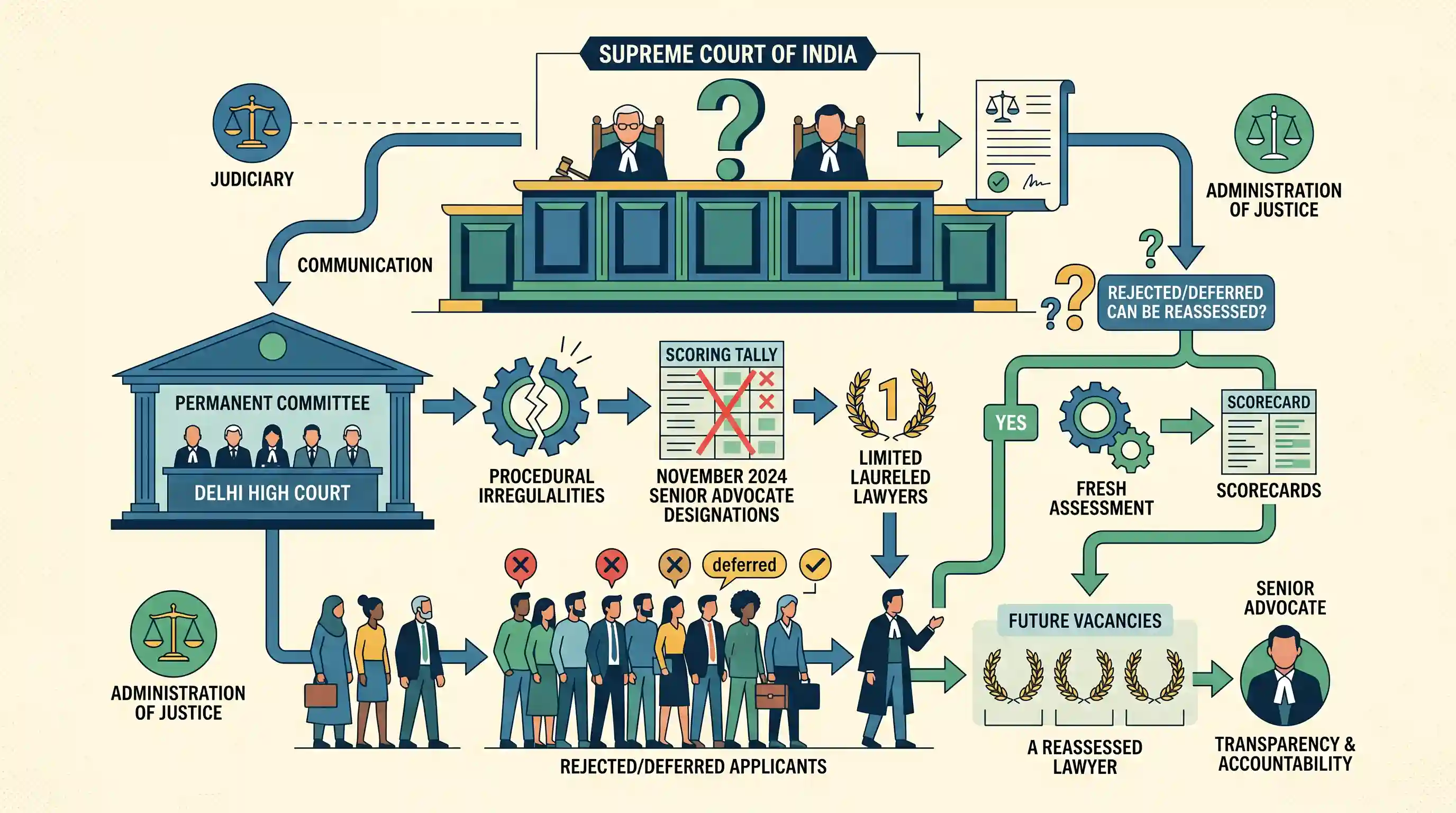
The Supreme Court has asked the Delhi High Court to clarify whether its permanent committee can undertake a fresh assessment of lawyers whose applications for senior advocate designation were previously deferred or rejected. This intervention follows a petition challenging the November 2024 senior advocate designations made by the Delhi High Court, alleging procedural irregularities. A bench consisting of Justices Abhay S Oka and Ujjal Bhuyan sought to know if reassessment is viable should vacancies arise.
Key Points
- The Supreme Court has sought clarification from the Delhi High Court on whether its permanent committee can conduct a fresh assessment for lawyers whose applications for 'senior advocate' designation were rejected or deferred.
- The inquiry follows a plea seeking the quashing of the Delhi High Court's November 2024 decision to designate certain advocates as senior, alleging irregularities in the selection process.
- The Supreme Court bench, comprising Justices Abhay S Oka and Ujjal Bhuyan, asked if reassessments could be held if vacancies exist for senior designations.
Important Terms
Senior Advocate

A lawyer designated by the Supreme Court or High Courts under Section 16 of the Advocates Act, 1961, based on excellence, legal expertise, and standing at the Bar; subject to certain practice restrictions.
UPSC context
GS Paper II: Judiciary. Relevant for topics on legal profession regulation, judicial transparency, and the administration of justice in India.
Committee for Designation of Senior Advocates (Permanent Committee)
A permanent body (comprising the Chief Justice, senior judges, government law officers, and Bar members) tasked with evaluating and interviewing candidates for senior status using a merit-based, point-driven assessment system.
UPSC context
GS Paper II: Judiciary. Tests knowledge of judicial institutional reforms post-Indira Jaising and procedural transparency in the legal profession.
Advocates Act, 1961
The primary legislation regulating the legal profession in India, establishing the Bar Council and categorizing lawyers into two classes—senior advocates and other advocates—based on merit and professional standing.
UPSC context
GS Paper II: Judiciary. Fundamental for understanding the statutory framework governing legal practice, professional ethics, and judicial administration.
Indira Jaising v. Union of India (2017)
A landmark 2017 Supreme Court judgment that overhauled the senior advocate designation process, mandating permanent committees and objective criteria (experience, judgments, and publications) to ensure meritocracy and eliminate judicial arbitrariness.
UPSC context
GS Paper II: Judiciary. A key case study for judicial reforms, transparency in legal honors, and constitutional challenges to discretionary powers.
Full Court
A collective assembly of all judges of the Supreme Court or a High Court. It serves as the final authority for approving senior designations and discussing major administrative or policy matters.
UPSC context
GS Paper II: Judiciary. Important for understanding the collegial nature of judicial administration and decision-making within Indian courts.
Prelims Trap
"Senior Advocates can directly accept client briefs and file a Vakalatnama in the Supreme Court."
Senior Advocates face strict restrictions. They cannot directly accept client briefs, independently draft pleadings, or file a Vakalatnama in any court. They must be instructed by another advocate.
Static Concepts Connected
How are Senior Advocates designated in India?
- Statutory Basis: Section 16 of the Advocates Act, 1961 empowers both the Supreme Court and High Courts to confer this distinction.
- Permanent Committee: Post the Indira Jaising judgments, a Permanent Committee oversees the process. For the SC, it comprises the CJI, two senior-most judges, the Attorney General, and a nominated Bar member.
- Eligibility Criteria: Requires at least 10 years of standing as an advocate (or combined judicial service) and generally a minimum age of 45 years.
What are the privileges and restrictions of Senior Advocates?
- Key Privileges: They enjoy the statutory "right of pre-audience" (cases heard before junior advocates) and the privilege of sitting in the court's 'Inner Bar'.
- Strict Restrictions: They cannot file a 'Vakalatnama', directly accept briefs from clients, or independently draft pleadings. They only appear when briefed by an AoR or junior advocate.
Cross-Topic Patterns
Judicial administration & transparency
The push for objective scoring in senior designations (via the Indira Jaising judgment) parallels broader demands for transparency in judicial administration, much like the debates surrounding the Collegium system.
Advocates Act & BCI regulations
Rules for Senior Advocates frequently overlap with broader regulatory debates under the Advocates Act, including the Bar Council of India's powers and the recent entry of foreign law firms.

Expect a multi-statement Prelims question on the Advocates Act, specifically mixing Senior Advocate privileges with Advocate-on-Record rules.
Linked PYQs · 2
Linked PYQs · 2
- 2023MainsGS2
“Constitutionally guaranteed judicial independence is a prerequisite of democracy.” Comment.
- 2019MainsGS2
“The Attorney-General is the chief legal adviser and lawyer of the Government of India.” Discuss.
