Monetary Policy Limitations on Supply Side Inflation
Source:Indian Express ↗
Why It Matters
Understanding how central banks tackle or fail to tackle supply-side inflation is crucial for GS3 Economy syllabus, especially given recurring food and energy price shocks in India.
Summary
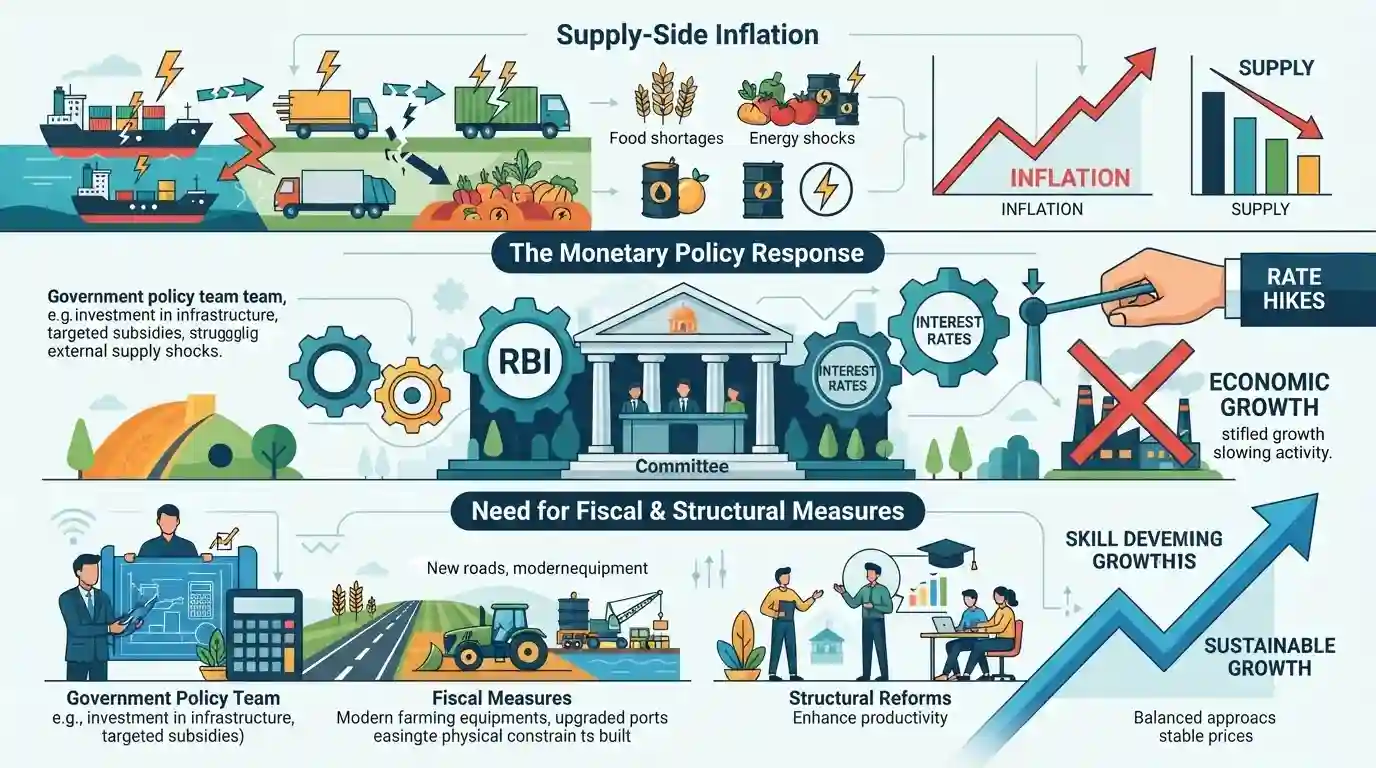
The article explores the limitations of monetary policy in managing inflation caused by supply-side disruptions. While central banks like the RBI use interest rate adjustments to curb demand-pull inflation, supply shocks—such as food and energy shortages—reduce output and drive up prices. Tightening monetary policy in response can stifle growth without fixing physical supply constraints, making fiscal and structural measures essential.
Key Points
- Monetary policy primarily addresses demand-pull inflation by adjusting interest rates and liquidity to influence aggregate demand.
- Inflation arising from supply-side disruptions (such as geopolitical conflicts, crop failures, or supply chain bottlenecks) reduces output and raises prices simultaneously, presenting a dilemma for central banks.
- Using contractionary monetary policy to combat supply-side inflation can severely hurt economic growth and output without directly easing the underlying physical shortages.
- Central banks often look through transient supply shocks, but persistent supply-side pressures require structural measures, fiscal interventions, and supply management rather than monetary tightening alone.
Important Terms
Reserve Bank of India

India's central banking institution that controls monetary policy, regulates the banking system, manages foreign exchange, and acts as a lender of last resort to commercial banks.
UPSC context
UPSC GS Paper III (Indian Economy): Core institution responsible for monetary management, inflation targeting, and financial stability.
Monetary Policy Committee
A statutory six-member body headed by the RBI Governor, responsible for fixing the benchmark interest rate (repo rate) to achieve the mandated inflation target.
UPSC context
UPSC GS Paper III (Indian Economy): Tests understanding of inflation targeting framework, monetary policy tools, and institutional governance.
Prelims Trap
Monetary policy tools can effectively counter all forms of inflation, including food and energy supply shocks, by adjusting interest rates.
Aspirants often assume that raising interest rates is a universal remedy for all types of inflation. In reality, monetary policy has severe limitations against structural supply shocks.
Static Concepts Connected
What is the difference between demand-pull inflation and cost-push inflation, and how do their transmission mechanisms vary?
- Demand-Pull: Caused by aggregate demand exceeding aggregate supply ('too much money chasing too few goods'); typically managed effectively via contractionary monetary policy.
- Cost-Push: Caused by rising costs of wages, raw materials, or supply chain bottlenecks; reduces output while raising prices, creating a dilemma for central banks.
- Policy Dilemma: Monetary policy can cool demand-pull quickly, but raising interest rates cannot fix physical shortages behind cost-push inflation without crushing growth.
Cross-Topic Patterns
Supply-Side Inflation vs Industrial Growth Cycles
Food inflation driven by crop failures forces RBI to pause rate cuts, directly impacting credit availability for industrial growth and capex cycles.

Inflation targeting + supply shocks tested via statement questions on MPC mandate limits and fiscal-monetary coordination.
Linked PYQs · 1
Linked PYQs · 1
- 2024MainsGS3
What are the causes of persistent high food inflation in India? Comment on the effectiveness of the monetary policy of the RBI to control this type of inflation.
