Monetary Policy Limitations on Supply Side Inflation
Source:Indian Express ↗
આ શા માટે મહત્વનું છે
Understanding the limits of monetary policy in curbing supply-side and food inflation is crucial for aspirants studying macroeconomic stabilization, central banking, and coordination between fiscal and monetary policies in India.
સારાંશ
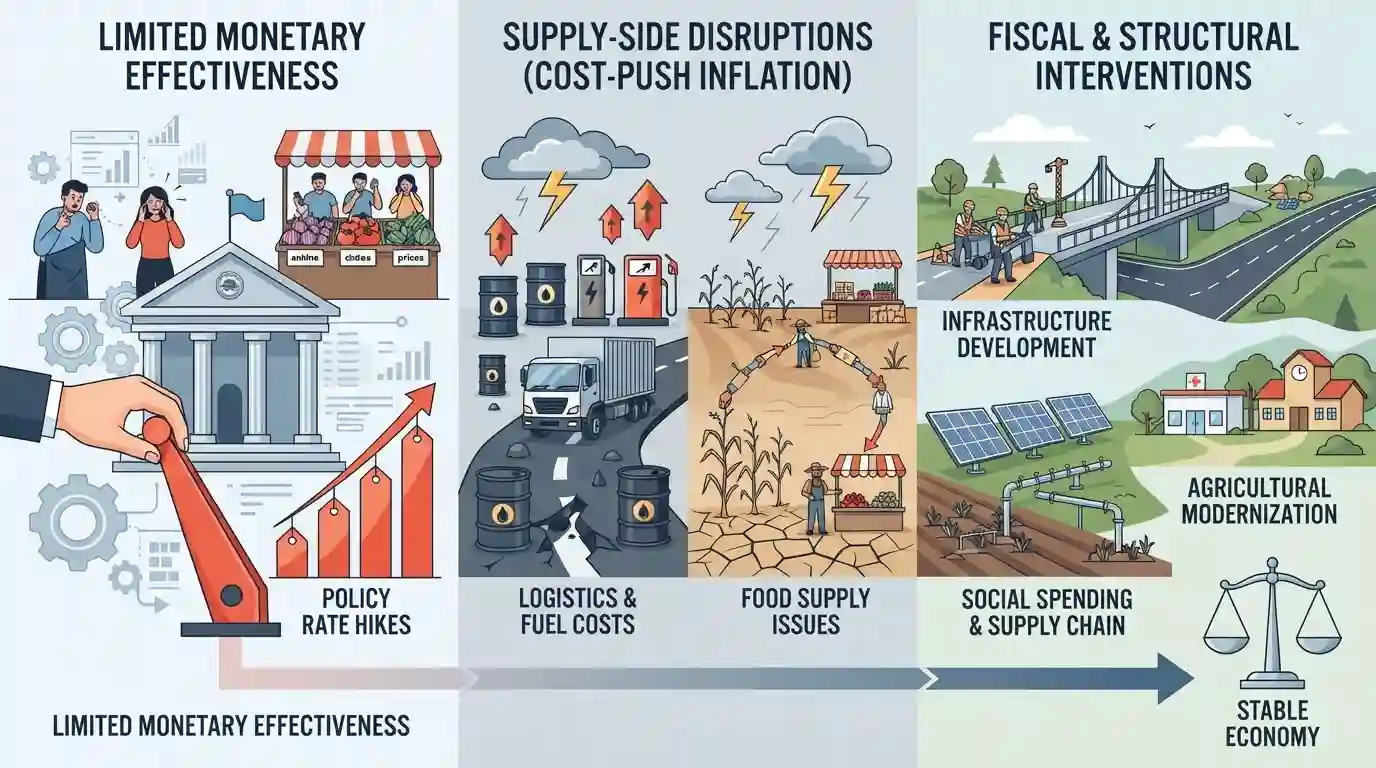
The article examines the limitations of monetary policy in addressing inflation driven by supply-side disruptions, highlighting why tools like interest rate hikes are less effective against cost-push or food inflation and emphasizing the need for fiscal and structural interventions.
મુખ્ય મુદ્દા
- Monetary policy primarily targets demand-pull inflation by altering interest rates and liquidity to influence aggregate demand.
- Supply-side disruptions, such as crop failures, supply chain bottlenecks, and geopolitical conflicts, cause cost-push inflation which is difficult for monetary policy to tackle directly.
- Using high interest rates to combat supply-side inflation can harm economic growth and investment without significantly reducing food or fuel prices.
- A coordinated approach combining monetary policy with fiscal measures, supply management, and structural reforms is necessary to address inflation effectively.
મહત્વપૂર્ણ શબ્દો
Reserve Bank of India

India's central banking institution, which controls monetary policy, regulates the banking system, manages foreign exchange, and operates the currency issuing system under the RBI Act, 1934.
UPSC context
UPSC GS Paper III (Indian Economy): Essential for questions on monetary policy, inflation targeting, banking regulation, and macroeconomic stability.
Monetary Policy Committee
A statutory 6-member body constituted under the RBI Act to fix the benchmark policy interest rate (repo rate) to achieve the inflation target while supporting growth.
UPSC context
UPSC GS Paper III (Indian Economy): Directly tested under monetary policy framework, inflation management, and institutional roles.
Supply-side Inflation
Inflation triggered by negative shocks to aggregate supply, such as spikes in oil prices, geopolitical conflicts, or crop failures, leading to rising production costs and commodity prices.
UPSC context
UPSC GS Paper III (Indian Economy): Tests understanding of inflation dynamics, structural bottlenecks, and limitations of central bank tools.
Second-round Effects
Indirect spillover effects where initial supply-side shocks or commodity price hikes propagate into generalized wage demands, transportation costs, and broader consumer price inflation.
UPSC context
UPSC GS Paper III (Indian Economy): Crucial for analyzing why central banks raise interest rates even during supply-driven inflation crises.
Fiscal Intervention
Government measures involving taxation, public expenditure, subsidies, and capital investments used alongside or instead of monetary policy to alleviate supply constraints and cost-push inflation.
UPSC context
UPSC GS Paper III (Indian Economy): Important for questions comparing monetary vs. fiscal policy instruments in managing inflation and economic growth.
પ્રિલિમ્સ ટ્રેપ
Monetary policy tools like repo rate hikes are equally effective in tackling both demand-pull and supply-side cost-push inflation.
Aspirants often assume central bank rate hikes can cure all forms of inflation equally, forgetting that monetary policy operates primarily on demand-pull rather than cost-push or supply-shock inflation.
સંલગ્ન સ્થિર ખ્યાલો
What is the difference between demand-pull and cost-push inflation in the Indian macroeconomic context?
- Demand-pull definition: Excess aggregate demand over aggregate supply, often fueled by excess money supply or fiscal expansion, driving up general price levels.
- Cost-push definition: Increase in costs of wages and raw materials, or supply shocks like crop failures and geopolitical oil spikes, shifting the aggregate supply curve leftward.
- Policy response divergence: RBI's Monetary Policy Committee primarily targets demand-pull pressures via interest rates, while cost-push requires supply management and fiscal interventions.
આંતર-વિષય પેટર્ન
Monetary Policy vs Fiscal Deficit Trade-off
Food inflation driven by supply shocks often forces RBI into rate hikes, directly conflicting with industrial credit growth and fiscal deficit consolidation targets.
Inflation Targeting vs Structural Food Shocks
Agricultural supply chain bottlenecks create persistent food inflation, testing the limits of RBI's flexible inflation targeting framework designed primarily for demand management.

Expect a multi-statement Prelims question on whether RBI's repo rate hikes can directly tame cost-push or food inflation.
સંલગ્ન PYQ · 1
સંલગ્ન PYQ · 1
- 2024MainsGS3
What are the causes of persistent high food inflation in India? Comment on the effectiveness of the monetary policy of the RBI to control this type of inflation.
