Molecular Data Storage Emerges as Alternative to Silicon Technology
Source:The Hindu ↗
Why It Matters
Evaluates an emerging crossover technology between biology, chemistry, and computer science that could solve the global data storage crisis. Highly relevant for Mains questions on emerging technologies and Prelims questions on advanced computing, similar to past questions on quantum computing (qubits) and synthetic biology.
Summary
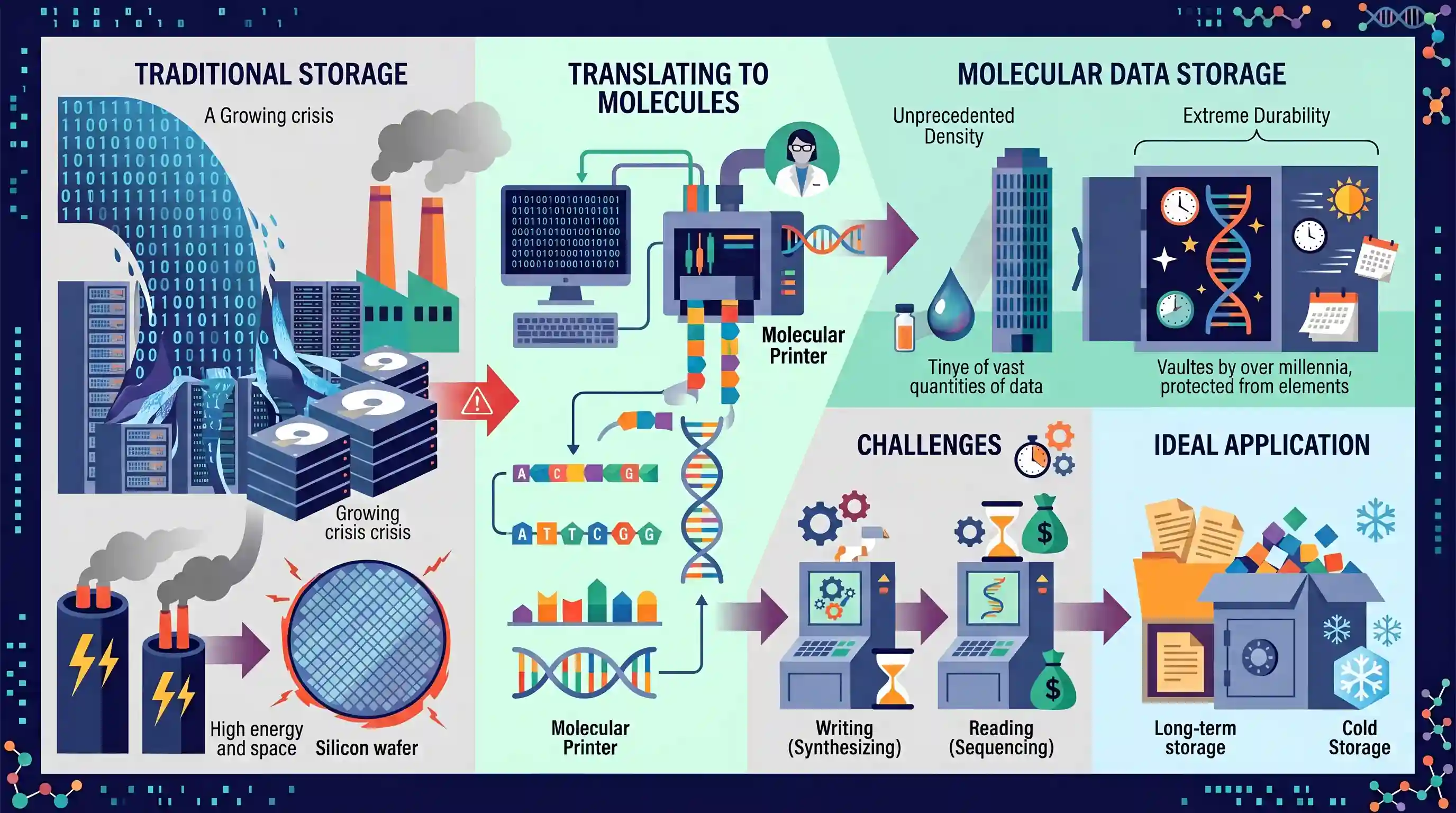
The exponential rise in global digital data is pushing traditional silicon and magnetic storage technologies to their limits, demanding vast amounts of physical space and energy. To address this, scientists are exploring molecular data storage, which involves translating binary digital information into molecular sequences, such as the base pairs (A, C, T, G) of DNA or synthetic polymers. This emerging technology offers unprecedented data density—potentially storing exabytes of data in a microscopic volume—and exceptional durability, capable of preserving information for millennia without power. However, significant challenges remain, primarily the slow speed and high cost of "writing" (synthesizing) and "reading" (sequencing) the molecular data. As a result, molecular storage is currently viewed as a promising solution for long-term archival "cold storage" rather than for applications requiring rapid data retrieval.
Key Points
- The exponential growth of global data is creating a critical challenge for traditional storage methods (silicon chips, magnetic tapes), which consume massive amounts of energy and physical space.
- Molecular data storage, particularly using DNA or synthetic polymers, offers a revolutionary alternative by translating digital binary data (0s and 1s) into molecular sequences (such as A, T, C, G in DNA).
- The primary advantages of molecular storage are ultra-high data density (storing exabytes in a tiny volume) and extreme longevity (remaining stable for thousands of years without requiring constant power).
- The main challenges preventing immediate widespread adoption are the high costs and slow speeds of writing (synthesizing the molecules) and reading (sequencing) the data.
- Consequently, molecular data storage is currently most viable as an archival 'cold storage' solution rather than for data needing frequent or instantaneous access.
Prelims Trap
Molecular data storage currently offers faster read/write data retrieval speeds than traditional silicon chips.
It is the opposite. Synthesizing (writing) and sequencing (reading) DNA is currently very slow and expensive, making it suitable only for archival 'cold storage'.
Static Concepts Connected
What is the structural basis of DNA used in molecular data storage?
- Nucleotides: The basic building blocks of DNA containing a sugar, a phosphate group, and a nitrogenous base.
- Base Pairs: Binary information (0s and 1s) is mapped to the sequence of four bases: Adenine (A), Thymine (T), Cytosine (C), and Guanine (G).
- Double Helix: The highly stable molecular structure ensures extreme longevity, capable of preserving data for millennia without requiring a power supply.
What characterizes 'cold storage' in IT and data management?
- Archival Use: Used for retaining inactive data that is rarely accessed but must be preserved for regulatory compliance, historical, or backup purposes.
- High Latency: Prioritizes ultra-high capacity, durability, and low maintenance energy over rapid read/write access speeds.
Cross-Topic Patterns
Green Computing and Climate Goals
Traditional data centers consume massive electricity for cooling. DNA storage offers a zero-power archival alternative, linking IT infrastructure directly to national emission reduction strategies.
Convergence of Biotech & IT
UPSC frequently tests interdisciplinary tech. Molecular storage blends genomic sequencing (biotech) with binary data encoding (computer science) to solve physical limits of global data storage.

2026 Prelims will likely test DNA data storage by highlighting its 'cold storage' limitation due to very slow read/write speeds.
Linked PYQs · 4
Linked PYQs · 4
- 2022PrelimsGS1
Which one of the following is the context in which the term "qubit" is mentioned ?
- 2024PrelimsGS1
Consider the following statements: I. It is expected that Majorana 1 chip will enable quantum computing. II. Majorana 1 chip has been introduced by Amazon Web Services (AWS). III. Deep learning is a subset of machine learning. Which of the statements given above are correct?
- 2021MainsGS3
What are the research and developmental achievements in applied biotechnology? How will these achievements help to uplift the poorer sections of the society?
- 2020MainsGS3
What do you understand by nanotechnology and how is it helping in health sector?
