Edge AI Adoption Strategy and Semiconductor Mission Integration
Source:Indian Express ↗
Why It Matters
Artificial Intelligence and advanced computing paradigms (like Edge Computing, Quantum Computing, etc.) are highly recurrent themes in UPSC Prelims and Mains (GS3). Understanding the shift from Cloud AI to Edge AI is vital for answering questions on technology applications, data security, and India's indigenization efforts (e.g., India Semiconductor Mission).
Summary
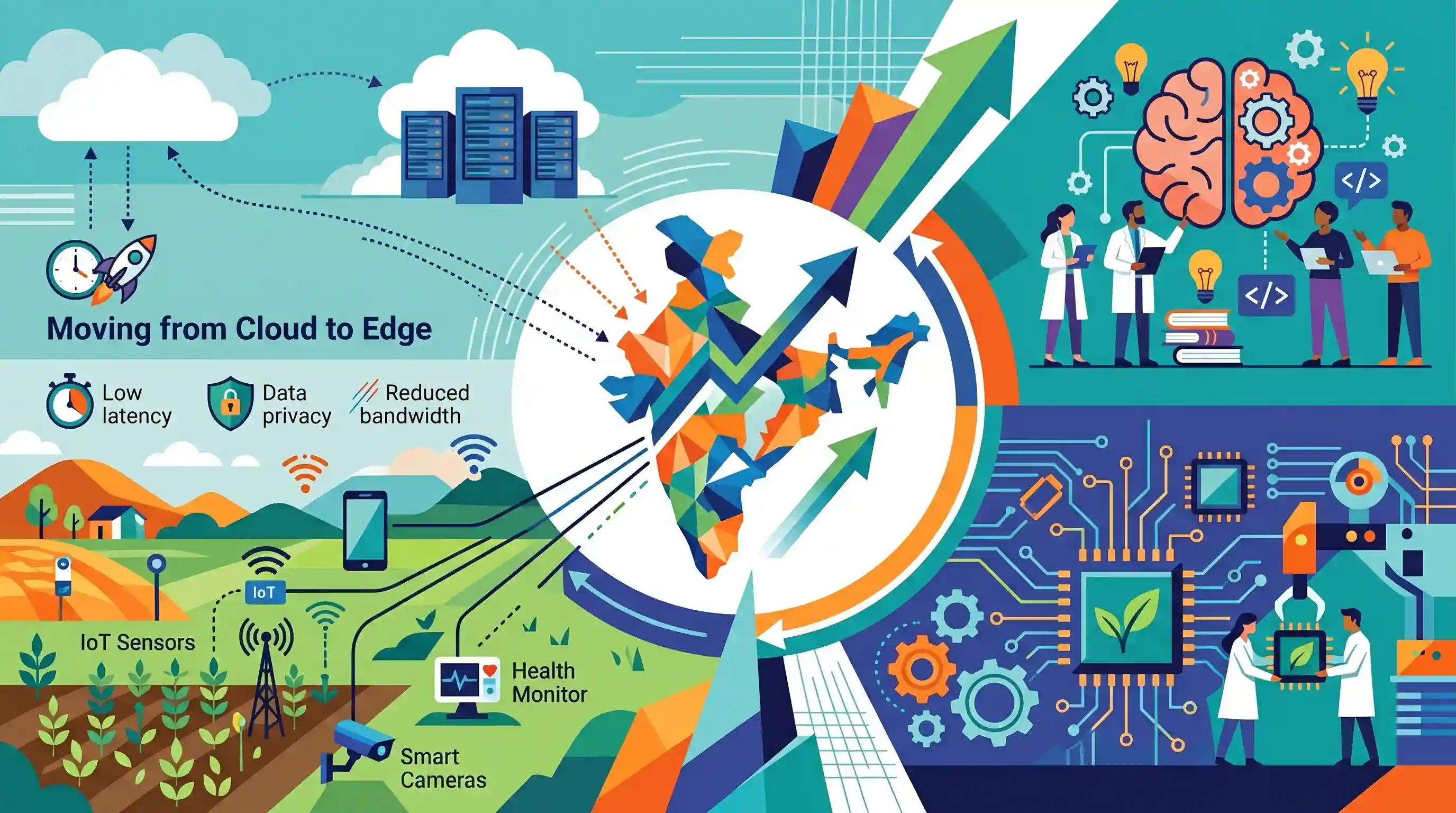
The article discusses India's strategic potential to carve out a leadership role in "Edge AI" amidst the global artificial intelligence race. Discussed at a pre-summit event, experts emphasized that moving AI processing from the cloud to the "edge" (local devices) offers critical advantages like lower latency, reduced bandwidth reliance, and enhanced data privacy. For India, this approach is particularly relevant given its vast rural expanses with intermittent internet connectivity. To capitalize on this, India needs to align its AI strategies with hardware development, heavily relying on the India Semiconductor Mission to build localized, power-efficient chips, and the IndiaAI Mission to foster indigenous innovation and talent.
Key Points
- Edge AI refers to processing artificial intelligence algorithms locally on hardware devices (like smartphones or IoT sensors) rather than relying on centralized cloud servers, significantly reducing latency and bandwidth usage.
- By processing data on the device, Edge AI enhances data privacy and security, aligning with India's push for data sovereignty and localized solutions.
- Experts at the pre-summit event highlighted that India can leverage its massive developer ecosystem and diverse domestic use cases (in agriculture, healthcare, and smart cities) to lead the Edge AI revolution.
- Scaling Edge AI in India requires overcoming hardware constraints, necessitating synergy with the India Semiconductor Mission to manufacture specialized, low-power AI chips domestically.
- The IndiaAI Mission acts as a crucial policy enabler to transition India from a consumer of global AI models to a creator of indigenous, edge-optimized AI solutions.
Important Terms
Edge AI

Deploying AI algorithms directly on local devices (e.g., smartphones, sensors) to process data on-site. This ensures real-time decision-making and enhanced privacy by reducing reliance on remote cloud servers.
UPSC context
GS Paper 3 (S&T); crucial for understanding emerging tech, 5G, and data sovereignty.
IndiaAI Mission
A national initiative (₹10,372 crore outlay) to build a self-reliant AI ecosystem through computing infrastructure (GPUs), curated datasets, and indigenous application development under the 'Make AI in India' vision.
UPSC context
GS Paper 2 (Govt Policies) and Paper 3 (S&T); tests knowledge of digital sovereignty.
India Semiconductor Mission (ISM)
A specialized division within Digital India Corporation tasked with establishing a sustainable semiconductor and display ecosystem. It provides fiscal support for chip fabrication, design, and international supply chain integration.
UPSC context
GS Paper 3 (S&T/Economy); critical for electronics manufacturing and supply chain resilience.
Edge Computing
A distributed computing architecture where data is processed near the source of generation (the 'edge') rather than a centralized cloud, minimizing bandwidth usage and latency for time-sensitive applications.
UPSC context
GS Paper 3 (S&T); foundational concept for IoT, smart cities, and industrial automation.
Ministry of Electronics and Information Technology (MeitY)
The nodal Indian ministry for IT policy, electronics manufacturing, and digital infrastructure. it oversees major initiatives like the IndiaAI Mission, ISM, and the Digital Personal Data Protection Act.
UPSC context
GS Paper 2 (Governance); central authority for digital transformation and technological legislative frameworks.
Prelims Trap
Edge AI applications require continuous high-speed 5G connectivity to function effectively.
Edge AI specifically processes data on the device locally to REDUCE reliance on the cloud, making it functional even with intermittent or no internet connectivity.
Static Concepts Connected
How does Edge Computing differ from Cloud Computing?
- Processing Location: Cloud computing relies on centralized data centers, whereas edge computing processes data locally at or near the source (e.g., IoT devices, smartphones).
- Latency Levels: Cloud computing has higher latency due to data travel time; edge computing offers near real-time processing, crucial for autonomous vehicles and healthcare.
- Bandwidth Reliance: Edge computing drastically reduces the need to transmit massive datasets over networks, conserving bandwidth and functioning well in low-connectivity areas.
What are the core components of the India Semiconductor Mission (ISM)?
- Nodal Framework: Established under the Digital India Corporation (MeitY) to build a robust, self-reliant semiconductor and display manufacturing ecosystem.
- Fiscal Incentives: Offers uniform financial support of up to 50% of the project cost for setting up Semiconductor Fabs and Display Fabs in India.
- Design Linked Incentive: Includes a Design Linked Incentive (DLI) scheme to support fabless startups in designing integrated circuits, chipsets, and edge-AI hardware.
Cross-Topic Patterns
Edge AI in Precision Agriculture
Edge AI devices can analyze soil and crop health locally without internet, integrating seamlessly with the Digital Agriculture Mission and overcoming rural connectivity barriers.
Semiconductor & AI Mission Convergence
The success of the ₹10,300+ crore IndiaAI Mission depends heavily on the India Semiconductor Mission's ability to produce specialized, low-power chips required for edge devices.

Expect a multi-statement prelims question contrasting Edge vs Cloud AI on latency, data privacy, and internet dependency for rural India.
Linked PYQs · 3
Linked PYQs · 3
- 2025MainsGS3
India aims to become a semiconductor manufacturing hub. What are the challenges faced by the semiconductor industry in India? Mention the salient features of the India Semiconductor Mission.
- 2023MainsGS3
Introduce the concept of Artificial Intelligence (AI). How does Al help clinical diagnosis? Do you perceive any threat to privacy of the individual in the use of Al in healthcare?
- 2025PrelimsGS1
Consider the following statements: I. It is expected that Majorana 1 chip will enable quantum computing. II. Majorana 1 chip has been introduced by Amazon Web Services (AWS). III. Deep learning is a subset of machine learning. Which of the statements given above are correct?
