Edge AI strategic adoption and challenges for India
Source:Indian Express ↗
Why It Matters
AI and semiconductor manufacturing are critical pillars of modern economic and national security. Understanding the shift from cloud AI to Edge AI is essential for UPSC aspirants, as it connects software policy (data privacy, AI regulation) with hardware policy (PLI schemes, semiconductor mission) and addresses India's unique socio-economic challenges like rural connectivity and healthcare access.
Summary
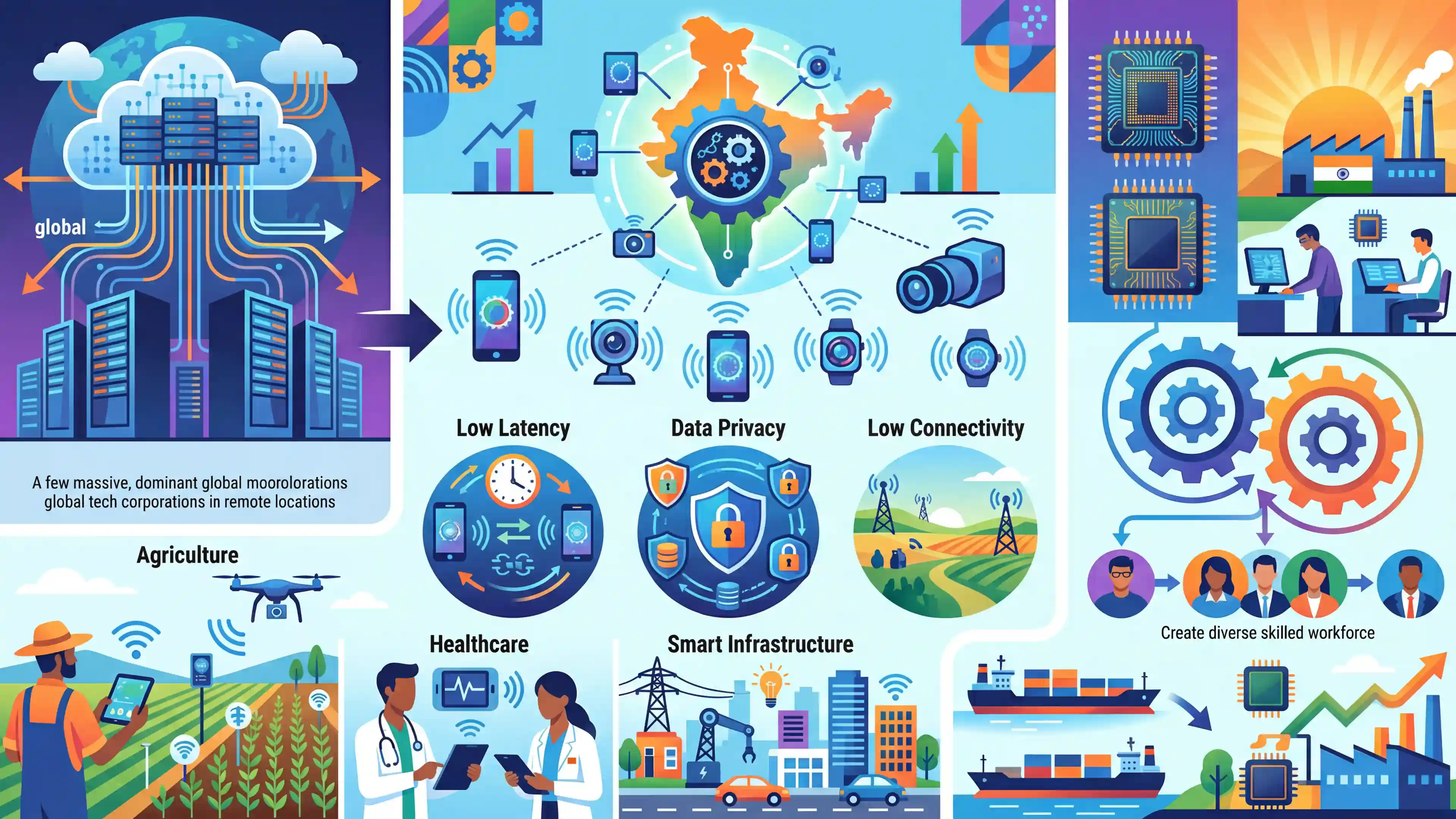
India is exploring strategies to carve out a competitive advantage in 'Edge AI'—a paradigm where artificial intelligence computations are performed locally on devices rather than in centralized cloud servers. As part of a pre-summit dialogue on the global AI race, experts highlighted that while big tech companies dominate cloud-based AI, the emerging Edge AI sector offers India a strategic opening. Edge computing provides low latency, better data privacy, and works efficiently in low-connectivity areas, making it ideal for India's agriculture, healthcare, and smart infrastructure needs. However, leveraging this potential requires robust domestic hardware capabilities. Bridging the gap demands a skilled workforce and strong policy synergy between software development (IndiaAI Mission) and hardware manufacturing (India Semiconductor Mission) to reduce reliance on imported AI chips.
Key Points
- Edge AI involves processing AI algorithms locally on hardware devices (at the 'edge' of a network) rather than relying on centralized cloud servers.
- It offers significant advantages such as lower latency for real-time decision-making, enhanced data privacy, reduced bandwidth requirements, and the ability to operate in areas with poor internet connectivity.
- Edge AI holds transformative potential for sectors crucial to India, including remote healthcare diagnostics, precision agriculture, smart city infrastructure, and manufacturing (Industry 4.0).
- To become a global leader in Edge AI, India must overcome structural challenges like the high cost of specialized AI chips, limited domestic semiconductor manufacturing capacity, and the need for a highly skilled workforce.
- Success in this domain requires tight synergy between software innovation and hardware manufacturing, linking the goals of the IndiaAI Mission with the India Semiconductor Mission.
Important Terms
Edge AI

Decentralized AI paradigm where data processing occurs directly on local devices (e.g., sensors, smartphones) rather than remote cloud servers, ensuring real-time response and privacy.
UPSC context
GS Paper III: Science & Technology; critical for indigenization of tech and real-time applications like autonomous driving.
IndiaAI Mission
A ₹10,370 crore national initiative to establish a sovereign AI ecosystem, including compute capacity (10,000+ GPUs), foundational models, and datasets for socio-economic transformation.
UPSC context
GS Paper III: Science & Technology; tests 'Make AI in India' strategy and digital sovereignty.
India Semiconductor Mission (ISM)
An autonomous business division under MeitY with a ₹76,000 crore outlay aimed at building a sustainable semiconductor and display manufacturing ecosystem in India.
UPSC context
GS Paper III: Economy/Infrastructure; focuses on self-reliance (Atmanirbharta) in the global electronics value chain.
Low Latency
The minimal time delay between a data command and its execution. In Edge AI, it is vital for time-critical sectors like healthcare and robotics.
UPSC context
GS Paper III: Science & Technology; essential technical parameter for 5G and Industry 4.0.
Ministry of Electronics and Information Technology (MeitY)
The nodal Union Ministry responsible for formulating national policies on IT, electronics manufacturing, AI, and digital public infrastructure.
UPSC context
GS Paper II: Governance; the institutional framework implementing India’s major digital and hardware missions.
Indigenization of Technology
The capability of a country to design, develop, and manufacture technology locally to reduce import dependence and enhance national security.
UPSC context
GS Paper III: Science & Technology; a recurring theme regarding self-reliance in high-tech sectors.
Prelims Trap
Edge AI requires continuous 5G connectivity to stream real-time data to centralized cloud servers.
False. Edge AI processes data locally on the device, specifically reducing the need for continuous high-speed internet or data transmission to centralized clouds.
Static Concepts Connected
How does Edge Computing differ from Cloud Computing?
- Processing location: Edge computes data on local devices (e.g., IoT sensors, smartphones); Cloud relies on distant, centralized data centers.
- Latency: Edge offers ultra-low latency ideal for real-time actions (e.g., autonomous vehicles); Cloud has higher data transmission delays.
- Bandwidth dependence: Edge minimizes data transfer and works well in low-connectivity areas; Cloud requires continuous internet connectivity.
What are the core pillars of the India Semiconductor Mission (ISM)?
- Financial Outlay: A ₹76,000 crore incentive scheme to establish a comprehensive domestic semiconductor and display ecosystem.
- Scheme focus: Provides substantial fiscal support for setting up Semiconductor Fabs, Display Fabs, and ATMP/OSAT packaging facilities in India.
- Nodal agency: Driven by the Digital India Corporation (DIC) under the Ministry of Electronics and IT (MeitY).
Cross-Topic Patterns
Data Governance + Privacy by Design
Edge AI inherently supports India's data localization push and the DPDP Act by processing sensitive user data locally, eliminating the need to transmit it to foreign-hosted cloud servers.
Precision Agriculture in Connectivity-Dark Zones
Linking IndiaAI to agriculture relies on Edge AI. Rural farms often lack the reliable broadband necessary for cloud-reliant AI tools, making offline, on-device processing crucial for precision farming.

A 2026 Prelims statement will likely test the conceptual difference between Edge and Cloud AI, focusing on latency, privacy, and bandwidth.
Linked PYQs · 4
Linked PYQs · 4
- 2023MainsGS3
Introduce the concept of Artificial Intelligence (AI). How does Al help clinical diagnosis? Do you perceive any threat to privacy of the individual in the use of Al in healthcare?
- 2025MainsGS3
India aims to become a semiconductor manufacturing hub. What are the challenges faced by the semiconductor industry in India? Mention the salient features of the India Semiconductor Mission.
- 2025PrelimsGS1
Consider the following statements: I. It is expected that Majorana 1 chip will enable quantum computing. II. Majorana 1 chip has been introduced by Amazon Web Services (AWS). III. Deep learning is a subset of machine learning. Which of the statements given above are correct?
- 2023MainsGS3
What is the status of digitalization in the Indian economy? Examine the problems faced in this regard and suggest improvements.
