Giant Magellan Telescope and Exoplanet Habitability Research
Source:Indian Express ↗
Why It Matters
Next-generation observatories like the GMT are pivotal for the future of space exploration, addressing fundamental questions about extraterrestrial life and cosmic origins. Understanding these mega-science projects, their technological innovations (like adaptive optics), and their scientific objectives is highly relevant for the GS-3 Science & Technology syllabus.
Summary
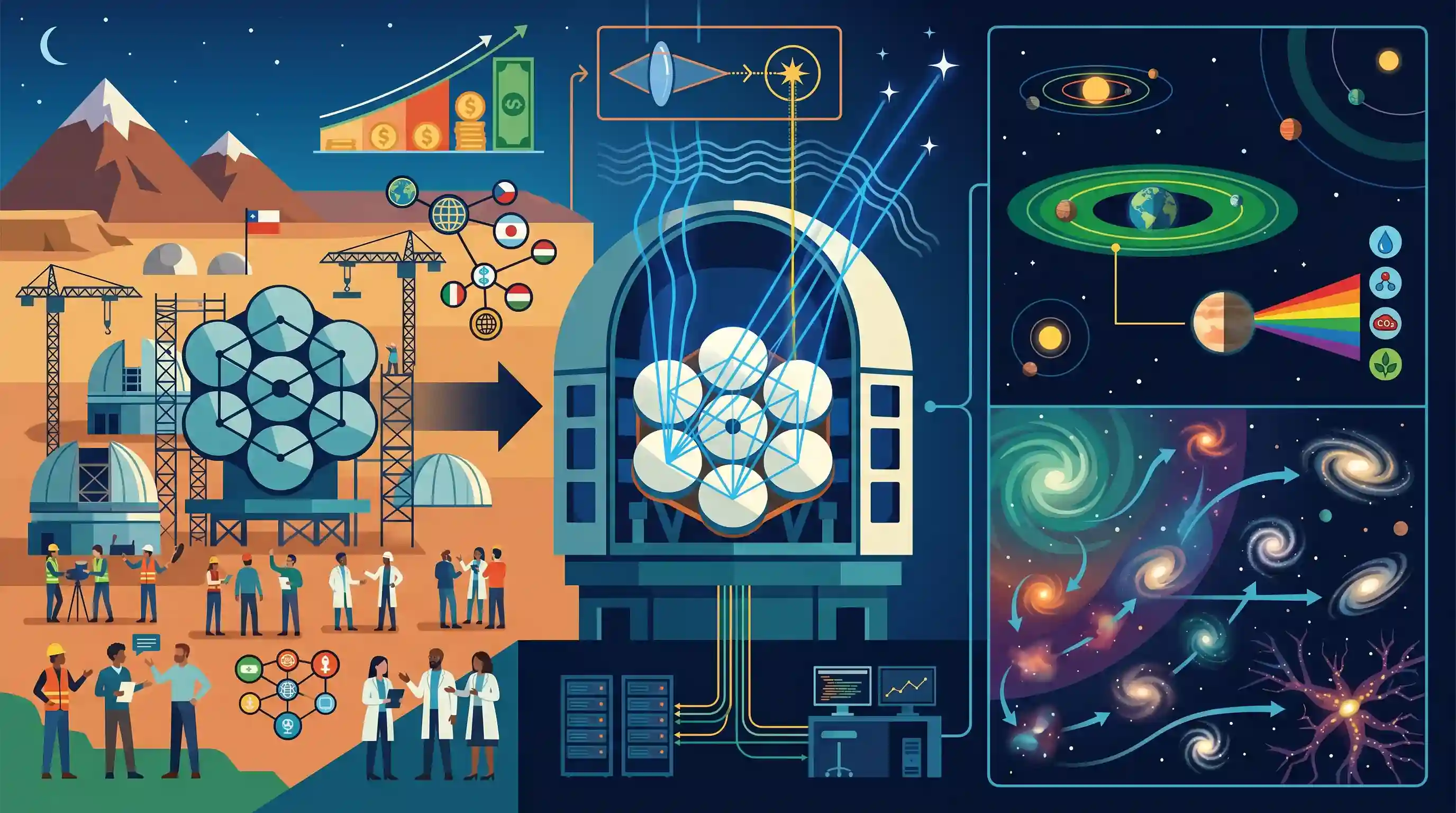
The article discusses the Giant Magellan Telescope (GMT), a massive next-generation optical observatory currently being built in Chile's Atacama Desert. Driven by a global consortium, the project requires significant federal funding to overcome its $2 billion cost. The telescope features a revolutionary optical design that combines seven giant monolithic mirrors and uses adaptive optics to correct atmospheric distortion. Once operational, the GMT aims to transform space exploration by studying exoplanets, characterizing their atmospheres to find habitable 'Goldilocks' zones, and analyzing the flow of gas in the early universe to understand galaxy formation.
Key Points
- The Giant Magellan Telescope (GMT) is a next-generation optical observatory under construction at the Las Campanas Observatory in Chile's Atacama Desert.
- Its design combines seven of the world's largest monolithic mirrors (8.4 meters each) into a single effective 25.4-meter primary mirror to gather unprecedented amounts of light.
- The GMT will utilize advanced adaptive optics to correct the blurring effects of Earth's atmosphere, providing extremely high-resolution images.
- Key scientific goals include studying exoplanets in habitable 'Goldilocks zones', detecting biosignatures in their atmospheres, and understanding early universe galaxy formation.
- The project is spearheaded by a 16-member global consortium but requires substantial US federal funding to meet its estimated $2 billion completion cost over the coming decades.
Important Terms
Giant Magellan Telescope (GMT)

A ground-based extremely large telescope (ELT) under construction in Chile, featuring seven 8.4-meter mirrors with a 25.4-meter effective aperture to study exoplanets and the early universe.
UPSC context
GS Paper III: Science & Technology. Significant for topics on space exploration, next-gen observatories, and international scientific collaborations.
Las Campanas Observatory (LCO)
An astronomical observatory in Chile's Atacama Desert, managed by the Carnegie Institution for Science, known for its exceptional atmospheric stability and clear skies.
UPSC context
GS Paper I (Geography) and GS Paper III (S&T). Important as a global site for major astronomical infrastructure.
Goldilocks Zone
The habitable region around a star where temperatures are suitable for liquid water to exist on a planet's surface, a key indicator for potential life.
UPSC context
GS Paper III: S&T. Frequently tested in Prelims regarding exoplanetary habitability and NASA/international space missions.
Adaptive Optics
A technology that uses deformable mirrors and sensors to correct atmospheric distortion in real-time, allowing ground-based telescopes to produce images as clear as space-based ones.
UPSC context
GS Paper III: S&T. Tests knowledge of technological innovations overcoming physical limitations in astronomical research.
Exoplanets
Planets orbiting stars outside our solar system. Their discovery and characterization are primary goals for modern space missions and large-scale ground-based observatories.
UPSC context
GS Paper III: S&T. Central to the study of the universe's evolution and the search for extraterrestrial biosignatures.
GMTO Corporation
A non-profit international consortium of 15 universities and research institutions responsible for the design, construction, and management of the Giant Magellan Telescope project.
UPSC context
GS Paper III: S&T. Relevant for questions on institutional frameworks and international partnerships in high-end scientific research.
Prelims Trap
Giant Magellan Telescope is a space-based observatory being developed with India as a consortium member.
GMT is a ground-based telescope located in Chile, not in space. Additionally, India is a partner in the Thirty Meter Telescope (TMT), not GMT.
Static Concepts Connected
Why are major optical observatories concentrated in the Atacama Desert?
- High altitude: Thinner atmosphere reduces the scattering of incoming starlight and allows clearer imaging.
- Extreme aridity: Near-zero humidity means minimal water vapor, which otherwise absorbs incoming infrared and sub-millimeter radiation.
- Remote location: Provides incredibly dark skies with minimal radio interference and over 300 cloudless nights annually.
What is Adaptive Optics in ground-based telescopes?
- The Problem: Earth's atmospheric turbulence bends and blurs incoming starlight, causing the phenomenon known as stellar twinkling.
- The Solution: Uses computer-controlled deformable mirrors and laser guide stars to measure and correct this atmospheric distortion in real-time.
- The Result: Allows ground-based telescopes to achieve image resolutions rivaling or even exceeding space-based telescopes like Hubble.
Cross-Topic Patterns
India's role in Mega-Science Projects
UPSC frequently tests India's role in global projects. India is a key partner in the Thirty Meter Telescope (TMT) and Square Kilometre Array (SKA), but is notably absent from the GMT.
Habitability and Exoplanet Biosignatures
The search for 'Goldilocks zones' connects to past UPSC questions on exoplanets, Kepler missions, and James Webb's atmospheric analyses of distant worlds.

Expect match-the-pair questions linking mega-telescopes (GMT, TMT, SKA) to their geographical locations and India's participation status.
Linked PYQs · 2
Linked PYQs · 2
- 2015PrelimsGS1
The term 'Goldilocks Zone' is often seen in the news in the context of
- 2022MainsGS3
Launched on 25th December, 2021, James Webb Space Telescope has been much in the news since then. What are its unique features which make it superior to its predecessor Space Telescopes ? What are the key goals of this mission ? What potential benefits does it hold for the human race?
