Rules of Business 2026 Redraws Cabinet Power Balance
Source:theprint ↗
Why It Matters
The article touches upon core constitutional concepts such as collective responsibility and the distribution of executive power between the Chief Minister and the Council of Ministers, which are frequently tested in the MPSC Prelims Polity section.
Summary
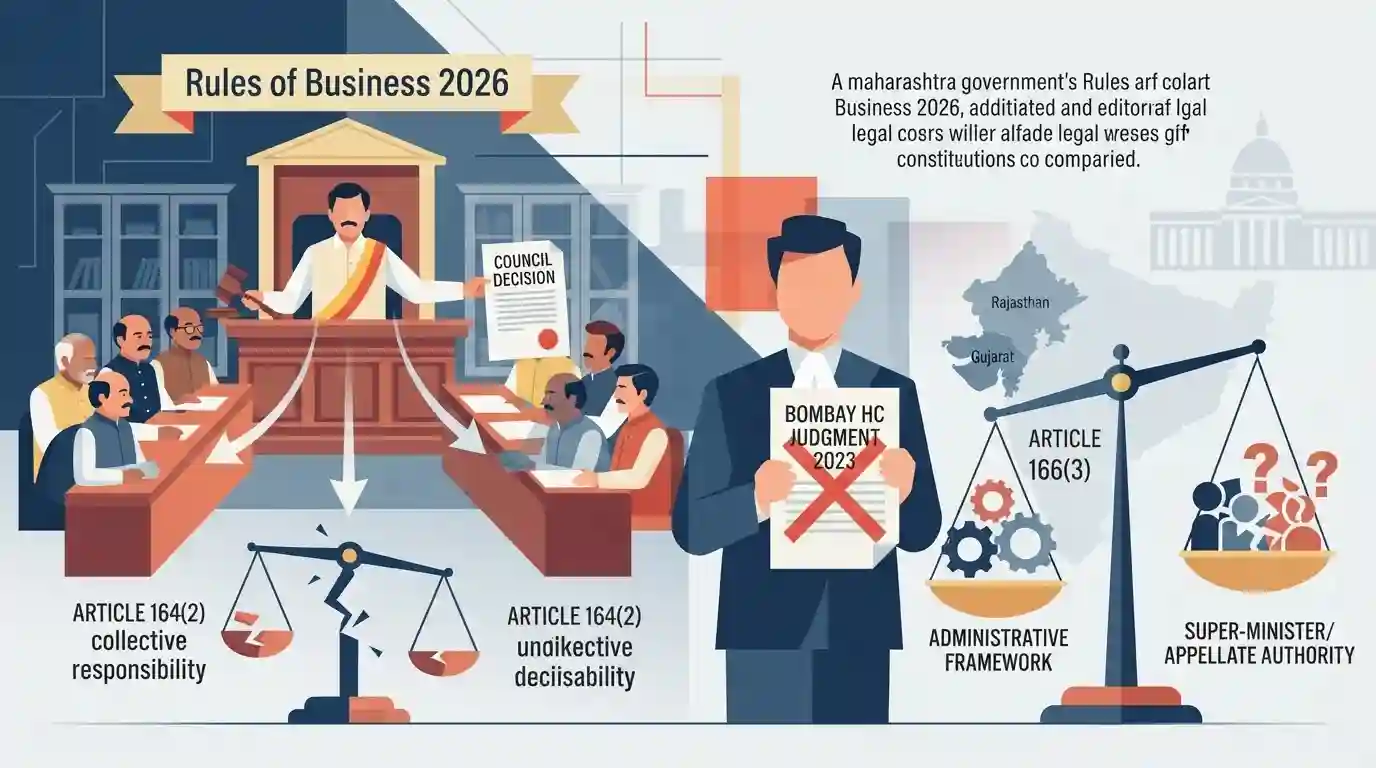
The Maharashtra government recently notified the Rules of Business 2026, which grant the Chief Minister overarching powers to intervene in and override decisions made by other cabinet ministers in the "public interest." Prompted by a 2023 Bombay High Court judgment that highlighted the lack of such powers under the previous 1975 rules, the move has ignited a legal debate. Critics assert that it undermines the constitutional doctrine of "collective responsibility" (Article 164(2)) by elevating the CM to a "super-minister" or appellate authority. Conversely, proponents argue the provision is a valid exercise of power under Article 166(3) and aligns Maharashtra with similar administrative frameworks in states like Rajasthan and Gujarat.
Key Points
- The Maharashtra government has introduced the Rules of Business 2026, replacing the 1975 rules, allowing the Chief Minister to intervene and override any minister’s decision in the public interest under Rule 13(5).
- This amendment was a response to a 2023 Bombay High Court ruling that invalidated former CM Eknath Shinde's intervention in a cooperative bank matter, stating the CM lacked independent authority under the 1975 rules to review another minister's orders.
- Legal experts are divided; critics argue the new rule violates the constitutional principle of "collective responsibility" under Article 164(2), effectively making the CM an appellate authority over cabinet colleagues.
- Supporters defend the rule citing the Governor's power to make rules of business under Article 166(3), pointing out that similar provisions exist in states like Gujarat, Rajasthan, and Andhra Pradesh, and that it fills a regulatory lacuna.
Important Terms
Maharashtra Government Rules of Business 2026

A newly notified administrative framework explicitly granting the Maharashtra Chief Minister the legal authority to review, modify, or override decisions made by other cabinet ministers in the public interest.
UPSC context
Vital for MPSC Polity. Tests knowledge of State Executive functions, Chief Minister's powers, and intra-cabinet dynamics in Maharashtra.
Article 164(2) of the Indian Constitution
A constitutional provision mandating that the Council of Ministers is collectively responsible to the State Legislative Assembly, ensuring unified accountability of the government.
UPSC context
Core to MPSC Polity. Highlights the doctrine of collective responsibility, which critics argue is undermined by the CM's newly granted veto powers.
Article 166(3) of the Indian Constitution
Empowers the Governor to formulate rules for the convenient transaction of State Government business and the allocation of such work among ministers.
UPSC context
Important for MPSC State Executive topics. It forms the constitutional foundation for enacting frameworks like the Maharashtra Government Rules of Business.
Chandrapur District Central Cooperative Bank
The subject of a 2023 Bombay High Court case which ruled that the Maharashtra Chief Minister lacked supervisory power to modify a minister's decision under the 1975 business rules.
UPSC context
Relevant for MPSC current affairs. This specific judicial precedent highlighted legal gaps in the CM's authority, directly prompting the 2026 Rules of Business.
Prelims Trap
"Under Article 166(3), the Chief Minister frames the Rules of Business for allocating portfolios among state ministers."
While the CM advises on portfolio allocation, Article 166(3) explicitly vests the constitutional power to make rules for the transaction of state business solely in the Governor.
Static Concepts Connected
How does the Constitution regulate the conduct of State Government business under Article 166?
- Executive actions: Under Article 166(1), all executive actions of the Government of a State shall be expressed to be taken in the name of the Governor.
- Rule-making power: Under Article 166(3), the Governor makes rules for the more convenient transaction of government business.
- Allocation of business: The Governor allocates business among the Ministers via these rules, acting on the advice of the Chief Minister.
What are the core tenets of Ministerial responsibility under Article 164?
- Collective Responsibility: Under Art 164(2), the Council of Ministers is collectively responsible to the State Legislative Assembly, ensuring cabinet solidarity and joint accountability.
- Individual Responsibility: Under Art 164(1), Ministers hold office during the pleasure of the Governor (which practically translates to the pleasure of the Chief Minister).
Cross-Topic Patterns
Primus Inter Pares vs Super-Minister
The evolution of the CM's role from a Westminster 'first among equals' to an explicit appellate authority tests the core Parliamentary doctrine of cabinet solidarity.
Rules of Business & Delhi UT conflict
The Transaction of Business Rules frequently appear in constitutional disputes, most notably in the ongoing tussle between the Delhi LG and the elected government over file routing and executive independence.

Expect a multi-statement question contrasting Art 166(3) (Governor's rule-making) with Art 164(2) (Collective responsibility).
Linked PYQs · 1
Linked PYQs · 1
- 2023MPSC_PRELIMSGS1
Which of the following statement is not included in Article 164 ?
