NCDRC Ruling on Consumer Rights and Vehicle Defect Claims
Source:Indian Express ↗
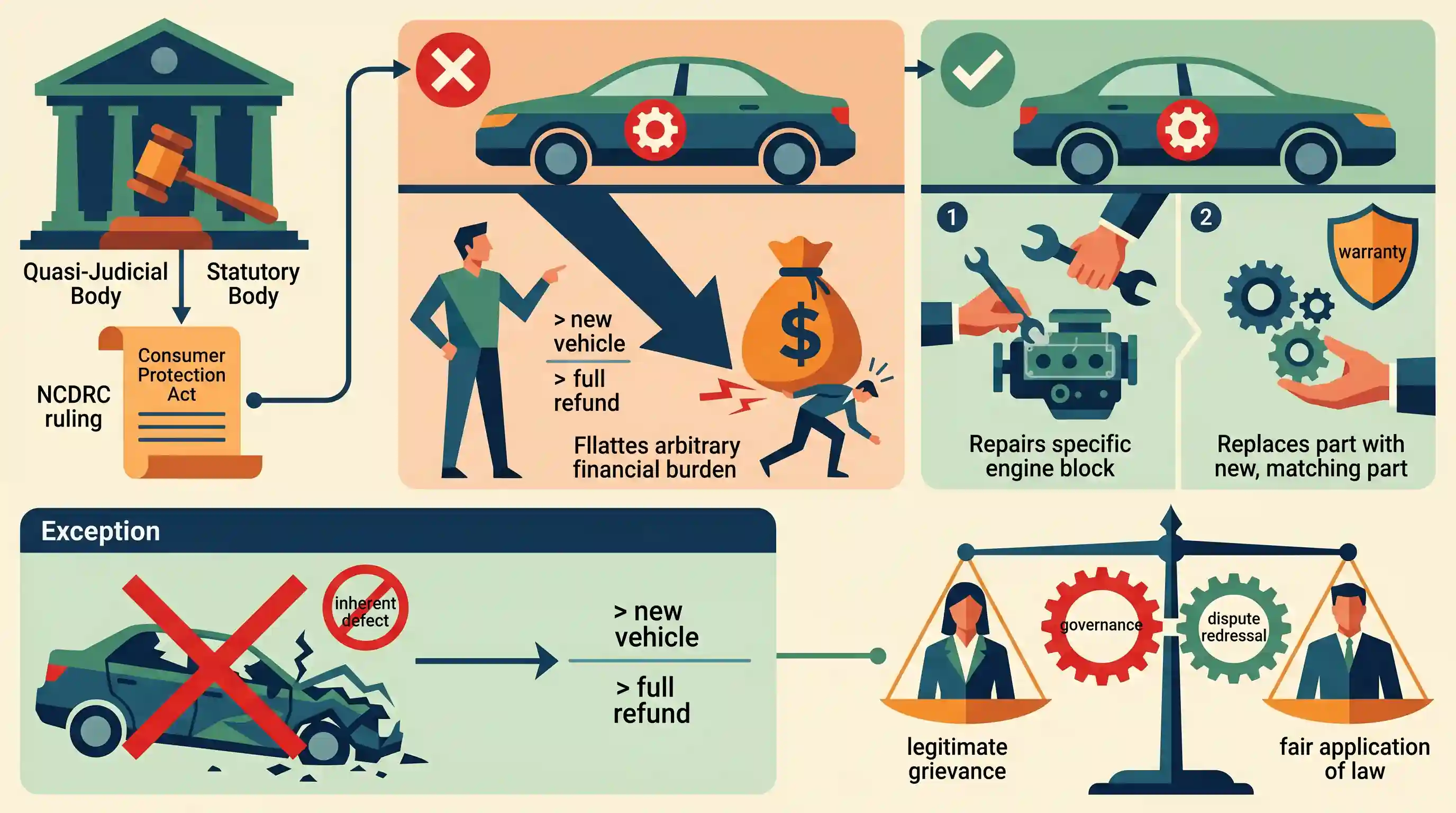
Why It Matters
The NCDRC's ruling is an excellent case study of how quasi-judicial bodies in India operate to balance conflicting rights—in this case, consumer protection versus corporate liability. It highlights the practical application of the Consumer Protection Act and serves as an example for answers related to dispute resolution mechanisms.
Summary
The National Consumer Disputes Redressal Commission (NCDRC) has ruled that consumers cannot invariably demand a new vehicle or a full refund simply because of a defect in their purchased car. The quasi-judicial body noted that unless a vehicle suffers from a systemic or inherent manufacturing defect that renders it completely unserviceable, the manufacturer's obligation is primarily to repair or replace the specific defective components under warranty conditions. This clarification establishes an important precedent, ensuring that the Consumer Protection Act is applied fairly to protect legitimate buyer grievances without placing arbitrary financial burdens on automobile manufacturers.
Key Points
- The National Consumer Disputes Redressal Commission (NCDRC) clarified that a defect in a car does not automatically entitle a consumer to demand a brand-new vehicle or a full refund.
- A full replacement is generally warranted only if there is a fundamental or inherent manufacturing defect that cannot be rectified.
- For minor or localized defects, the liability of the manufacturer or dealer is limited to repairing or replacing the specific defective parts as per the terms of the warranty.
- The ruling strikes a balance between protecting consumer rights and preventing the misuse of the Consumer Protection Act to impose unreasonable liabilities on businesses.
Important Terms
National Consumer Disputes Redressal Commission (NCDRC)

India's apex quasi-judicial body for consumer grievances, established under the Consumer Protection Act. It adjudicates high-value claims (exceeding ₹10 crore) and hears appeals from State Commissions.
UPSC context
GS Paper II (Statutory/Quasi-judicial bodies); tests knowledge of grievance redressal frameworks and administrative law.
Consumer Protection Act, 2019
A landmark law replacing the 1986 version to modernize consumer rights, covering e-commerce, introducing product liability, and establishing the Central Consumer Protection Authority (CCPA).
UPSC context
GS Paper II (Governance/Social Justice); essential for questions on regulatory reforms and citizen empowerment.
Quasi-judicial Body
An authority with powers resembling a court—such as summoning witnesses and issuing binding orders—but specialized in specific statutory areas like consumer rights or environment.
UPSC context
GS Paper II (Polity); tests understanding of the separation of powers and specialized adjudication.
Product Liability
The legal responsibility of a manufacturer or seller to compensate consumers for harm caused by defective products or deficient services, formalised in India by the 2019 Act.
UPSC context
GS Paper II/III (Governance/Economy); relevant to corporate accountability and legal rights of citizens.
Three-tier Redressal Mechanism
The hierarchy of Consumer Commissions at District (up to ₹1cr), State (₹1cr-₹10cr), and National (>₹10cr) levels for efficient dispute resolution.
UPSC context
GS Paper II (Governance); tests knowledge of the institutional structure for public grievance redressal.
Prelims Trap
Any functional defect in an automobile automatically entitles the consumer to a full vehicle replacement or refund.
The NCDRC ruled full replacements are strictly for systemic/inherent manufacturing defects. Minor defects only obligate repair or component replacement under warranty.
Static Concepts Connected
What distinguishes the CCPA from the NCDRC under the Consumer Protection Act 2019?
- CCPA Nature: An executive regulatory body with suo-moto powers to recall unsafe goods, halt unfair trade practices, and penalize misleading advertisements.
- NCDRC Nature: An apex statutory quasi-judicial body for dispute adjudication, headed by a sitting/retired SC judge, handling complaints exceeding ₹2 crore.
What is 'Product Liability' under the Consumer Protection Act 2019?
- Principle Shift: Legally shifts the primary market doctrine from 'Caveat Emptor' (let the buyer beware) to 'Caveat Venditor' (let the seller beware).
- Accountability: Holds product manufacturers, service providers, and sellers (including e-commerce platforms) legally accountable to compensate consumers for harm caused by defective goods.
Cross-Topic Patterns
Regulatory vs Adjudicatory bodies
The functional split between CCPA (executive/regulatory) and NCDRC (quasi-judicial) parallels SEBI and SAT, a structural separation of powers frequently tested in Polity.
E-commerce and Dark Patterns
Consumer rights in India increasingly overlap with digital governance, notably the CCPA's recent interventions against deceptive digital 'dark patterns' and misleading influencer endorsements.

Expect a multi-statement prelims question contrasting CCPA's suo-moto regulatory powers with NCDRC's quasi-judicial adjudicatory role.
Linked PYQs · 2
Linked PYQs · 2
- 2023PrelimsGS1
Consider the following organizations/bodies in India: 1. The National Commission for Backward Classes 2. The National Human Rights Commission 3. The National Law Commission 4. The National Consumer Disputes Redressal Commission How many of the above are constitutional bodies?
- 2016MainsGS2
What is a quasi-judicial body? Explain with the help of concrete examples.
