Cambodia Thailand Border Conflict and ASEAN Regional Security
Source:The Hindu ↗
Why It Matters
Understanding Southeast Asian geopolitics is crucial for UPSC aspirants, especially regarding ASEAN's internal cohesion. The Cambodia-Thailand dispute highlights the challenges of border management, international mediation, and the lingering impacts of historical conflicts (like landmines), which parallel India's own neighborhood and border security challenges.
Summary
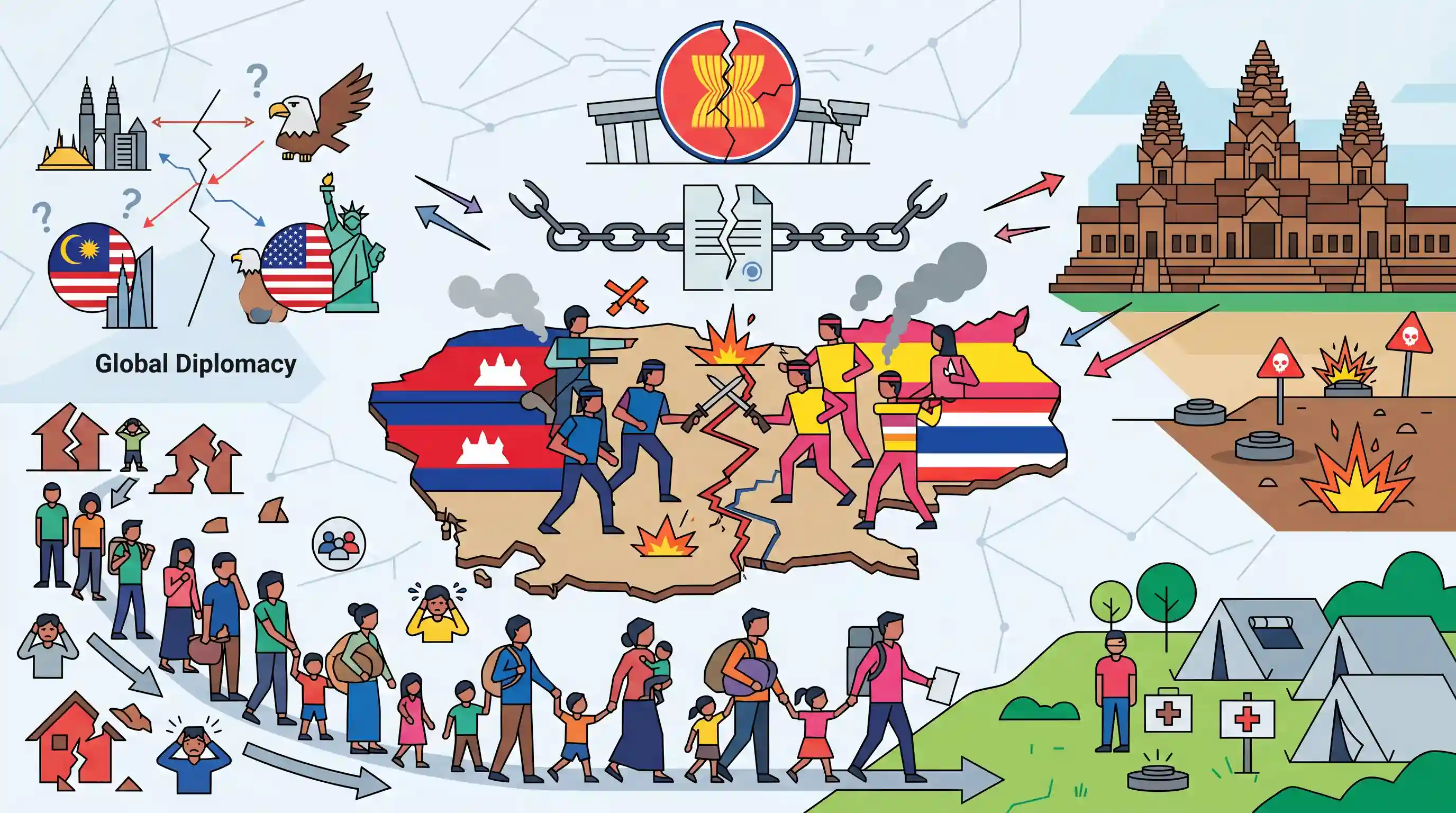
An escalating border conflict between Cambodia and Thailand has triggered intense fighting, shattering a ceasefire recently brokered by Malaysia and influenced by the United States. The renewed hostilities have caused a significant humanitarian crisis, prompting mass evacuations of civilians from the borderlands. The situation is further complicated by historical grievances over ancient temples and the deadly presence of legacy landmines from past conflicts. This bilateral dispute poses a severe challenge to ASEAN's regional stability and conflict resolution mechanisms.
Key Points
- The border conflict between Cambodia and Thailand has escalated into active fighting, breaking recent ceasefire agreements and escalating regional tensions.
- Mediation efforts by regional neighbors such as Malaysia, alongside diplomatic pressure from the United States, have failed to stabilize the situation.
- The ongoing clashes have triggered a humanitarian emergency, forcing large-scale evacuations of civilians living near the contested border areas.
- Historical complexities, including disputes over centuries-old heritage sites and the presence of uncleared landmines from previous wars, exacerbate the security crisis and complicate military maneuvering.
- The bilateral clash exposes the limitations of the ASEAN framework in resolving deep-seated territorial and historical disputes among its member states.
Important Terms
ASEAN

Association of Southeast Asian Nations; a regional intergovernmental organization of ten Southeast Asian countries promoting economic growth, social progress, and regional peace.
UPSC context
GS Paper 2: International Relations; critical for India's 'Act East Policy' and regional security architecture.
Preah Vihear Temple
An 11th-century Hindu temple and UNESCO World Heritage site central to the Cambodia-Thailand border dispute; ruled Cambodian territory by the ICJ in 1962 and 2013.
UPSC context
GS Paper 2: Bilateral Relations; illustrates how cultural heritage sites can become flashpoints for territorial sovereignty conflicts.
International Court of Justice (ICJ)
The United Nations' principal judicial organ that settles legal disputes between states, including the landmark 1962 and 2013 rulings on the Cambodia-Thailand border.
UPSC context
GS Paper 2: Important International Institutions; tests understanding of global legal mechanisms in resolving territorial and sovereignty disputes.
Bilateralism vs. Internationalization
A diplomatic tension between resolving disputes through direct two-party negotiation versus involving international bodies like the UN or ICJ to arbitrate unsettled boundaries.
UPSC context
GS Paper 2: Global Diplomacy; analyzes different approaches to conflict resolution and the role of third-party mediators.
Landmine Contamination
The presence of unexploded explosive devices from past wars that continue to cause casualties and trigger border skirmishes during patrol or civilian movements.
UPSC context
GS Paper 3: Internal Security/Border Management; highlights legacy challenges in border security and the humanitarian impact of historical conflicts.
Humanitarian Crisis
The displacement of large populations—over one million in the 2025-2026 Cambodia-Thailand crisis—due to armed conflict, requiring urgent international aid and mediation.
UPSC context
GS Paper 2: International Relations; focuses on the impact of regional instability on civilian safety and human rights.
Prelims Trap
"India is a founding signatory to the 1997 Ottawa Convention banning anti-personnel landmines."
Despite supporting UN demining operations globally, major military powers like India, the US, China, and Russia have NOT signed the Ottawa Convention due to border security imperatives.
Static Concepts Connected
What is the "ASEAN Way" and how does it affect conflict resolution?
- Core Principle: Decision-making based strictly on consensus-building and absolute non-interference in the internal affairs of member states.
- Operational Mechanism: Relies heavily on informal, quiet diplomacy rather than legally binding or coercive dispute resolution mechanisms.
- Institutional Limitation: Frequently renders ASEAN ineffective in resolving hard-security territorial disputes or internal democratic crises (e.g., Myanmar) among its own members.
What are the core parameters of the Mekong-Ganga Cooperation (MGC)?
- Formation: Established in 2000 in Vientiane, Laos to enhance ties between the Ganga and Mekong river basins.
- Membership: Comprises India and five ASEAN countries: Cambodia, Laos, Myanmar, Thailand, and Vietnam. China is notably absent.
- Focus Areas: Primarily focuses on tourism, culture, education, and transport/communication connectivity, acting as a cultural and economic bridge.
Cross-Topic Patterns
Khmer Architecture & Indian Soft Power
The Preah Vihear Temple (dedicated to Shiva) highlights historical Hindu influence in Southeast Asia, frequently tested alongside Chola naval expeditions, Angkor Wat, and India's Look East soft-power diplomacy.
Colonial Cartography & Modern Border Conflicts
Like the McMahon Line or Durand Line, the 1904/1907 Franco-Siamese map discrepancies illustrate how vaguely drawn or unilaterally imposed colonial frontiers continue to drive modern geopolitical flashpoints.

Expect a Prelims mapping pair linking Preah Vihear to Cambodia, or a multi-statement question on the 1997 Ottawa Convention non-signatories.
Linked PYQs · 3
Linked PYQs · 3
- 2015PrelimsGS1
In the Mekong-Ganga Cooperation, an initiative of six countries, which of the following is/are not a participant/participants? 1. Bangladesh 2. Cambodia 3. China 4. Myanmar 5. Thailand Select the correct answer using the code given below.
- 2014MainsGS2
With respect to the South China sea, maritime territorial disputes and rising tension affirm the need for safeguarding maritime security to ensure freedom of navigation and over flight throughout the region. In this context, discuss the bilateral issues between India and China.
- 2024MainsGS3
India has a long and troubled border with China and Pakistan fraught with contentious issues. Examine the conflicting issues and security challenges along the border. Also give out the development being undertaken in these areas under the Border Area Development Programme (BADP) and Border Infrastructure and Management (BIM) Scheme.
