Foreign Direct Investment Restrictions on Chinese Firms
Source:The Hindu ↗
Why It Matters
The debate highlights the complex intertwining of India's economic dependencies and national security imperatives. Easing restrictions on Chinese investments and public contracts—despite ongoing border standoffs, geopolitical provocations, and a massive bilateral trade deficit—forces a reevaluation of India's strategic autonomy and economic decoupling strategies.
Summary
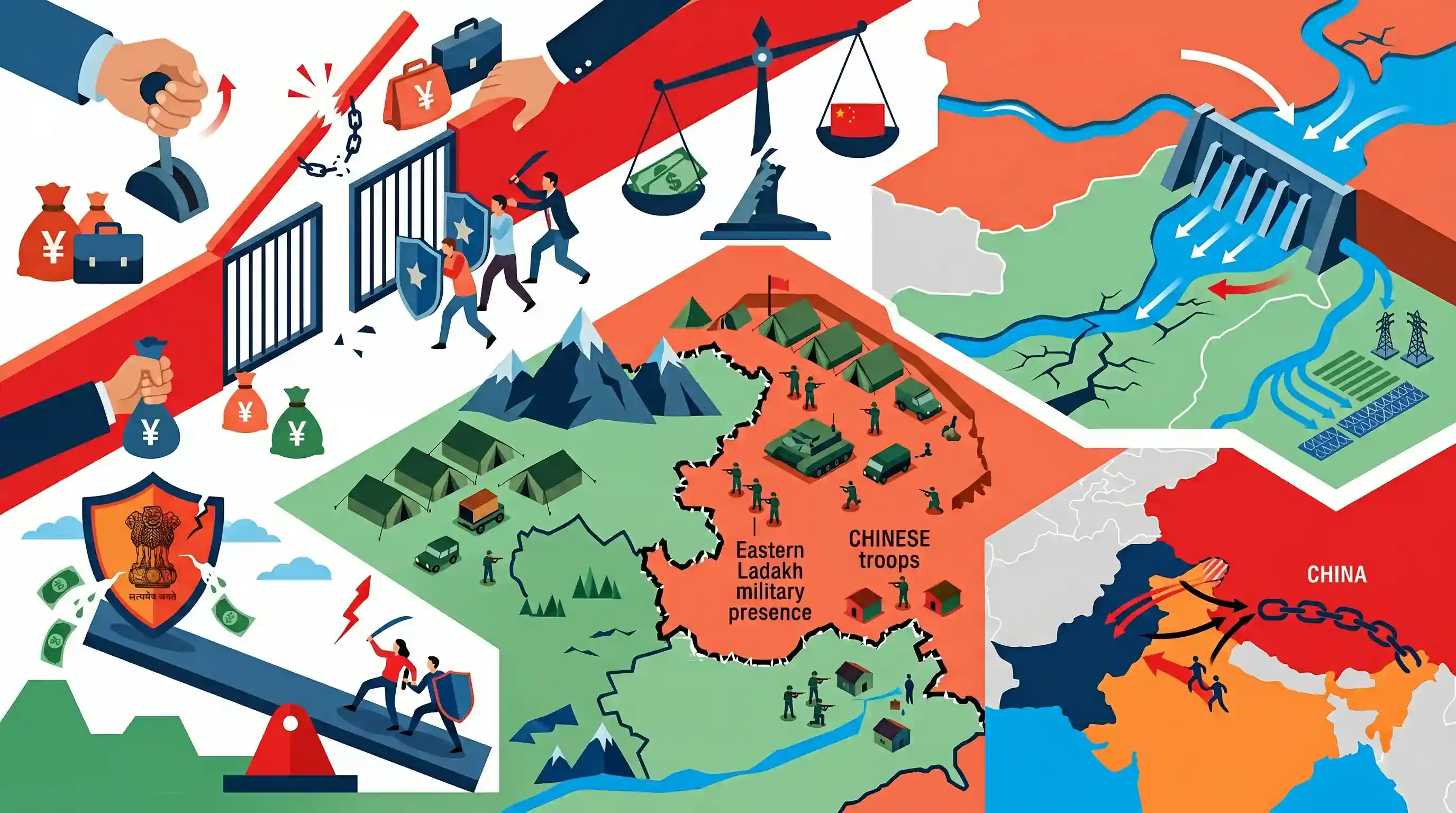
The Congress party has strongly opposed the Union government's reported plans to lift a five-year ban on Chinese companies bidding for public contracts, terming it a "calibrated capitulation." The opposition emphasized that this easing of economic curbs, alongside NITI Aayog recommendations favoring Chinese FDI and visas, contradicts India's national security interests. It cited China's continued military presence in Eastern Ladakh, its backing of Pakistan during "Operation Sindoor," ongoing provocations in Arunachal Pradesh, and the construction of the Medog dam on the Brahmaputra river as unresolved geopolitical threats that clash with the normalization of economic ties.
Key Points
- The Congress party criticized the Union government's reported proposal to lift restrictions on Chinese companies bidding for Indian government contracts, calling it a 'calibrated capitulation.'
- The opposition highlighted ongoing national security concerns, noting China's military backing of Pakistan during Operation Sindoor and unresolved border friction in Eastern Ladakh.
- Easing of economic curbs, including NITI Aayog's recommendations for Chinese FDI and visas, is being questioned amid India's ballooning trade deficit with Beijing.
- Other cited strategic threats include China's provocations in Arunachal Pradesh and the construction of the Medog mega-dam on the transnational Brahmaputra river.
Important Terms
Operation Sindoor

An Indian military operation launched in May 2025 targeting Pakistan-backed terror networks; cited as evidence of China's hostile 'fronting' for Pakistan through military backing.
UPSC context
GS Paper III: Internal Security. Tests understanding of response to cross-border terrorism and the role of third-party (China) support to Pakistan.
NITI Aayog
India's premier policy think tank (National Institution for Transforming India). It recommended easing restrictions on Chinese FDI to integrate India into global supply chains.
UPSC context
GS Paper II & III: Statutory/Regulatory Bodies & Indian Economy. Tests knowledge of institutional roles in economic policy-making.
Press Note 3 (2020)
A 2020 DPIIT regulation mandating government approval for FDI from countries sharing land borders with India to prevent opportunistic takeovers of domestic firms.
UPSC context
GS Paper III: Indian Economy. Tests understanding of FDI policy and the balance between economic liberalization and national security.
Medog Dam
A massive Chinese hydropower project on the Yarlung Tsangpo (Brahmaputra) in Tibet near the Indian border; viewed by India as a threat to downstream water security.
UPSC context
GS Paper II: International Relations. Tests knowledge of transboundary water disputes and the 'hydro-hegemony' of upper-riparian states like China.
Line of Actual Control (LAC)
The de facto 3,488 km border between India and China. It remains the site of major military standoffs in Eastern Ladakh and Arunachal Pradesh.
UPSC context
GS Paper III: Security. Tests awareness of border management, territorial disputes, and regional strategic stability.
Prelims Trap
FDI from countries sharing a land border with India is completely prohibited under Press Note 3 (2020).
Press Note 3 (2020) did not ban FDI from land-border sharing countries. It merely shifted them from the 'automatic route' to the 'government approval route'.
Static Concepts Connected
How does Press Note 3 (2020) regulate FDI from neighboring countries?
- Approval Route: Mandates prior government approval for FDI from entities in countries sharing a land border with India.
- Beneficial Ownership: Applies even if the beneficial owner of an investment is situated in or is a citizen of such a land-bordering country.
- Core Objective: Introduced during the pandemic to curb opportunistic takeovers or acquisitions of vulnerable Indian companies.
What mechanisms govern transnational rivers like the Brahmaputra between India and China?
- No Formal Treaty: There is no formal bilateral water-sharing treaty between India and China, unlike the Indus Water Treaty with Pakistan.
- International Law: Customary international law (Helsinki Rules) mandates equitable utilization and an obligation not to cause significant harm to downstream states.
- Data Sharing MoUs: Bilateral cooperation is currently limited to Memorandums of Understanding (MoUs) for sharing hydrological data during the monsoon season.
Cross-Topic Patterns
Border Security vs. Supply Chain Integration
Economic decoupling from China is constrained by India's structural reliance on Chinese APIs, electronics, and machinery to meet its own domestic manufacturing and export targets.
Hydropolitics of the Brahmaputra
China's Medog dam links geographical runoff dependencies with internal security threats like downstream flooding in the Northeast, exacerbated by the absence of a formal bilateral water treaty.

Press Note 3 FDI rules + public procurement mandates + transnational river dams likely to form a complex multi-statement IR/Economy Q.
Linked PYQs · 3
Linked PYQs · 3
- 2012MainsGS2
Do you think that China's emergence as one of the largest trading partners of India has adversely affected the settlement of the outstanding border problem?
- 2014MainsGS2
With respect to the South China sea, maritime territorial disputes and rising tension affirm the need for safeguarding maritime security to ensure freedom of navigation and over flight throughout the region. In this context, discuss the bilateral issues between India and China.
- 2024MainsGS3
India has a long and troubled border with China and Pakistan fraught with contentious issues. Examine the conflicting issues and security challenges along the border. Also give out the development being undertaken in these areas under the Border Area Development Programme (BADP) and Border Infrastructure and Management (BIM) Scheme.
