Calcutta High Court protects welfare benefits amid roll revisions
Source:The Hindu ↗
Why It Matters
This highlights the critical judicial distinction between electoral rights and fundamental welfare entitlements, while clarifying evidentiary standards for proving Indian citizenship—essential topics for Polity and Governance.
Summary
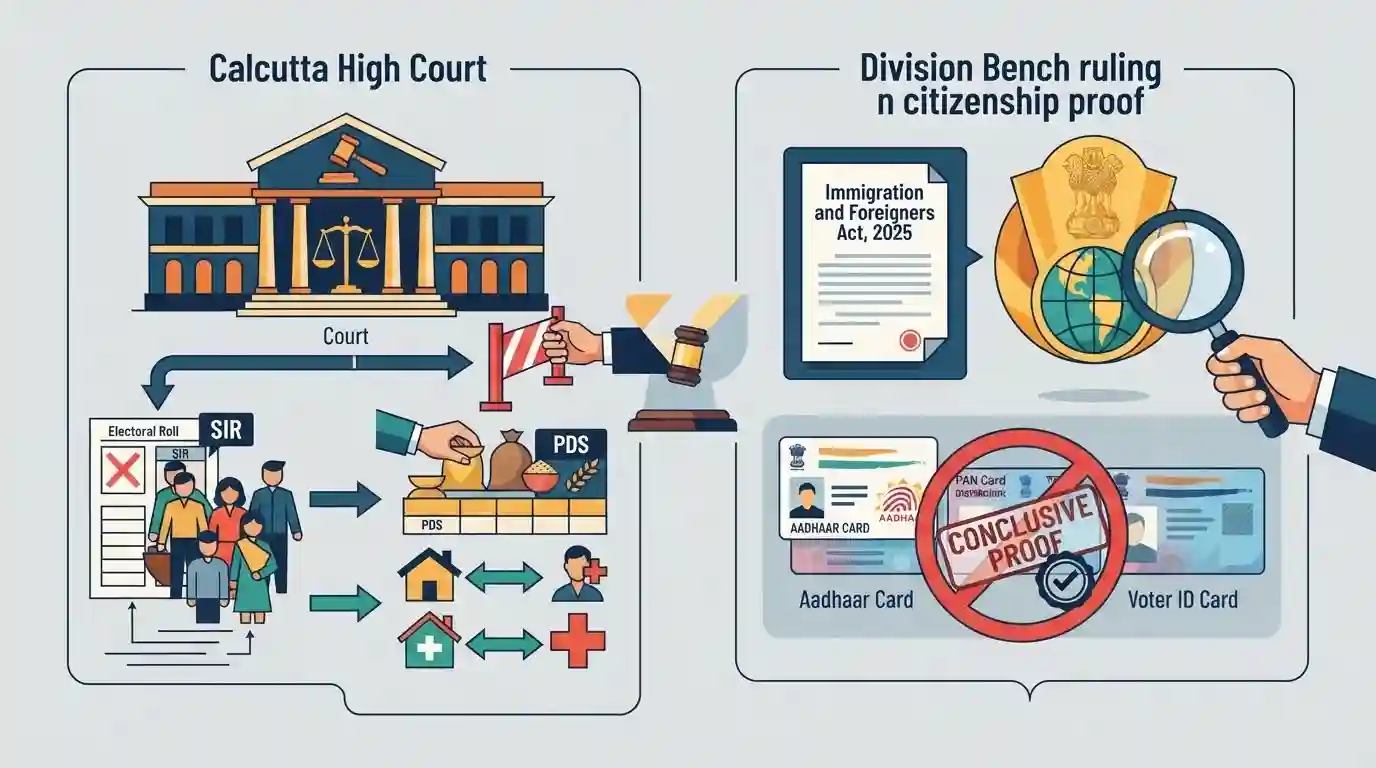
The Calcutta High Court has intervened against the West Bengal government's decision to discontinue Public Distribution System (PDS) and other welfare benefits for individuals removed from electoral rolls during the Special Intensive Revision (SIR). The court ruled that electoral exclusion cannot deprive citizens of basic necessities. Separately, a Division Bench ruled that Aadhaar, PAN, and Voter ID cards do not constitute conclusive proof of Indian citizenship under the Immigration and Foreigners Act, 2025.
Key Points
- The Calcutta High Court stayed a West Bengal government order that discontinued PDS and Annapurna Bhandar scheme benefits for individuals whose names were deleted from the electoral roll during the Special Intensive Revision (SIR).
- The court reiterated the Supreme Court's position that exclusion from electoral rolls should not lead to the denial of necessities and welfare benefits unrelated to voting.
- In a separate ruling involving a habeas corpus petition, the court held that Voter ID, Aadhaar, and PAN cards do not serve as conclusive proof of Indian citizenship.
- The burden of proving citizenship rests with the individual, per the mandates of the Immigration and Foreigners Act, 2025.
Important Terms
Public Distribution System (PDS)

A government food security system that distributes essential food grains and non-food items to vulnerable and low-income households at highly subsidized prices through a network of fair price shops.
UPSC context
GS Paper III (Subsidies, PDS, Food Security); tests understanding of administrative welfare delivery, economic reforms, and challenges in targeting.
Immigration and Foreigners Act, 2025
A comprehensive Indian law enacted in 2025 consolidating four legacy statutes to modernize and regulate the entry, stay, movement, and exit of foreign nationals in India.
UPSC context
GS Paper II (Polity and Citizenship); tests knowledge of statutory reforms in border control, internal security, and rights of non-citizens.
Annapurna Bhandar scheme
A West Bengal government cash-transfer scheme launched in June 2026, providing eligible resident women aged 25–60 with ₹3,000 monthly, replacing the earlier Lakshmir Bhandar scheme.
UPSC context
GS Paper II (Social Justice and Welfare Schemes); tests critical evaluation of direct benefit transfers and gender-focused social security measures.
Calcutta High Court
The oldest High Court in India, established in 1862, with original and appellate jurisdiction over West Bengal and the Andaman and Nicobar Islands.
UPSC context
GS Paper II (Judiciary structure); tests knowledge of high court jurisdictions, constitutional remedies, and federal division of power.
Supreme Court
The apex judicial authority of India under the Constitution, serving as the ultimate court of appeal, interpreter of constitutional law, and guarantor of fundamental rights.
UPSC context
GS Paper II (Indian Judiciary); tests comprehension of judicial review, separation of powers, and the enforcement of constitutional rights.
Prelims Trap
Aadhaar, PAN, and Voter ID cards serve as legally conclusive proof of Indian citizenship.
Aadhaar and PAN denote residency and financial identity, not citizenship. Furthermore, under immigration laws, the burden of proving citizenship lies solely with the individual, not the state.
Static Concepts Connected
Which Fundamental Rights are available to both citizens and foreigners?
- Articles 14 & 21: Equality before law (14) and protection of life and personal liberty (21) apply to every person, whether citizen or alien.
- Articles 20 & 22: Protection in respect of conviction for offences (20) and protection against arbitrary arrest and detention (22).
- Citizen-only rights: Articles 15, 16, 19, 29, and 30 are explicitly reserved only for Indian citizens, denying foreigners rights like free speech or public employment equality.
What is the statutory stance on Aadhaar and citizenship?
- Proof of residence: Aadhaar establishes identity and residency in India (requiring 182 days of residence in the preceding year), not nationality.
- Section 9 mandate: Section 9 of the Aadhaar Act, 2016 explicitly states that obtaining an Aadhaar number does not confer any right or proof of citizenship.
Cross-Topic Patterns
PDS as an Article 21 extension
Courts repeatedly separate welfare entitlements from electoral status, treating food security via PDS as an extension of the right to life rather than a privilege tied to voting rights.
Citizenship laws and reverse onus
The Immigration and Foreigners Act 2025 maintains the reverse burden of proof, linking directly to syllabus themes like Assam NRC, Foreigners Tribunals, and the fundamental rights of suspected aliens.

Expect a 2026 question comparing the legal validity of identity documents (Aadhaar/Voter ID) against the reverse onus in citizenship laws.
Linked PYQs · 2
Linked PYQs · 2
- 2024WBCS_PRELIMSGS1
Which one of the following is included in acquiring foreign citizenship?
- 2019WBCS_PRELIMSGS1
Right to vote and to be elected in India is a
