Calcutta High Court Writ Jurisdiction on Amtala Demolition
Source:The Hindu ↗
Why It Matters
Illustrates the use of the High Court's writ jurisdiction and judicial review to stay executive actions (like administrative demolition drives), ensuring procedural fairness and the rule of law.
Summary
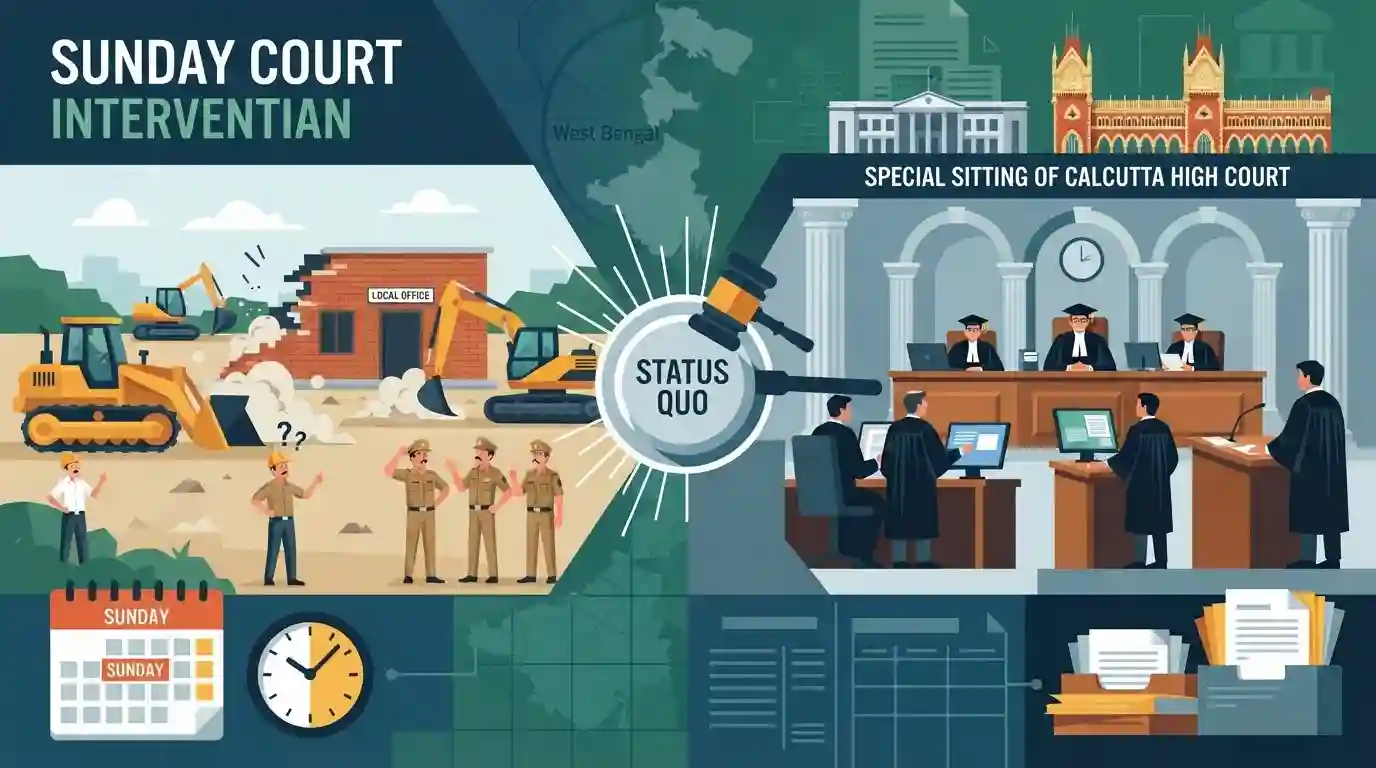
The Calcutta High Court intervened in a special Sunday sitting to halt the demolition of Trinamool Congress MP Abhishek Banerjee's Diamond Harbour constituency office in Amtala. The South 24 Parganas district administration had begun demolishing the structure, which is allegedly owned by 'Leaps and Bounds', citing construction without an approved building plan. The Court ordered a status quo and directed the State government to submit all relevant documents.
Key Points
- The Calcutta High Court held a special Sunday sitting to order a stay on the demolition of TMC MP Abhishek Banerjee's constituency office in Amtala.
- The demolition was initiated by the South 24 Parganas district administration, citing the absence of an approved building plan.
- The building is reportedly owned by the company 'Leaps and Bounds', of which Banerjee is allegedly the CEO.
- Justice Raja Basu Chowdhury directed the State government to produce all documents regarding the construction of the building by the end of July.
Important Terms
Calcutta High Court

The highest judicial body in West Bengal, established in 1862. It exercises appellate and writ jurisdiction over West Bengal and the Andaman and Nicobar Islands, ensuring the enforcement of fundamental rights and scrutinizing executive actions.
UPSC context
GS Paper 2 (Polity). Tests the organization, functioning, and writ jurisdiction of State High Courts under Article 226 of the Constitution.
Enforcement Directorate (ED)
A financial investigation agency under the Ministry of Finance. It enforces the Prevention of Money Laundering Act (PMLA) and the Foreign Exchange Management Act (FEMA) to combat economic crimes, such as illicit wealth accumulation.
UPSC context
GS Paper 2 & 3. Tests statutory bodies, law enforcement agencies, and regulatory mechanisms for the prevention of money laundering.
Leaps and Bounds
A private company founded by politician Abhishek Banerjee. It is currently being investigated by the Enforcement Directorate for its alleged role in laundering illicit funds connected to the West Bengal primary school recruitment scam.
UPSC context
GS Paper 3. Serves as a contemporary case study for understanding corporate money laundering networks and economic crime investigations.
Trinamool Congress (TMC)
A major Indian political party currently in power in West Bengal. Regional political parties like the TMC play a significant role in state-level governance, opposition politics, and the multi-party democratic framework of India.
UPSC context
GS Paper 2. Relevant for analyzing the Indian party system, regional political dynamics, and center-state political relations.
Prelims Trap
Writ jurisdiction under Article 226 is restricted to the enforcement of Fundamental Rights.
Unlike the Supreme Court under Article 32, High Courts can issue writs for fundamental rights AND 'any other purpose', such as defending statutory property rights against arbitrary demolition.
Static Concepts Connected
How does High Court writ jurisdiction (Art 226) differ from the Supreme Court (Art 32)?
- Wider Scope: High Courts can issue writs for both Fundamental Rights and other legal rights (e.g., property rights). The Supreme Court's power is restricted to Fundamental Rights.
- Discretionary Nature: Article 32 is itself a Fundamental Right, meaning the SC generally cannot refuse to exercise it. Article 226 is discretionary.
What constitutional safeguards protect citizens against arbitrary property demolition?
- Article 300A: Under Article 300A, no person shall be deprived of their property save by authority of law. It is a constitutional, though not fundamental, right.
- Natural Justice: Executive actions like municipal demolitions must follow 'audi alteram partem' (right to be heard), requiring authorities to issue a show-cause notice before proceeding.
Cross-Topic Patterns
Municipal Demolitions + Rule of Law
Recent judicial stays on municipal demolitions emphasize the strict requirement of 'audi alteram partem' (prior notice), linking local government administration directly to core constitutional rule of law principles.
Sunday Court Sittings + Access to Justice
High Courts holding special Sunday sittings to prevent irreversible executive harm showcases structural flexibility. This connects to themes of access to justice, judicial activism, and the protection of civil liberties.

Expect a 2026 Mains question analyzing the tension between municipal enforcement drives and constitutional protections under Article 300A.
Linked PYQs · 2
Linked PYQs · 2
- 2024WBCS_PRELIMSGS1
Public Interest Litigation is primarily associated with which concept?
- 2009WBCS_PRELIMSGS1
The decision to hold Panchayat Election is taken by the
