Judicial Officers on Electoral Duty in West Bengal
Source:The Hindu ↗
Why It Matters
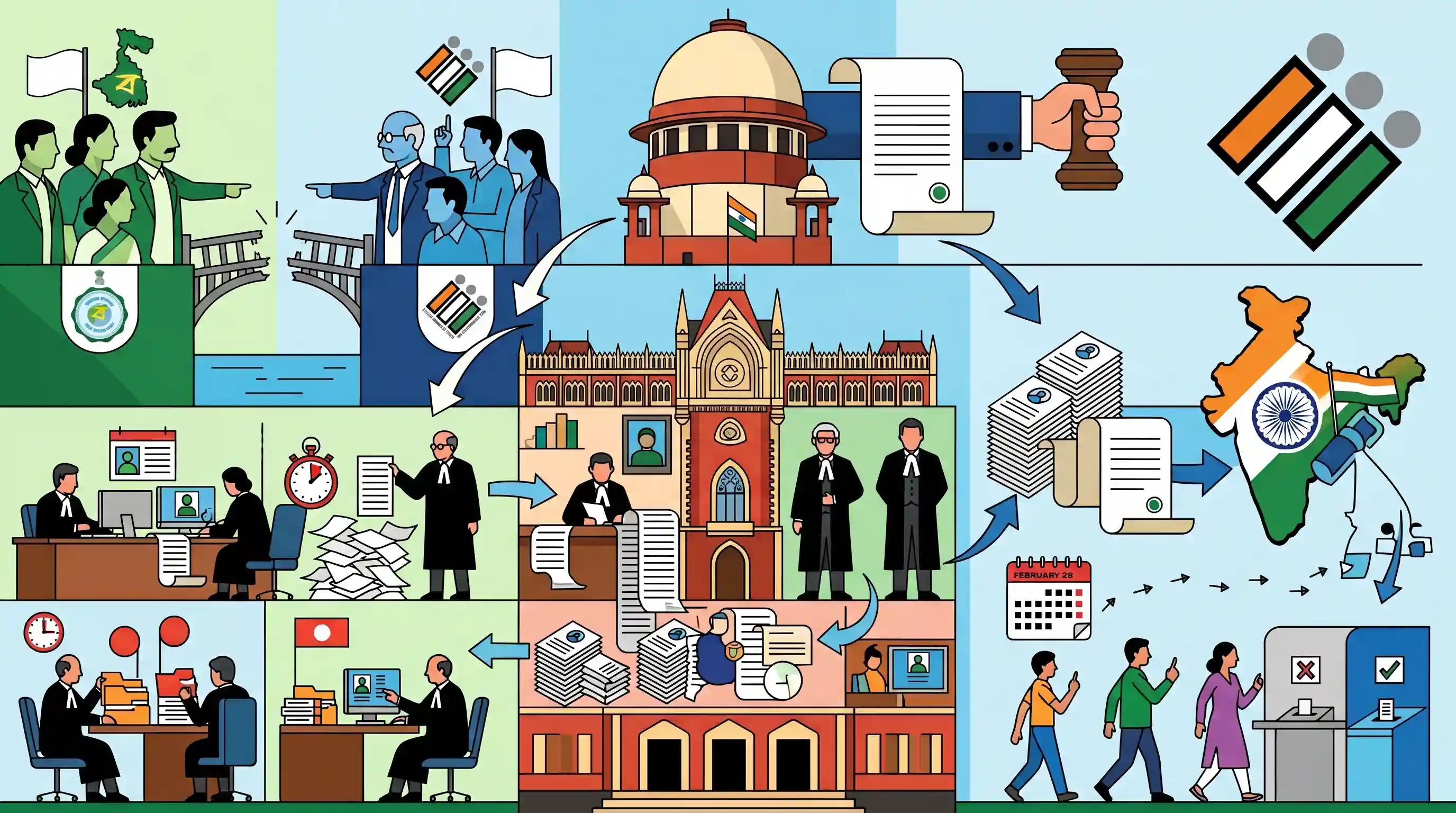
The article highlights a unique constitutional scenario where the Supreme Court mandated judicial officers to perform administrative electoral duties due to an institutional breakdown and 'trust deficit' between a State government and the Election Commission. It is a critical case study for GS Paper 2 topics concerning the independence of the ECI, the conduct of free and fair elections, and the evolving role of the judiciary in resolving administrative stalemates.
Summary
The Calcutta High Court, under Chief Justice Sujoy Paul, has established committees to manage urgent cases, as judicial officers have been temporarily reassigned to finalize West Bengal's Special Intensive Revision (SIR) of electoral rolls. This unprecedented deployment of judicial officers for electoral administration was ordered by the Supreme Court to resolve a stalemate caused by a persistent 'trust deficit' between the West Bengal State government and the Election Commission of India (ECI). The Supreme Court has mandated the completion of the electoral rolls by February 28, which is necessary before the ECI can announce the schedule for the state Assembly elections.
Key Points
- The Calcutta High Court has formed committees to shift urgent legal matters as judicial officers have been assigned to electoral duties.
- This follows a Supreme Court directive mandating judicial officers to oversee the Special Intensive Revision (SIR) of electoral rolls in West Bengal.
- The Supreme Court intervened due to a severe 'trust deficit' between the Mamata Banerjee-led State government and the Election Commission of India, which had stalled the process.
- Finalization of electoral rolls by February 28 is a prerequisite for the announcement of the West Bengal Assembly election schedule.
- The ECI will deploy 480 companies of Central Armed Police Forces (CAPF) to ensure security during the upcoming elections.
Important Terms
Special Intensive Revision (SIR)

A comprehensive, time-bound house-to-house verification drive by the ECI to update and correct electoral rolls, distinct from routine annual summary revisions.
UPSC context
GS Paper 2 (Elections); tests understanding of electoral roll integrity and ECI's discretionary administrative powers under RPA 1950.
Election Commission of India (ECI)
A permanent constitutional body established under Article 324 to ensure the superintendence, direction, and control of elections to Parliament and State Legislatures.
UPSC context
GS Paper 2 (Constitutional Bodies); critical for questions on electoral reforms, constitutional mandates, and institutional neutrality.
Article 142
A constitutional provision granting the Supreme Court plenary power to pass any decree or order necessary for doing "complete justice" in any matter.
UPSC context
GS Paper 2 (Judiciary); frequently tested regarding judicial activism and the court's role in resolving administrative deadlocks.
Separation of Powers
A constitutional doctrine (implied and under Article 50) that divides government responsibilities into distinct branches to prevent the concentration of power.
UPSC context
GS Paper 2 (Polity); relevant to cases where judicial officers perform executive/administrative tasks during extraordinary circumstances.
Representation of the People Act, 1950
The legal framework governing the allocation of seats, delimitation of constituencies, and the registration of voters and preparation of electoral rolls.
UPSC context
GS Paper 2 (Salient features of RPA); tests statutory knowledge of voter list maintenance and eligibility (Sections 16, 19, 21).
Prelims Trap
The RPA 1950 mandates that Special Intensive Revision of electoral rolls must be overseen by judicial officers.
Electoral roll revision is normally an executive function executed by state administrative staff. Deploying judicial officers is an extraordinary Supreme Court intervention, not a statutory mandate.
Static Concepts Connected
What is the key difference between RPA 1950 and RPA 1951?
- RPA 1950 focus: Governs foundational pre-election steps: allocation of seats, delimitation of constituencies, voter qualifications, and the preparation/revision of electoral rolls.
- RPA 1951 focus: Governs the actual execution: conduct of elections, corrupt practices, electoral offenses, and dispute resolution mechanisms.
How does this news interact with Article 50 of the Constitution?
- Directive Principle: Article 50 (a DPSP) mandates the State to separate the judiciary from the executive in public services to ensure total judicial independence.
- Extraordinary Exception: Deploying judicial officers for an executive task (electoral roll revision) is a rare, extraordinary constitutional workaround mandated by the Supreme Court to fix a deadlock.
Cross-Topic Patterns
Federal friction in election administration
The 'trust deficit' highlights how the ECI's constitutional dependence on state administrative machinery under Article 324 can stall vital electoral processes when political relations deteriorate.
Judicial intervention vs Separation of Powers
The Supreme Court effectively bypassed the separation of powers (Article 50) to enforce universal adult suffrage (Article 326), showcasing extraordinary judicial intervention to resolve a state-ECI deadlock.

Expect a 2026 prelims question contrasting RPA 1950 vs 1951, paired with a statement on the ECI's reliance on state machinery under Art 324.
Linked PYQs · 3
Linked PYQs · 3
- 2018MainsGS2
In the light of recent controversy regarding the use of Electronic Voting Machines (EVM), what are the challenges before the Election Commission of India to ensure the trustworthiness of elections in India?
- 2022MainsGS2
Discuss the role of the Election Commission of India in the light of the evolution of the Model Code of Conduct.
- 2020MainsGS2
Judicial Legislation is antithetical to the doctrine of separation of powers as envisaged in the Indian Constitution. In this context justify the filing of large number of public interest petitions praying for issuing guidelines to executive authorities.
