Calcutta High Court interim protection jurisdiction in multiple FIRs
Source:thestatesman ↗
Why It Matters
The case highlights the exercise of the High Court's writ and inherent jurisdiction to protect individual liberty against multiple FIRs. It reflects the practical application of constitutional safeguards regarding arrests and police investigations, which are key components of the Indian Polity syllabus.
Summary
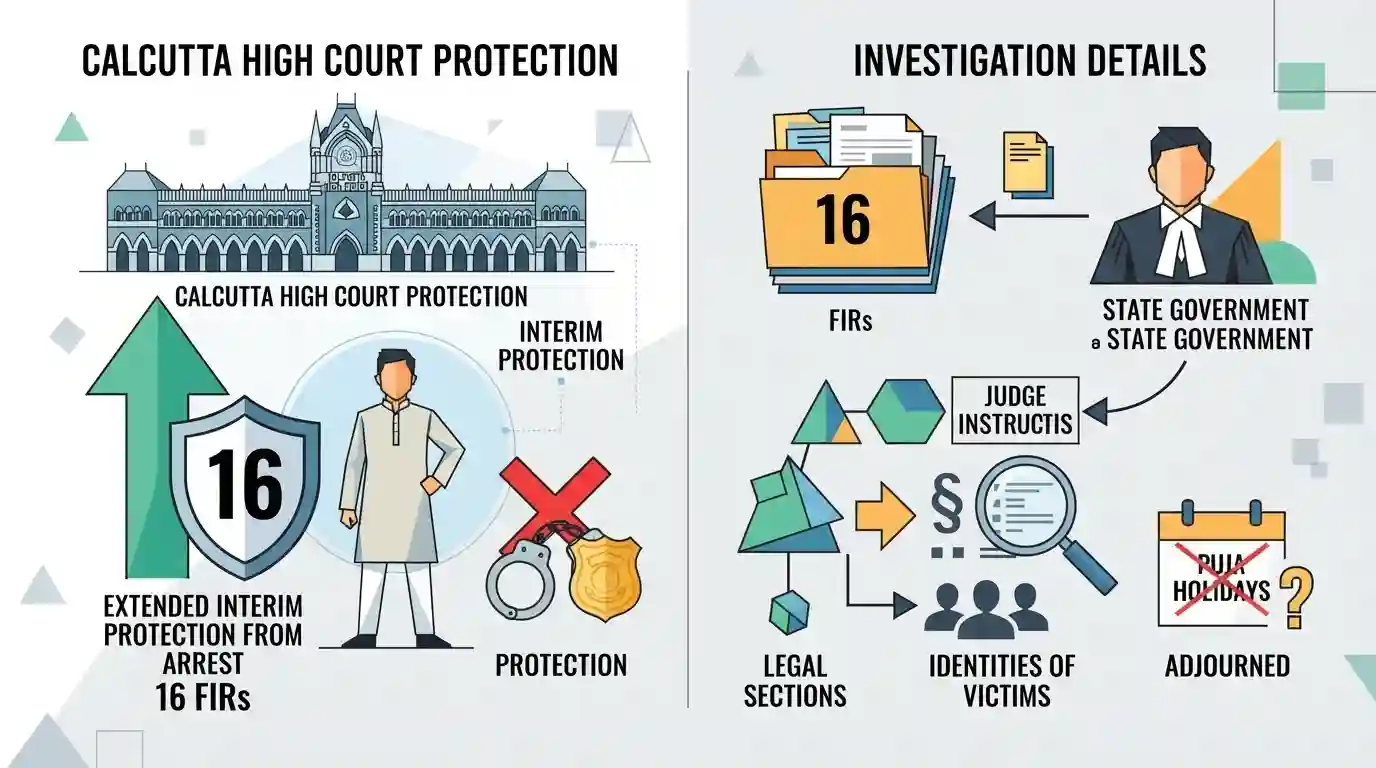
The Calcutta High Court has granted extended interim protection to TMC leader Abhishek Banerjee from arrest in connection with 16 FIRs filed against him across West Bengal. The FIRs relate to public remarks he made following the RG Kar Medical College and Hospital incident. Justice Tirthankar Ghosh instructed the state government to provide detailed information in its final report regarding the sections under which the cases were filed and the identities of the victims. The matter will be heard again after the Puja holidays.
Key Points
- The Calcutta High Court extended interim protection against arrest for TMC national general secretary Abhishek Banerjee until the next hearing.
- The protection is against 16 FIRs registered across West Bengal following remarks Banerjee made regarding the RG Kar Medical College incident.
- Justice Tirthankar Ghosh directed the state government to specify the specific IPC/BNS sections applied and identify the victims in its final report.
- The state submitted a progress report of the investigation to the court, and the next hearing was scheduled after the Puja vacation.
Important Terms
Calcutta High Court

The highest judicial court in West Bengal, with jurisdiction over the state and the Andaman and Nicobar Islands. It has powers under Article 226 to issue writs for the enforcement of Fundamental Rights and statutory rights.
UPSC context
Relevant to GS Paper II (Polity). Tests understanding of the Indian Judiciary, High Court powers, and jurisdiction in state matters.
Interim Protection
A legal safeguard granted by a court, typically under Section 482 or Section 438 of the CrPC, preventing coercive action like arrest against an accused person pending further judicial review or trial court decisions.
UPSC context
Relevant for GS Paper II (Polity). Touches on Fundamental Rights (Article 21 - Personal Liberty) and the Criminal Justice System.
RG Kar Medical College and Hospital
A government-run medical college in Kolkata, West Bengal, recently central to widespread protests, CBI investigations, and judicial interventions following a severe criminal incident involving a postgraduate trainee doctor on its campus in August 2024.
UPSC context
Highlights issues of internal security, women's safety in workplaces, and the \"rarest of rare\" legal doctrine (GS Paper II & III).
Prelims Trap
The inherent powers of the High Court to quash FIRs are derived from Section 482 of the BNSS.
Under the new BNSS 2023, Section 482 deals with anticipatory bail (formerly Sec 438 CrPC). The inherent powers of the High Court are now under Section 528.
Static Concepts Connected
What is the High Court's inherent power to quash criminal proceedings?
- BNSS Section 528: Under Section 528 of BNSS (formerly Sec 482 CrPC), High Courts can pass orders to prevent abuse of court processes or secure the ends of justice.
- Bhajan Lal Guidelines: The SC's 1992 Bhajan Lal judgment laid down 7 scenarios for quashing FIRs, such as when allegations are absurd or maliciously instituted.
- No Trial Proceedings: The High Court does not appreciate evidence or conduct a mini-trial at this stage; it only assesses the prima facie validity of the allegations.
How is Anticipatory Bail governed under the new criminal framework?
- Section 482 BNSS: Replaces Section 438 of the CrPC, governing the grant of bail to persons apprehending arrest for non-bailable offences.
- Concurrent Jurisdiction: Both the High Court and the Court of Session possess the power to grant anticipatory bail.
- Subject to Conditions: It is usually granted for specific offences and can be subject to conditions like cooperating with the investigation and not tampering with evidence.
Cross-Topic Patterns
Free Speech & Clubbing of FIRs
The SC frequently invokes writ jurisdiction (Art 32) to club multiple FIRs across states for the same public remark, preventing procedural harassment and protecting Article 19(1)(a) and Article 21.
Constitutional Writs vs Statutory BNSS
High Courts can quash FIRs or grant protection directly under Article 226, operating independently of the BNSS. This emphasizes the supremacy of constitutional remedies over statutory criminal codes.

Expect a multi-statement question mapping old CrPC provisions (like inherent powers or anticipatory bail) to the new BNSS sections.
Linked PYQs · 2
Linked PYQs · 2
- 2021WBCS_PRELIMSGS1
The Chief Justice of High Court is appointed by the
- 2021WBCS_PRELIMSGS1
In the Constitution of India, ‘Protection of Life and Personal Liberty’ is guaranteed under Article No.
