CAG Integrated Audit Reports on MSMEs and Logistics
Source:The Hindu ↗
Why It Matters
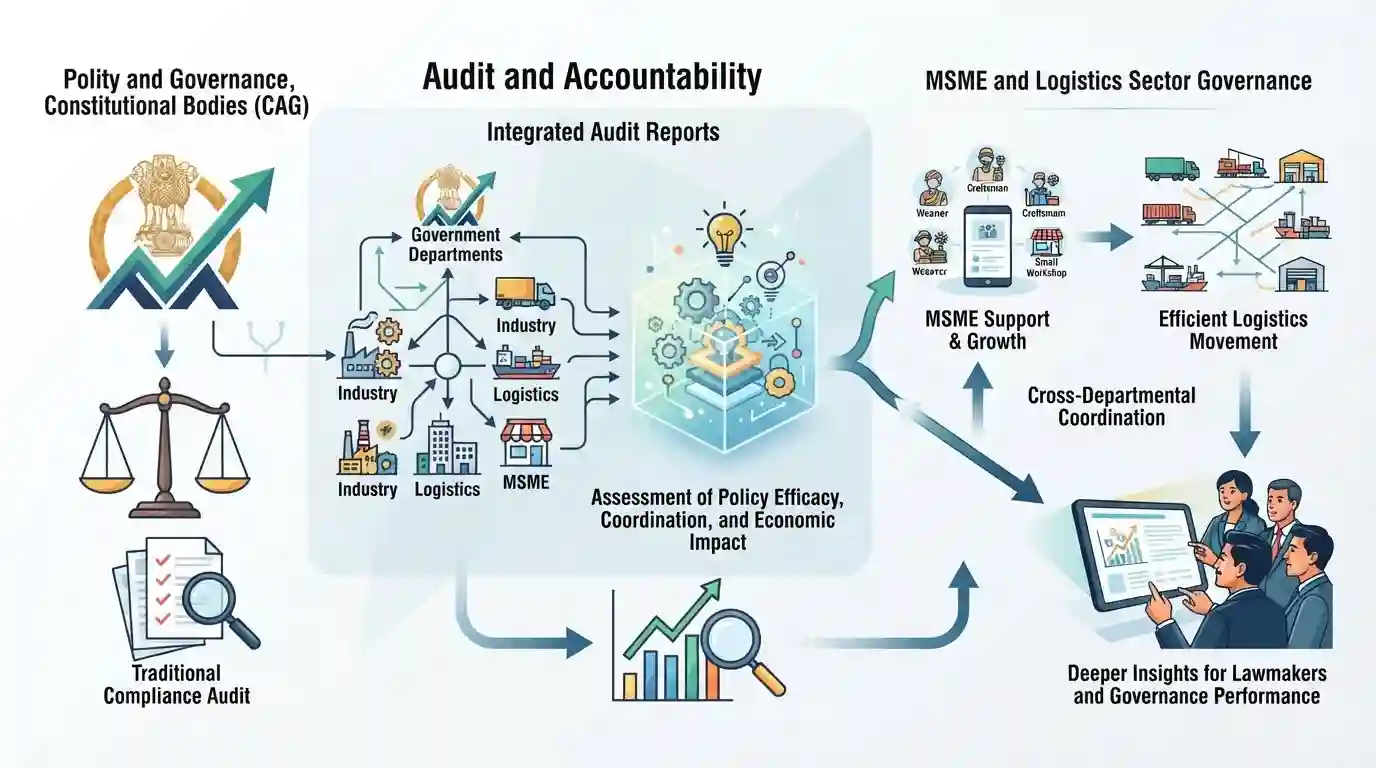
The introduction of integrated audit reports by the CAG marks a significant evolution in public auditing methodology in India, moving towards multi-sectoral and outcome-oriented evaluations that directly impact economic policy, governance transparency, and accountability in vital growth drivers like MSMEs and logistics.
Summary
The Comptroller and Auditor General (CAG) of India plans to introduce its first integrated audit reports in December, focusing on key economic sectors like MSMEs and logistics. This methodology moves beyond traditional compliance auditing to assess overall policy efficacy, coordination across multiple departments, and economic impact, providing lawmakers with deeper insights into public expenditure and governance performance.
Key Points
- The Comptroller and Auditor General (CAG) of India is set to table its first integrated audit reports in December.
- The initial reports will focus on critical sectors including Micro, Small and Medium Enterprises (MSMEs) and logistics.
- Integrated audits represent a shift towards holistic evaluations of cross-cutting government policies and supply chains rather than isolated departmental accounting.
- This approach aims to enhance public financial accountability, efficiency, and policy coherence in key economic growth drivers.
Important Terms
Comptroller and Auditor General of India

An independent constitutional authority under Article 148 of the Indian Constitution responsible for auditing the accounts of the Union and State governments and ensuring financial accountability.
UPSC context
GS Paper II (Polity and Governance - Constitutional Bodies). Tests knowledge of constitutional offices, financial oversight, and accountability mechanisms.
Ministry of Micro, Small and Medium Enterprises
A ministry under the Government of India tasked with formulating policies, promotion, development, and regulation of micro, small, and medium enterprises in the country.
UPSC context
GS Paper III (Economy - Growth & Development). Tests institutional frameworks supporting the MSME sector, employment generation, and industrial governance.
Static Concepts Connected
What are the constitutional provisions and duties of the Comptroller and Auditor General (CAG) of India?
- Article 148: Constitutional Basis: Appointed by the President under Article 148; holds office for 6 years or up to 65 years of age.
- Financial Jurisdiction: Scope of Audit: Audits all receipts and expenditure of the Consolidated Fund of India, States, and UTs having legislative assemblies.
- Legislative Role: Parliamentary Link: Reports are submitted to the President/Governor, who places them before Parliament/State Legislatures, examined by the Public Accounts Committee (PAC).
Cross-Topic Patterns
CAG Integrated Audits & PM GatiShakti Synergy
The shift from single-department accounting to multi-departmental integrated auditing mirrors the whole-of-government approach required in executing national logistics and industrial corridors.

Expect statement-based questions on Article 148 powers, differentiating traditional compliance audits from new thematic/integrated audits.
Linked PYQs · 3
Linked PYQs · 3
- 2024MainsGS2
“The duty of the Comptroller and Auditor General is not merely to ensure the legality of expenditure but also its propriety.” Comment.
- 2018MainsGS2
“The Comptroller and Auditor General (CAG) has a very vital role to play.” Explain how this is reflected in the method and terms of his appointment as well as the range of powers he can exercise.
- 2023MainsGS3
Faster economic growth requires increased share of the manufacturing sector in GDP, particularly of MSMEs. Comment on the present policies of the Government in this regard.
