CAG Audit Highlights Railway Signalling Failures
Source:Indian Express ↗
Why It Matters
Railway safety has been a prominent issue in India following several tragic train collisions attributed to signalling failures. The CAG's findings reflect systemic vulnerabilities and underscore the importance of accountability in infrastructure management. For UPSC aspirants, this illustrates the practical application of CAG's mandate (GS Paper 2) to audit public sector operational safety, while highlighting the ongoing challenges in maintaining and modernizing India's critical railway infrastructure (GS Paper 3).
Summary
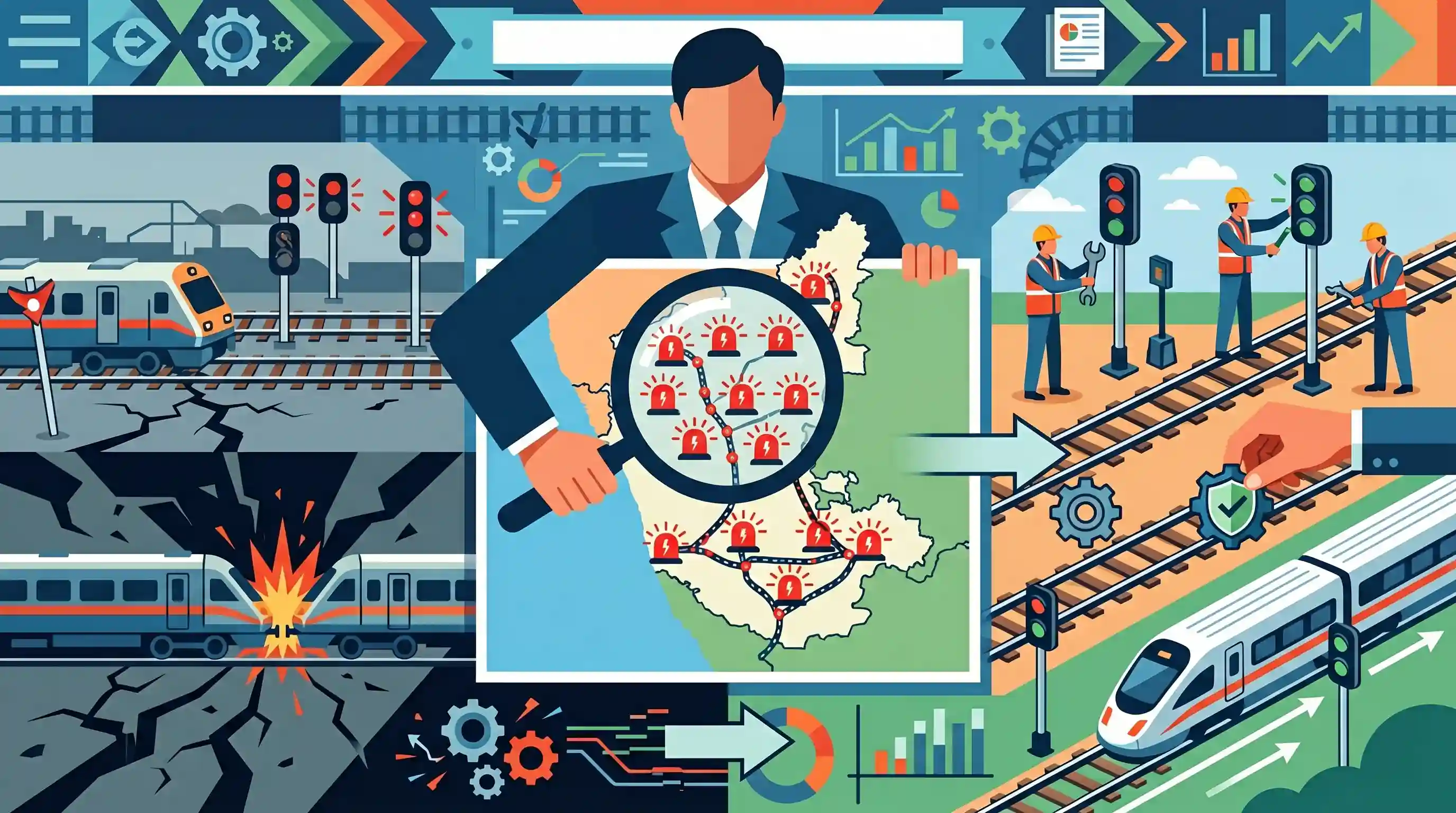
A recent Comptroller and Auditor General (CAG) report on the South Western Railway (SWR) has brought critical safety concerns to light, revealing that the zone experiences nearly 3,000 signalling failures every year. The auditor strongly urged the implementation of a robust maintenance mechanism to address these systemic vulnerabilities and prevent potential railway disasters. This report highlights ongoing challenges in the modernization and maintenance of Indian Railways infrastructure, while illustrating the vital role of the CAG in auditing the operational accountability and safety standards of public enterprises.
Key Points
- A CAG report revealed that the South Western Railway (SWR) zone experiences nearly 3,000 signalling failures annually.
- The auditor emphasized the urgent need for a stronger, more robust maintenance mechanism for signalling infrastructure to avert catastrophic railway accidents.
- The findings underscore systemic vulnerabilities in railway operations, highly relevant in the context of recent tragic train collisions in India linked to signalling faults.
- Highlights the broader role of the CAG in ensuring not just financial propriety, but also operational accountability, efficiency, and safety in essential public utilities.
Important Terms
Comptroller and Auditor General of India (CAG)

An independent constitutional authority established under Article 148 to audit all receipts and expenditures of the Government of India and the State Governments.
UPSC context
GS Paper 2: Constitutional Bodies. Tests understanding of financial accountability and the 'bulwark' of Indian democracy.
South Western Railway (SWR)
One of the 19 zones of Indian Railways, headquartered in Hubballi, Karnataka; it primarily serves Karnataka, Goa, and parts of Andhra Pradesh and Maharashtra.
UPSC context
GS Paper 3: Infrastructure. Relevant for transport geography and regional infrastructure management.
Kavach (ATP System)
An indigenously developed Automatic Train Protection (ATP) system designed to prevent train collisions by automatically applying brakes if a pilot passes a red signal.
UPSC context
GS Paper 3: Science and Technology/Infrastructure. A critical safety technology frequently featured in Prelims and Mains.
Railway Signalling System
A technical framework of track circuits, relays, and interlocking used to control train movements and prevent accidents by ensuring tracks are clear.
UPSC context
GS Paper 3: Disaster Management. Focuses on technological failures and safety protocols in public transport.
Predictive Maintenance
An advanced maintenance strategy using data loggers and AI to identify potential equipment failures before they occur, reducing downtime and accidents.
UPSC context
GS Paper 3: Science and Technology. Relevant for the modernization of infrastructure and operational efficiency in governance.
Signal Passing At Danger (SPAD)
A dangerous operational lapse where a locomotive pilot ignores or fails to see a red signal, potentially leading to head-on or rear-end collisions.
UPSC context
GS Paper 3: Infrastructure and Safety. A key performance indicator for railway safety and human error audits.
Prelims Trap
The CAG's constitutional mandate is strictly limited to financial compliance audits and does not cover operational safety.
The CAG conducts comprehensive Performance Audits to evaluate the economy, efficiency, and effectiveness of government programs, which actively includes assessing infrastructure safety and operational standards.
Static Concepts Connected
What are the primary types of audits conducted by the CAG?
- Financial Audit: Assesses whether the government's financial statements are properly prepared, complete, and accurate.
- Compliance Audit: Ensures that government spending and resource utilization strictly adhere to existing laws, rules, and regulations.
- Performance Audit: Evaluates programs/enterprises for economy, efficiency, and effectiveness. The safety audit of railway signalling falls under this category.
What is the Rashtriya Rail Sanraksha Kosh (RRSK)?
- Dedicated Safety Fund: A ₹1 lakh crore non-lapsable railway safety fund launched in 2017-18 to clear the backlog of critical safety upgrades over five years.
- Target Areas: Primarily earmarked for track renewals, bridge rehabilitation, and modernizing signalling and telecom systems to avert collisions and derailments.
- CAG Observations: CAG reports have previously noted concerns over RRSK funds being underutilized or diverted toward non-priority works, delaying vital safety renewals.
Cross-Topic Patterns
CAG reports + GS3 Disaster Management
CAG performance audits have evolved into vital diagnostic tools for identifying systemic infrastructure vulnerabilities, forming excellent fodder for GS3 answers on disaster prevention and operational accountability.
Indigenous Tech vs Legacy Deficits
The push for SIL-4 certified Kavach (RFID-based) sits in stark contrast to the persistent 3,000+ annual failures in basic legacy signalling, highlighting India's dual-speed railway modernization challenge.

Expect a 2026 Prelims question linking Kavach's RFID technology, RRSK fund utilization, and the CAG’s performance audit jurisdiction.
Linked PYQs · 4
Linked PYQs · 4
- 2024MainsGS2
“The duty of the Comptroller and Auditor General is not merely to ensure the legality of expenditure but also its propriety.” Comment.
- 2018MainsGS2
“The Comptroller and Auditor General (CAG) has a very vital role to play.” Explain how this is reflected in the method and terms of his appointment as well as the range of powers he can exercise.
- 2012PrelimsGS1
In India, other than ensuring that public funds are used efficiently and for intended purpose, what is the importance of the office of the Comptroller and Auditor General (CAG)? 1. CAG exercises exchequer control on behalf of the Parliament when the President of India declares national emergency/financial emergency. 2. CAG reports on the execution of projects or programmes by the ministries are discussed by the Public Accounts Committee. 3. Information from CAG reports can be used by investigating agencies to press charges against those who have violated the law while managing public finances. 4. While dealing with the audit and accounting of government companies, CAG has certain judicial powers for prosecuting those who violate the law. Which of the statements given above is/are correct?
- 2013PrelimsGS1
Consider the following statements : The Parliamentary Committee on Public Accounts 1. consists of not more than 25 Members of the Lok Sabha 2. scrutinizes appropriation and finance accounts of the Government 3. examines the report of the Comptroller and Auditor General of India Which of the statements given above is/are correct?
