Comptroller and Auditor General findings on rural employment scheme
Source:Indian Express ↗
Why It Matters
It provides a concrete case study on the performance audit function of the CAG (propriety audit) and highlights chronic implementation challenges in India's flagship rural employment scheme, which are vital for GS-2 (Governance and Social Justice) and GS-3 (Inclusive Growth).
Summary
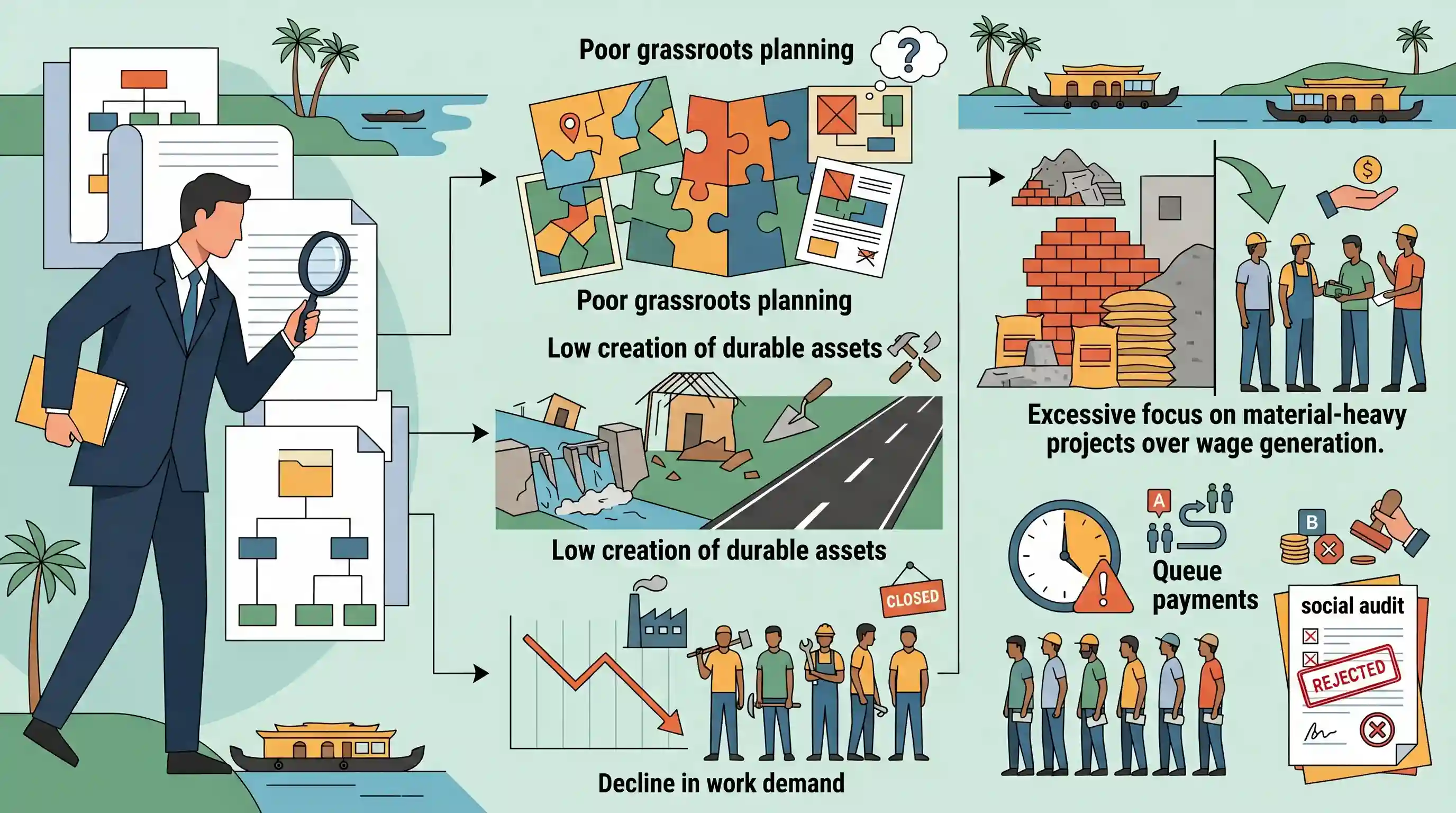
The Comptroller and Auditor General (CAG) of India has highlighted multiple lapses in the implementation of the Mahatma Gandhi National Rural Employment Guarantee Scheme (MGNREGS) in Kerala. The audit report points to poor planning at the grassroots level, low creation of durable assets, and a decline in work demand. Furthermore, the CAG criticized the excessive focus on material-heavy projects over wage generation, violating the scheme's core objective of employment provision. Administrative shortcomings, including delayed wage payments and improper social audits, were also flagged as major concerns impacting rural livelihoods in the state.
Key Points
- A recent CAG report has flagged significant implementation lapses in Kerala's execution of the MGNREGS.
- Key issues identified include poor local-level planning, inadequate creation of durable rural assets, and a noticeable decline in the demand for work.
- The audit revealed a skewed wage-to-material ratio, with excessive expenditure on material-intensive projects rather than prioritized wage generation.
- Administrative failures, such as delayed wage payments and ineffective social audits, undermine the scheme's role as a rural safety net.
Important Terms
Mahatma Gandhi National Rural Employment Guarantee Scheme (MGNREGS)

A landmark 2005 law guaranteeing 100 days of unskilled manual work per financial year to rural households, aimed at enhancing livelihood security and creating durable assets.
UPSC context
GS Paper 2/3: Tests knowledge of welfare schemes, poverty alleviation, and rights-based approaches to rural employment.
Comptroller and Auditor General of India (CAG)
The constitutional authority (Article 148) responsible for auditing all receipts and expenditures of the Government of India and the states, acting as the 'Guardian of the Public Purse.'
UPSC context
GS Paper 2: Key constitutional body ensuring executive accountability, financial oversight, and transparency in public spending.
Gram Panchayats
The primary local self-government units at the village level responsible for identifying beneficiaries, planning projects, and executing at least 50% of MGNREGS works.
UPSC context
GS Paper 2: Vital for questions on Panchayati Raj Institutions (PRIs), decentralization, and grassroots governance.
Social Audit
A process where the community audits the scheme's records and expenditures to ensure transparency, verify work quality, and prevent corruption in local implementations.
UPSC context
GS Paper 2: Central to topics of governance, accountability, and citizen-led monitoring of public welfare schemes.
Durable Assets
Tangible infrastructure such as roads, ponds, and cattle sheds created under MGNREGS to provide long-term economic and environmental benefits to rural communities.
UPSC context
GS Paper 3: Evaluates the effectiveness of public investment in rural infrastructure and sustainable economic development.
Prelims Trap
"The CAG conducts the mandatory social audits for MGNREGS to ensure grassroots accountability."
The CAG conducts financial and performance audits. However, the mandatory 'social audits' under Section 17 of the MGNREG Act are strictly the legal responsibility of the Gram Sabha.
Static Concepts Connected
What are the key statutory guarantees under MGNREGS?
- Wage timeline: Workers are legally guaranteed wage payment within 15 days of muster roll closure; delays mandate a 0.05% daily compensation.
- Unemployment allowance: If work is not provided within 15 days of demand, the State government must pay an unemployment allowance.
- Expenditure ratio: A strict 60:40 wage-to-material expenditure ratio must be maintained to ensure the scheme remains labor-intensive.
- Decentralized execution: Gram Sabhas must recommend projects, and Gram Panchayats are mandated to execute at least 50% of the works.
What types of audits are conducted by the CAG?
- Financial Audit: Checks if the financial statements of an entity accurately reflect its true financial position.
- Compliance Audit: Ensures that government transactions comply with applicable laws, rules, and regulations.
- Performance Audit: Assesses whether government programs (like MGNREGS) achieve their policy objectives efficiently, economically, and effectively.
Cross-Topic Patterns
MGNREGS as Climate Adaptation
Asset creation under MGNREGS (water harvesting, plantations) increasingly links rural poverty alleviation directly with GS-3 climate resilience and disaster mitigation strategies.
CAG and Local Body Audits
The CAG's technical guidance for local fund audits bridges central constitutional oversight with the 73rd Amendment’s decentralized governance and accountability goals.

Expect a GS-2 Mains question linking MGNREGS asset durability, wage delays, and the efficacy of Gram Sabha social audits in 2026.
Linked PYQs · 4
Linked PYQs · 4
- 2018MainsGS2
“The Comptroller and Auditor General (CAG) has a very vital role to play.” Explain how this is reflected in the method and terms of his appointment as well as the range of powers he can exercise.
- 2024MainsGS2
“The duty of the Comptroller and Auditor General is not merely to ensure the legality of expenditure but also its propriety.” Comment.
- 2012PrelimsGS1
In India, other than ensuring that public funds are used efficiently and for intended purpose, what is the importance of the office of the Comptroller and Auditor General (CAG)? 1. CAG exercises exchequer control on behalf of the Parliament when the President of India declares national emergency/financial emergency. 2. CAG reports on the execution of projects or programmes by the ministries are discussed by the Public Accounts Committee. 3. Information from CAG reports can be used by investigating agencies to press charges against those who have violated the law while managing public finances. 4. While dealing with the audit and accounting of government companies, CAG has certain judicial powers for prosecuting those who violate the law. Which of the statements given above is/are correct?
- 2011PrelimsGS1
Among the following who are eligible to benefit from the “Mahatma Gandhi National Rural Employment Guarantee Act”?
